


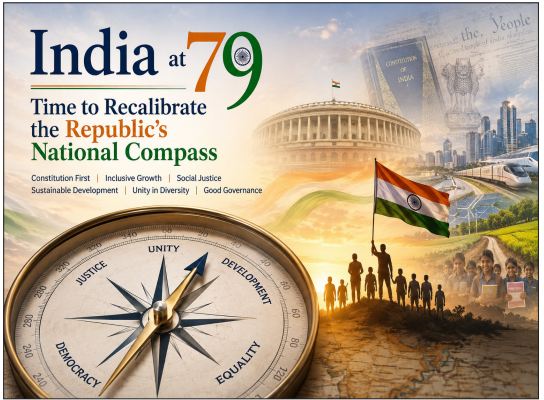
Time to Recalibrate the Republic’s National Compass
 KRC TIMES Desk
Col Satish Singh Lalotra
Every August 15, India wraps itself in the tricolour. Patriotic songs fill the air, speeches recall the sacrifices of the freedom movement, and social media overflows with declarations of national pride. For a few hours, the country appears to move as one.
But patriotism that survives only from sunrise to sunset on Independence Day is little more than ceremonial nationalism. The real test of freedom begins on August 16, when the flags come down, the speeches end and the country returns to the difficult business of governing itself. As India enters its 80th year of Independence, it is no longer fighting colonial rule. Its more complicated challenge is confronting its own contradictions. The greatest threats to the republic today do not necessarily arrive from foreign shores. Many have emerged from within-institutional erosion, shrinking space for reasoned public discourse, widening inequality, an employment challenge that accompanies rapid economic expansion, and a political culture that sometimes rewards spectacle over substance.
The uncomfortable truth is that India is progressing and regressing simultaneously.
Let me begin by extending my greetings to fellow citizens on the 80th Independence Day. I am conscious that this article may appear less celebratory than the conventional Independence Day discourse. That is deliberate. There is no intention to undermine national pride or diminish India’s considerable achievements. But if Independence Day is genuinely an occasion for introspection, then someone must ask uncomfortable questions. This article is an attempt to do precisely that.
India’s achievements are substantial. The economy has expanded, highways and expressways have multiplied, digital payments have transformed commerce, defence manufacturing has acquired greater momentum and India’s geopolitical relevance has risen considerably. India’s technological capabilities, space programme and digital public infrastructure have earned international recognition.
These achievements deserve unequivocal applause.
Yet beneath this impressive India lies another India-one whose problems cannot be concealed by impressive statistics or spectacular infrastructure. The first major issue concerns India’s greatest demographic advantage: its young population.

A youthful population can propel a nation towards extraordinary economic and social transformation. But demographics become a dividend only when young people have access to quality education, meaningful employment and opportunities for advancement.
India cannot afford a situation in which educated young people spend years preparing for competitive examinations, only to confront delayed recruitment processes, cancelled examinations or allegations of irregularities. Millions possess academic degrees but struggle to find employment that matches their qualifications. Coaching centres have, in many places, become parallel universities because confidence in formal educational systems has weakened.
This is not merely an employment problem. It is a national-security and democratic challenge.
A frustrated generation can become vulnerable to polarisation, misinformation and political manipulation. History, including India’s own experience in Punjab, Jammu and Kashmir and elsewhere, demonstrates that prolonged alienation among young people can acquire consequences far beyond the immediate economic sphere.
The demographic dividend must therefore be converted into a dividend of opportunity. Otherwise, the same demographic strength that India celebrates could become a source of social anxiety.
The second challenge is the health of public discourse. A democracy is not strengthened when everybody agrees. It is strengthened when citizens can disagree without treating one another as enemies.
Unfortunately, disagreement in contemporary India is increasingly being interpreted through the language of loyalty and disloyalty. Nuance has become unfashionable. Social media algorithms reward outrage, while television debates frequently turn complex issues into gladiatorial contests. National questions involving economics, federalism, foreign policy, identity or social policy are routinely reduced to simplistic binaries.
One must either applaud unquestioningly or oppose reflexively. But democracy cannot flourish in such an atmosphere.
A republic requires citizens who can listen, question, disagree and change their minds. Nations become intellectually weaker when conformity replaces curiosity. The ability to disagree respectfully is not a weakness of democracy; it is one of its greatest strengths.
Equally worrying is the erosion of institutional trust.
India has never possessed institutions that were entirely free of flaws. Our universities, investigative agencies, regulatory institutions, media organisations and other public bodies have faced controversies in the past as well. But the credibility of institutions depends upon the public’s belief that they operate according to established rules rather than political convenience.
When institutional independence is repeatedly questioned, even without every allegation being proved, the damage extends beyond individual controversies. It affects the confidence of citizens in the republic itself.

Send your resume:
biswa@jigyasu.co.in
krcfoundation@gmail.com
The judiciary, universities, media, bureaucracy, regulatory bodies and investigative agencies therefore carry a responsibility that extends beyond their formal mandates. Their legitimacy depends upon professionalism, transparency, independence and public confidence.
The republic cannot remain strong if its institutions become objects of permanent suspicion. The third contradiction is economic.
India has produced wealth and billionaires at an extraordinary pace. It has built modern cities, expanded infrastructure and created globally competitive companies. Yet prosperity has not always travelled with comparable speed to villages, small towns and informal workers.
Glittering skylines can coexist with fragile livelihoods.
Growth is essential, but growth without inclusion can eventually produce resentment. GDP figures can tell us how rapidly an economy is expanding, but they cannot fully capture the anxiety of a family struggling with medical expenses, expensive education, inadequate savings or uncertain employment.
The quality of economic growth must therefore be judged not merely by the size of the economy but by the opportunities it creates.
India needs growth that generates productive employment, strengthens small enterprises, improves agricultural incomes, expands social mobility and provides young people with a realistic pathway towards a better future. Another paradox concerns governance.
Technology has transformed the Indian state’s ability to deliver services. Digital payments, online public services, direct benefit transfers and digital identification have brought remarkable efficiencies. The transformation deserves recognition.
But technology cannot replace accountability.
A government can become digitally efficient while remaining administratively insensitive. Citizens ultimately judge governance not by the sophistication of an application but by whether they receive justice, whether an official listens to them, whether a welfare benefit reaches them and whether rules are applied fairly.
The republic must therefore remember that technology is a tool of governance, not a substitute for good governance. Perhaps the most dangerous development of our time is the replacement of informed citizenship by emotional mobilisation.
Almost every issue can rapidly become a battle of identities-religion, language, region, history and even food. Political mobilisation based entirely on emotion may produce short-term electoral gains, but a nation cannot build a stable future on permanent social confrontation.

India’s diversity has always been its defining characteristic. Managing diversity does not mean eliminating differences. It means creating a constitutional framework in which differences can coexist without threatening the unity of the republic.
This becomes even more important as India confronts an increasingly complicated external environment.
India has dealt with external challenges with greater confidence in recent years, while attempting to place national interests at the centre of its strategic calculations. Yet the international environment is becoming more uncertain. An assertive China, instability in India’s neighbourhood, technological competition, artificial intelligence, cyber threats and fragile global supply chains demand strategic clarity rather than rhetorical confidence.
National power is not merely military power. It rests upon economic resilience, technological capability, institutional credibility, social cohesion and the confidence of citizens in their own country.
That brings us back to the question of the republic’s compass.
India still possesses enormous democratic strengths. Unlike authoritarian systems, it retains constitutional freedoms that allow citizens to vote governments out of office, courts to intervene, journalists to investigate, civil society to organise and universities to debate.
These democratic correctives are among India’s greatest comparative advantages. But democratic institutions do not preserve themselves automatically.
They require citizens to defend constitutional values, institutions to uphold professional standards, governments to respect accountability and political parties to recognise that winning an election is not the same as possessing unlimited authority.
The strength of a republic is measured not by how loudly it celebrates itself but by how honestly it examines itself.
At 79 years of Independence, India has much to celebrate. It has survived enormous challenges, transformed its economy, expanded its technological capabilities and emerged as an increasingly influential power. Millions of Indians have moved out of poverty, infrastructure has improved and the country’s global ambitions are no longer in doubt.
But ambition without introspection can become arrogance.
The national question before India is therefore not whether the country is progressing. It clearly is. The more important question is whether the benefits of that progress are reaching enough citizens, whether institutions are retaining public trust, whether disagreement remains legitimate and whether economic and technological advancement is accompanied by social cohesion.
The freedom movement gave India more than political independence. It gave the country a constitutional imagination built around liberty, equality, justice and fraternity. Those principles cannot remain confined to speeches delivered on August 15.
They must be visible in the classroom, the workplace, the police station, the courtroom, the polling booth, the marketplace and the ordinary citizen’s interaction with the state. Perhaps, therefore, the 80th Independence Day should not only be a celebration of how far India has travelled. It should also be an opportunity to ask where it is going.
Has the national compass begun to deviate? If so, the answer is not despair. It is recalibration. India does not need to choose between patriotism and criticism. True patriotism demands both pride in the country’s achievements and courage to confront its shortcomings.
The republic does not need louder nationalism. It needs stronger institutions, better opportunities for its young people, inclusive growth, responsible public discourse and a renewed commitment to constitutional values.
The freedom fighters who envisioned an independent India did not merely dream of a powerful country. They dreamed of a free one.
As the tricolour rises again this August 15, let us celebrate India’s journey-but also examine its direction. For the real test of Independence begins the morning after the celebration. And that is when the national compass matters most.