


Building a Partnership for a Fragmented World
 KRC TIMES Desk
Ashok Bhan
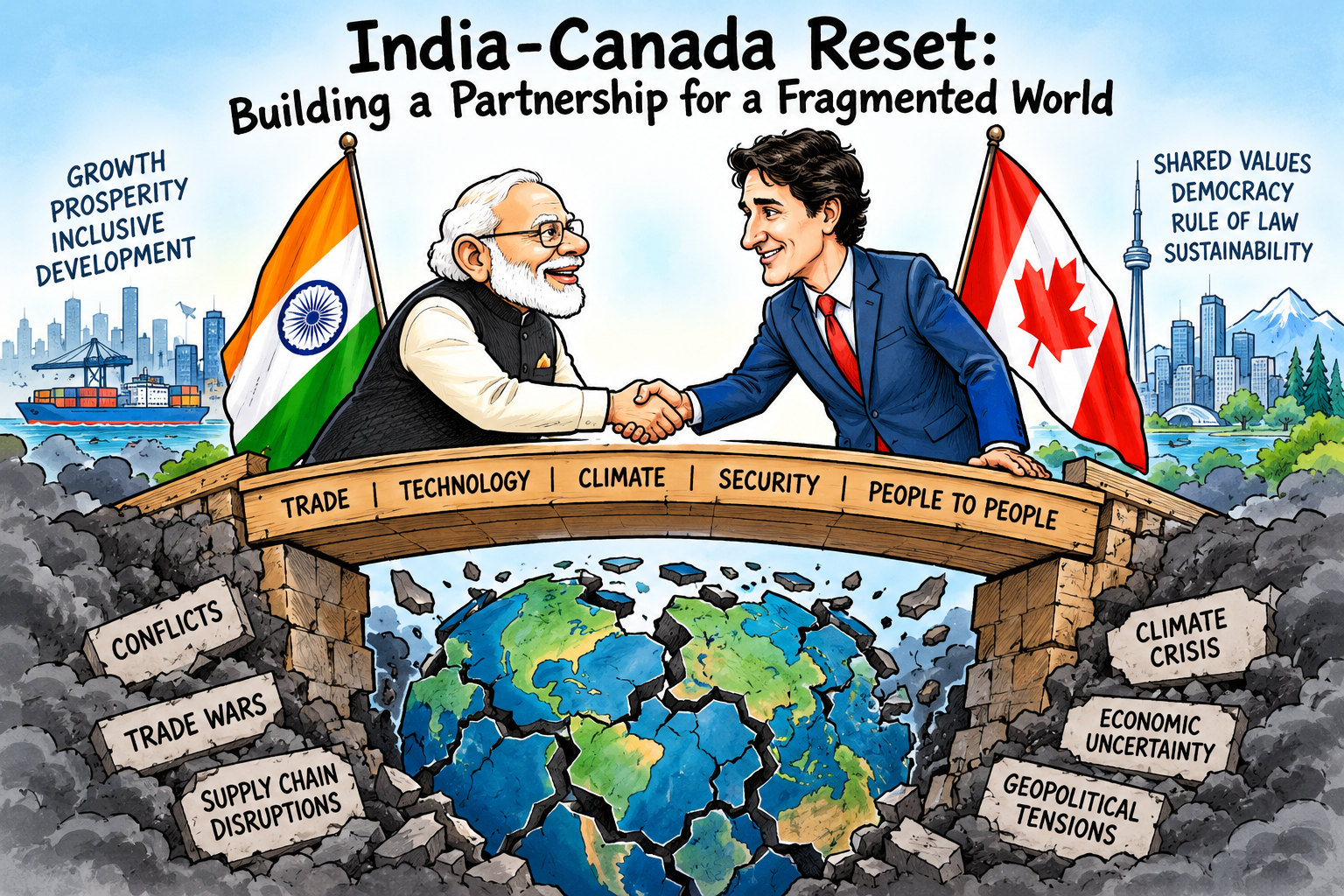
The world is entering an era in which old certainties are disappearing faster than new arrangements are taking shape. The post-Cold War belief in an increasingly integrated global economy has given way to geopolitical competition, strategic protectionism, fractured supply chains and a renewed contest for technology, energy and critical minerals. Europe remains unsettled by war; West Asia continues to experience profound instability; the United States and China are locked in an increasingly consequential strategic and economic competition; and countries across the Global South are demanding a greater voice in the institutions that govern the international system.
It is against this unsettled backdrop that the emerging India-Canada rapprochement deserves to be viewed.
What is taking place between New Delhi and Ottawa is more than a diplomatic thaw. It has the potential to become an important example of how two democracies can move beyond a period of profound disagreement and construct a relationship based on economic complementarity, strategic autonomy and institutional dialogue.
The inaugural India-Canada Finance Ministers’ Economic and Financial Dialogue held in Toronto on August 27 has given the reset a concrete economic foundation. The two countries have set an aspiration to expand bilateral trade to CAD 70 billion by 2030, while India has expressed readiness to begin negotiations on a Bilateral Investment Treaty. Cooperation is also being explored in financial technology, modern payment systems, cross-border remittances, capital markets and critical minerals. (Canada?)
This is no longer diplomacy conducted primarily through statements. It is diplomacy being translated into institutions.
India-Canada relations suffered a severe setback following Canadian allegations concerning the killing of Hardeep Singh Nijjar in British Columbia. The resulting diplomatic confrontation damaged political trust and disrupted normal high-level engagement.
The lesson from that difficult period should not be that India and Canada have incompatible interests. The opposite is true.Their interests are sufficiently complementary that prolonged estrangement carries a cost for both.
A mature bilateral relationship does not require two countries to agree on every question. Democracies will inevitably have differences over law, security, foreign policy and domestic politics. What matters is whether those differences are managed through evidence, due process, diplomacy and institutional channels.
Canada has a responsibility to uphold its constitutional commitments, the rule of law and freedom of expression. India has an equally legitimate responsibility to protect its national security, territorial integrity and citizens from terrorism and violent extremism.

These principles need not be contradictory.
The present reset represents an important recognition on both sides that disagreements should be contained within the relationship rather than allowed to define it.
That is the essence of mature diplomacy. Canada is looking beyond dependence
Canada’s strategic circumstances have changed dramatically.
For generations, the United States was the overwhelmingly dominant economic and strategic partner of Canada. Geographic proximity made this inevitable and economically advantageous. But the recent intensification of US-Canada trade tensions has demonstrated the vulnerability inherent in excessive dependence on a single market.
Prime Minister Mark Carney’s government has therefore placed greater emphasis on economic diversification and building new international partnerships. Canada’s present circumstances make that strategy not merely desirable but necessary. The breakdown of recent US-Canada trade negotiations and escalating tariff tensions have added urgency to Ottawa’s diversification strategy.
India naturally assumes significance in this search for diversification.
India is not simply a large consumer market. It is a major economic, technological and geopolitical power with a young population, expanding infrastructure, growing energy requirements and an increasingly important role in the Indo-Pacific and the Global South.
Canada, meanwhile, possesses precisely those resources and capabilities that India increasingly needs: energy, critical minerals, agricultural commodities, advanced technology, capital, research capacity and access to North American markets.
The relationship therefore offers a rare combination of complementarity and scale. India’s economic rise meets Canada’s resource strength The next chapter in India-Canada relations should be built around economics
The recent Finance Ministers’ Dialogue demonstrates how rapidly the agenda is expanding. The two countries are looking at financial-sector cooperation, FinTech, capital markets, payment modernisation, cross-border remittances and merchant payments. Canada and India have also discussed expanding the use of India’s Unified Payments Interface in Canada. (Canada?)
This is significant because modern diplomacy increasingly operates through economic infrastructure. A successful India-Canada economic relationship should encompass at least six strategic pillars. First, trade and investment. The proposed Comprehensive Economic Partnership Agreement should provide predictable rules for businesses and investors and create a framework extending well beyond traditional merchandise trade.
Second, critical minerals. Canada’s resource base and India’s manufacturing ambitions create an obvious strategic partnership. Batteries, semiconductors, electric vehicles, renewable energy systems and advanced technologies all depend upon secure mineral supply chains.
Third, energy security. India’s enormous and growing energy requirements create opportunities for Canadian LNG, clean energy, nuclear cooperation and other energy technologies.

Fourth, technology and artificial intelligence. Both countries possess strong technology ecosystems and substantial pools of highly educated talent. Collaboration in AI, cybersecurity, quantum technologies and digital infrastructure could produce benefits well beyond the bilateral relationship.
Fifth, financial cooperation. Canadian pension funds and institutional investors already have substantial exposure to India. Canada has acknowledged the significance of its long-term institutional capital in India’s development, while both sides are examining ways to deepen engagement between financial institutions and investors. (Canada?)
Sixth, education and human capital. Universities, research institutions and professional networks can provide the intellectual infrastructure for the partnership.
A CEPA concluded without these broader dimensions would be an opportunity missed. The Finance Ministers’ Dialogue: diplomacy becoming architecture. The August 2026 Finance Ministers’ Dialogue deserves particular attention because it represents a shift from episodic diplomacy towards institutionalised economic engagement.
The dialogue was established following the commitment made by Prime Minister Modi and Prime Minister Carney during their March 2026 meeting. Both governments have committed themselves to concluding CEPA negotiations by the end of 2026. (Canada?)
This institutionalisation matters.
Relationships become resilient when they are supported by permanent mechanisms rather than dependent upon individual leaders or temporary political moods. The India-Canada relationship now needs precisely such institutional resilience. Regular finance, trade, defence, science, technology, consular and migration dialogues should become permanent features of the relationship.
The two Prime Ministers’ June meeting at the G7 Summit already reflected this broader approach. They welcomed progress on economic cooperation, resilient supply chains, energy security and CEPA, while also agreeing to launch negotiations on a General Security of Information Agreement and deepen defence and security cooperation
That is a far more comprehensive relationship than the one that existed only a few years ago. The human bridge must become a strategic asset. Perhaps the most extraordinary strength of India-Canada relations is the people-to-people connection.
The Indian-origin community has become deeply embedded in Canadian economic, academic, cultural and political life. At the same time, Canada has developed generations of students, researchers, entrepreneurs and professionals with strong connections to India.
This human bridge must be treated as an asset rather than a source of political contestation. Diaspora communities should never become instruments of geopolitical rivalry. Canada’s commitment to multiculturalism and freedom of expression deserves respect. But freedom of expression cannot become a shield for incitement to violence or terrorism.
Conversely, allegations of foreign interference or transnational repression must be investigated through credible evidence and due process rather than political rhetoric. The objective should be to create a relationship in which the Indian diaspora feels secure in Canada and Canada feels confident that its institutions are respected by India.
That is entirely achievable. Security cannot be separated from friendship. No serious analysis of India-Canada relations can avoid the security question. India has consistently expressed concern about extremist and separatist activities emanating from Canadian soil. Canada has raised concerns regarding foreign interference and transnational repression.

These concerns require dialogue, not denial. The two countries should establish a sustained senior-level security mechanism involving diplomatic, intelligence and law-enforcement agencies. Cooperation should focus on terrorism, organised crime, money laundering, extortion, cybercrime and violent extremism.
The Kanishka tragedy remains a terrible reminder of what happens when terrorism transcends national boundaries. The principle should be universal: terrorism and political violence cannot be legitimised by ideology, ethnicity, religion or political grievance.
India and Canada can disagree profoundly on many political matters and still cooperate against violence.Indeed, that is what mature democracies should do. The deeper significance of this rapprochement lies in the character of the two countries.
India and Canada are not superpowers. Neither seeks to dominate the international system. Both, however, possess substantial economic, diplomatic, technological and human capital. This makes them important middle powers.
The emerging international system will increasingly depend upon such countries.
India has pursued strategic autonomy, maintaining relationships with the United States, Russia, Europe, Japan, the Gulf, Africa and the Global South. Canada is now attempting to diversify its external relationships while retaining its traditional partnerships.
Their approaches are different, but their strategic requirement is increasingly similar: neither country wants its national interests to be determined entirely by the preferences of a larger power.
This is where their partnership acquires a larger geopolitical meaning. India and Canada can help build a world of multiple partnerships rather than rigid blocs. The Indo-Pacific provides another important area for convergence.
India occupies a central strategic position in the Indian Ocean and is an essential actor in the Indo-Pacific. Canada, with its Pacific geography and expanding interest in the region, can become a constructive partner.
Cooperation in maritime security, critical-mineral supply chains, infrastructure, clean energy, technology and freedom of navigation can strengthen the broader regional architecture.
India has also supported Canada’s engagement with the Indian Ocean Rim Association, reflecting a growing recognition of the importance of Canadian participation in the wider Indo-Pacific framework. (PM of Canada?)
The relationship should therefore not be confined to bilateral geography. It can become part of a larger Indo-Pacific strategy. From reset to strategic partnership
The danger now is complacency. Diplomatic reconciliation can be fragile if it is not converted into institutional habits.
India and Canada should therefore pursue a structured five-year roadmap. They should conclude CEPA with ambition and balance; begin serious investment-treaty negotiations; establish permanent financial and security dialogues; expand cooperation in critical minerals and energy; strengthen university and research partnerships; and create mechanisms for regular consultation between parliamentarians, businesses, civil society and diaspora representatives
The objective should be to ensure that no future bilateral disagreement can once again bring the entire relationship to a halt.
The true test of diplomacy is not whether countries remain friendly when they agree. It is whether they remain engaged when they disagree. A partnership suited to the twenty-first century.The India-Canada relationship should not be described merely as a return to normalcy.
The old normal itself has disappeared.
The international system today is more fragmented, more competitive and more uncertain. Economic security has become national security. Supply chains have become strategic assets. Technology has become a component of geopolitical power. Critical minerals have become as important to future economies as oil was to the industrial age.
In such a world, countries need trusted partners across regions.
India needs Canada for resources, capital, technology, education and access to North American markets. Canada needs India for economic diversification, a vast and growing market, technology partnerships, investment opportunities and a stronger connection with the Indo-Pacific.
But both need something even more important: dependable democratic partnerships in an uncertain international environment.That is why the present India-Canada reset should be seen as an opportunity of historic proportions. The task before New Delhi and Ottawa is not to forget their disagreements. It is to develop the political maturity to prevent those disagreements from destroying the larger relationship.