

The Road Ahead Matters
 KRC TIMES Desk
Dhurjati Mukherjee
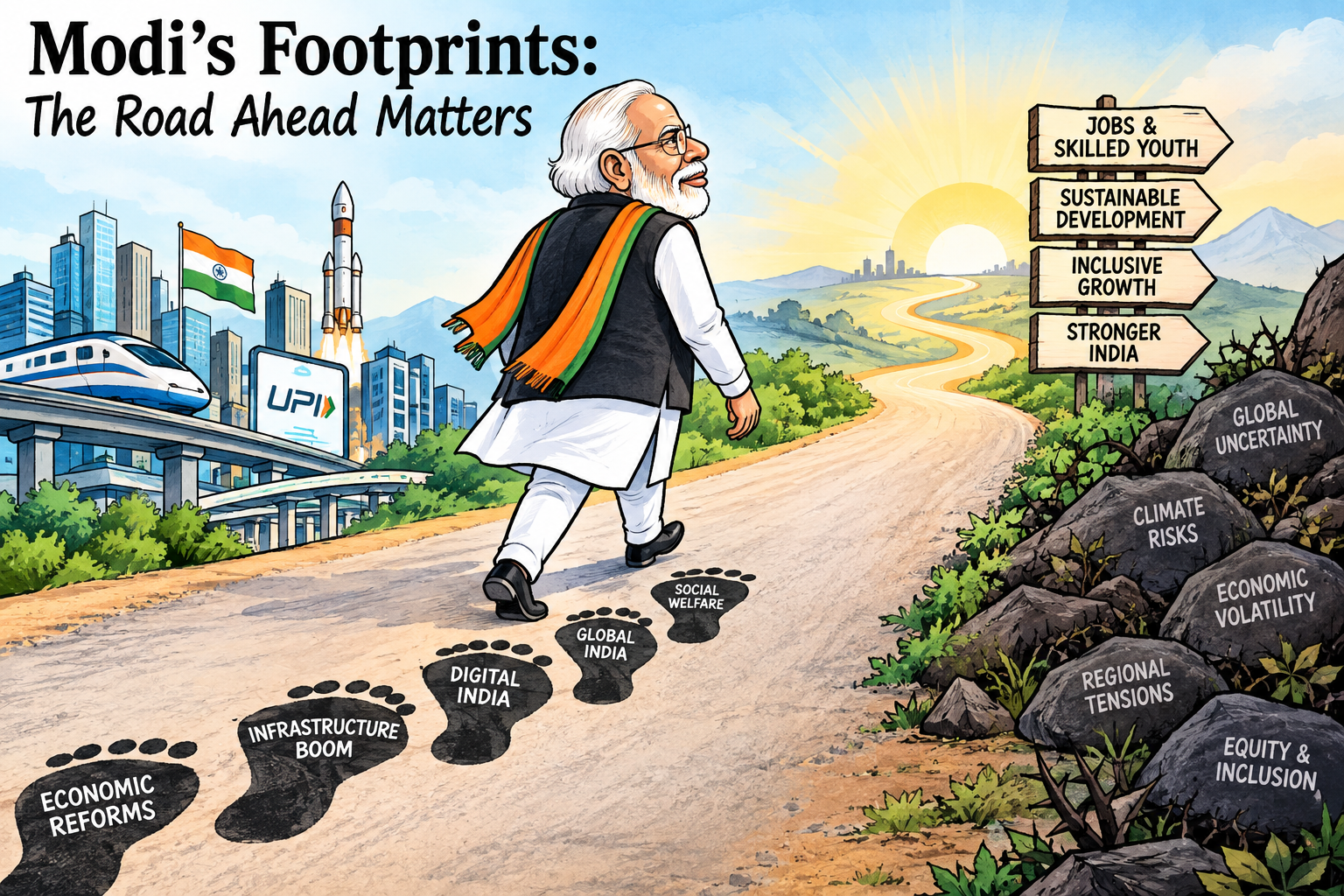
The 76th birthday of Prime Minister Narendra Modi, one of the ruling party’s most prominent figures, was marked with considerable fanfare. Having achieved the distinction of becoming India’s longest-serving prime minister, he received congratulatory messages from leaders across Asia, Europe and Africa, with many describing the occasion as a reflection of the trust and confidence placed in him by voters.
Yet beyond the celebrations and tributes, questions are being raised about the model of governance and its handling of socio-economic concerns, including unemployment, inflation, economic insecurity among minorities, and changing conditions among tribals, Dalits and other disadvantaged sections of society.
Meanwhile, the BJP has left no stone unturned in highlighting the Prime Minister’s importance to India’s development and underscoring the achievements of his tenure. Reports suggest that recent discontent among young people and students has raised questions about the government’s handling of the education sector and could affect its public image. There have also been reports suggesting some decline in the Prime Minister’s popularity, although the recent BRICS summit and India’s diplomatic engagement on the international stage may have given the government an opportunity to reinforce his image as a statesman of global stature.
While the present government has projected stability and development as the central objectives of governance, contrasting them with what it describes as an era of instability, scandals and misgovernance under the Congress, these claims require closer scrutiny. The Prime Minister had pledged to accelerate decision-making and presented the vision of a ‘Viksit Bharat’, an aspiration shared by citizens across the country.
Although several major changes have been introduced, studies of the economy have also raised concerns about growing inequality and disparities in income between urban and rural India, as well as between the formal and informal sectors. The Opposition attributes these trends to what it describes as ‘pro-rich’ policies designed to serve the interests of wealthier and upper-middle-class sections.
From the shortage of jobs to the slow pace of reforms, questions are being raised about India’s ability to realise its full economic potential. At the same time, the country’s pluralistic social fabric has come under strain amid concerns over majoritarian politics and increasing polarisation. Allegations of institutional bias have also grown. Although Modi has established the image of a shrewd politician who places national interest at the centre of his political narrative, questions remain about the depth of his government’s grassroots engagement with the disadvantaged and the poor.
Moreover, linking the women’s reservation legislation to delimitation has generated controversy, with the Opposition staging protests during the Monsoon Session of Parliament. One may recall the remarks of a former US trade representative who wrote in his memoirs that “only two businessmen ran the country”, while others put the number at seven. Whatever the exact figure, the perception has persisted that a small group with powerful business interests exercised disproportionate influence over the government and benefited significantly from the way capitalism operated in India.
Meanwhile, although there have been recent efforts to learn lessons from the West Asian conflict and expand oil and gas exploration, relatively little appears to have been done to expand higher education in the country’s backward districts, promote labour-intensive manufacturing, or make public institutions more efficient and impartial.
There is also continuing uncertainty over whether Indian diplomacy under Modi has retained the strategic autonomy that has traditionally characterised New Delhi’s foreign policy. While India has sought to build new partnerships, particularly in Africa and the Global South, some older relationships have also come under strain. Relations with the United States have brought significant strategic and economic engagement, but critics argue that New Delhi has not always been able to translate this into proportionate gains. Meanwhile, ties with China remain complex, marked by unresolved strategic differences as well as continuing economic interdependence.
The Modi government has strengthened India’s geopolitical position while maintaining strategic autonomy and deepening relationships across the geopolitical spectrum. India’s emergence as a genuine manufacturing alternative to China remains one of the country’s major challenges. Another is the development of new technologies, particularly artificial intelligence, and its application across Indian industry. Climate resilience, too, needs to become a central pillar of development policy. The real question is not whether India has become a large economy, but whether its resilience can pave the way for genuine and broad-based development.

In contrast to the growing footprint of Modi’s governance in states such as Bengal, Odisha and the Northeast, the Opposition and the Congress have failed to capitalise on the government’s shortcomings on the economic front. Neither Modi’s majoritarian and, to some extent, centralised approach nor policies seen as urban- and industry-oriented have been effectively challenged by the Congress. The party has failed to build a mass movement against these trends or mobilise intellectuals and academics around them.
Political analysts believe that the lack of support for, or initiative from, the Congress may be among the reasons why public opposition to the BJP’s perceived shortcomings on the economic front has failed to materialise. At the same time, it must be acknowledged that Rahul Gandhi has made serious efforts to connect with ordinary people, particularly through the Bharat Jodo Yatra and during student and youth movements. However, the party’s inability to consolidate the gains from these important initiatives remains a significant political development.
Meanwhile, it is widely acknowledged that the Opposition has failed to develop a political framework capable of articulating a clear anti-BJP position. The political consensus required for the Opposition to effectively challenge the policies of the NDA government has not materialised. Some analysts have argued that the Congress and its allies need to strengthen their base in the northern and western states, and that Kerala and Karnataka alone will not be sufficient.
The emerging political situation presents new dimensions. In the eastern region, the Hindutva factor has helped the BJP and is likely to remain significant in the future. The promotion of Modi’s version of nationalism has strengthened the party, although it is also true that the RJD and Samajwadi Party in the northern states, as well as the Dravidian parties in Tamil Nadu, rely heavily on social justice while maintaining their own frameworks for defining nationalism.
The challenge posed by the Congress and the broader Opposition to NDA policies has so far failed to make significant progress. Although some analysts point to indications of a possible decline in Modi’s popularity, the RSS-BJP combine continues to draw political strength from its assertive nationalism. For the Opposition to mount a more effective challenge, it would need to focus more clearly on pressing socio-economic issues as well as the aspirations and concerns of Generation Z. Any future strategy would also need to address the rural population and people at the grassroots who are struggling with questions of livelihood and survival.
For the moment, however, it appears difficult for the fragmented INDIA bloc to mount a significant challenge to Modi.