


How the Jana Sangh and BJP Changed India’s Political Landscape
 KRC TIMES Desk
Vinay Sahasrabuddhe
From Syama Prasad Mookerjee’s political alternative in 1951 to the BJP’s rise as a dominant national force, the journey reflects a profound shift in the relationship between nationalism, cultural identity and governance.
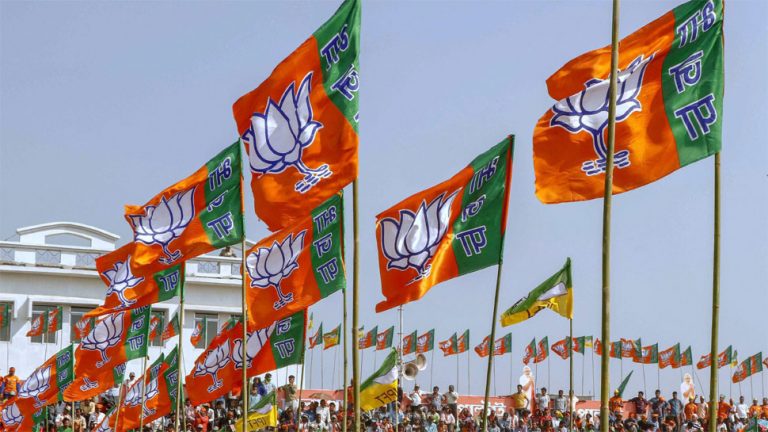
The founding of the Bharatiya Jana Sangh on October 21, 1951, marked a significant chapter in the evolution of Indian politics. Established under the leadership of Syama Prasad Mookerjee, the party emerged as an alternative to the Congress, which dominated the political landscape in the aftermath of independence. Seventy-five years later, the Jana Sangh’s political successor, the Bharatiya Janata Party (BJP), has become one of the country’s most influential political forces, reshaping the debate over patriotism, national identity and governance.
The Jana Sangh’s emergence challenged the Congress’s long-standing association with nationalism, built during the freedom struggle. While the Congress emphasised secular nationalism, parliamentary democracy and state-led economic development, the Jana Sangh argued that India’s civilisational heritage and cultural traditions should occupy a more prominent place in the process of nation-building.
This ideological difference gradually developed into a defining feature of Indian politics. The Jana Sangh, and later the BJP, sought to establish cultural nationalism as a distinct political philosophy, arguing that the country’s identity could not be understood solely through the institutions of a modern republic without acknowledging its historical and cultural inheritance.
Congress and the debate over national identity
The Congress faced the formidable task of governing a newly independent country divided by Partition and marked by religious tensions, mass displacement and deep social inequalities. Its emphasis on secularism and accommodation among communities was intended to preserve national unity in an exceptionally difficult period.
However, several decisions taken by successive Congress governments later became subjects of political controversy. The Shah Bano case of 1985-86, in which the Rajiv Gandhi government enacted legislation following a Supreme Court ruling on maintenance for divorced Muslim women, was widely criticised as a concession to conservative religious opinion at the expense of gender justice.

The Congress’s handling of the Ayodhya dispute, Article 370 and the Uniform Civil Code also fuelled criticism that political considerations sometimes took precedence over a consistent application of constitutional principles. Supporters of the Congress, however, have argued that governing a diverse society requires sensitivity to minority concerns and that accommodation should not automatically be dismissed as appeasement.
The debate highlights a central challenge for Indian democracy: protecting minority rights while ensuring equality before the law. Neither cultural identity nor religious accommodation can replace the constitutional principles of equal citizenship, justice and individual liberty.
The Jana Sangh and the BJP gained political support by making these questions central to their political agenda. Their opposition to Article 370, advocacy of a Uniform Civil Code and emphasis on a common national identity helped them consolidate a constituency that viewed the Congress’s approach to these issues as inconsistent.
Integral Humanism and the economic alternative
The Jana Sangh also sought to distinguish itself from the Congress’s economic model, which placed considerable emphasis on state planning and socialist principles. Its ideological framework drew heavily on Deendayal Upadhyaya’s concept of Integral Humanism, which sought to balance individual dignity, social responsibility, economic development and cultural values.
The philosophy presented an alternative to both unrestrained capitalism and excessive state control. It argued that development should address the needs of the whole person and society rather than focus exclusively on material growth or bureaucratic planning.
The Jana Sangh’s position on land-ceiling legislation in Rajasthan illustrated that its economic outlook did not necessarily imply opposition to redistributive policies. Despite resistance from some of its legislators, the party leadership supported the measure, reflecting an attempt to reconcile its ideological commitments with social and economic realities.
The Antyodaya initiative associated with Bhairon Singh Shekhawat subsequently reinforced the principle that development must reach the poorest sections of society. These examples demonstrate that economic justice is not the exclusive domain of any one political ideology; its value ultimately depends on whether policies improve living standards and reduce deprivation.
From political alternative to national power
The Jana Sangh’s participation in the Janata experiment of 1977 marked an important stage in its evolution. The formation of the BJP in 1980 provided a new platform for the continuation of its political project, although the party’s subsequent rise required decades of organisational expansion, ideological mobilisation and electoral consolidation.
Atal Bihari Vajpayee’s tenure as prime minister demonstrated that a non-Congress government could complete a full term while pursuing a substantial policy agenda. The Pokhran-II nuclear tests in 1998, the response to the Kargil conflict in 1999, the creation of Chhattisgarh, Jharkhand and Uttarakhand, and the expansion of elementary education through the Sarva Shiksha Abhiyan were among the notable initiatives of his government.
Vajpayee also demonstrated that a party with a strong ideological identity could govern through coalition politics. His administration depended on negotiations with allies and the management of competing political interests, underlining the importance of compromise and parliamentary cooperation in a diverse democracy.
Under Narendra Modi, the BJP has further consolidated its position through a combination of cultural nationalism, welfare delivery, infrastructure development and digital public services. The expansion of financial inclusion and direct benefit transfers through the Jan Dhan-Aadhaar-mobile framework, the introduction of the Goods and Services Tax, and the Insolvency and Bankruptcy Code have been important elements of its economic agenda.
The abrogation of Article 370 in 2019 represented a major constitutional change concerning Jammu and Kashmir. The criminalisation of instant triple talaq, the passage of the Women’s Reservation Act and the replacement of colonial-era criminal laws have also featured prominently in the government’s reform programme. Meanwhile, India’s growing defence production and diplomatic initiatives, including the International Solar Alliance, have strengthened the government’s emphasis on national capability and global influence.
However, the long-term success of these initiatives must be judged by their implementation and their impact on citizens. Employment generation, economic opportunity, social welfare, institutional accountability and the protection of democratic rights remain essential measures of governance, regardless of which party holds power.

Patriotism beyond party politics
The Jana Sangh’s 75-year journey illustrates how a political movement that once occupied the margins can transform the national agenda by connecting its ideas with public aspirations. The BJP has fundamentally altered the language of political competition by placing cultural nationalism, civilisational identity and a more assertive conception of national interest at the centre of its political narrative.
Yet patriotism cannot be the exclusive property of any political party. The Congress’s contribution to the freedom struggle, the role of regional movements and the sacrifices of citizens from different religious, linguistic and social backgrounds are integral to India’s national history. The country’s democratic strength depends on recognising this plurality rather than allowing any single political tradition to claim sole ownership of national loyalty.
Cultural nationalism can provide a sense of historical continuity and collective confidence, but it must operate alongside constitutional values. A strong nation is not defined only by its cultural heritage or international standing; it is also measured by the dignity it affords its citizens, the fairness of its institutions and its ability to protect individual rights.
The Congress, meanwhile, faces the challenge of overcoming the perception that its long period of political dominance encouraged complacency and weakened its ideological clarity. The BJP, having moved from opposition to a position of national dominance, must also guard against stagnation and ensure that electoral success does not weaken institutional accountability.
Seventy-five years after the Jana Sangh’s founding, cultural nationalism has become an established force in Indian politics. The more important question is how it will balance civilisational confidence with constitutional restraint, national ambition with social inclusion, and political authority with democratic accountability.
The Jana Sangh and the BJP have undeniably changed India’s political vocabulary. Their lasting contribution will ultimately depend not merely on how successfully they define patriotism, but on whether that vision helps build a more equitable, inclusive and democratic India. True patriotism finds its fullest expression not in partisan claims over the nation, but in the commitment to strengthen its institutions, uphold justice and improve the lives of its people.