


Russia’s Strategic Stakes in a Changing Middle East
 KRC TIMES Desk
A.ROBERT
Moscow wants to preserve Tehran as a strategic partner, expand its diplomatic influence and protect its regional interests-but the war also presents conflicting economic incentives and exposes the limits of Russian power.
Russian President Vladimir Putin’s October 27 meetings with Iranian President Masoud Pezeshkian and Qatar’s Emir Sheikh Tamim bin Hamad Al Thani offered an insight into Moscow’s calculations over the conflict involving Iran. Russia is seeking to retain its influence in the Middle East, protect its strategic partnership with Tehran and position itself as an important diplomatic player in efforts to end the confrontation. Yet its ambitions are constrained by competing economic interests, regional rivalries and the growing involvement of other mediators.
The meetings did not produce any publicly announced breakthrough in peace negotiations. Nevertheless, they highlighted a central dilemma for the Kremlin: Russia has a strategic interest in preventing Iran’s decisive geopolitical defeat, even as the conflict creates short-term economic opportunities for Russian energy exporters.
Moscow’s approach is therefore more complex than simply supporting Iran or opposing a US-led regional order. Putin’s priority appears to be ensuring that Iran emerges from the confrontation sufficiently stable and independent to remain a valuable Russian partner.
Preserving a strategic partnership
Russia and Iran formalised their strategic relationship through a treaty signed in 2025, covering political, economic and security cooperation. Although the agreement does not constitute a mutual-defence pact, it has strengthened the institutional foundations of their partnership.
For Moscow, Iran occupies an important position in its broader geopolitical calculations. A political collapse in Tehran, particularly if followed by the emergence of a government closely aligned with Washington, could seriously weaken Russia’s influence in the Middle East. Such a development would potentially strengthen American strategic leverage in a region where Moscow has invested considerable diplomatic and economic resources.
Consequently, preventing Iran’s decisive strategic defeat may be more important to the Kremlin than ensuring an outright Iranian victory.
A weakened but politically stable Iran, retaining its independence and continuing its cooperation with Moscow, could still serve Russian interests. By contrast, an Iran emerging from the conflict increasingly dependent on Washington would represent a significant setback for the Kremlin.

This does not necessarily mean Russia is committed to preserving Iran’s existing political system under every circumstance. Moscow’s deeper concern may be the country’s future strategic orientation. The nature of Iran’s political arrangements matters, but its relationship with the major international powers could matter even more to Russia.
There are, however, limits to Moscow’s influence. Maintaining close relations with Tehran does not give Putin the power to determine Iran’s political or military future. That will depend primarily on developments inside Iran, the balance of military power, decisions taken in Washington and the positions adopted by other regional countries.
The energy paradox
The conflict has also created a complicated economic equation for Russia.
Any disruption to shipping through the Strait of Hormuz, one of the world’s most important energy transit routes, can push international oil prices higher. Such an increase may benefit Russian exporters, particularly at a time when Moscow remains under pressure from Western sanctions and restrictions on its energy trade.
However, prolonged instability carries substantial risks. Disruption to shipping, uncertainty in energy markets, declining investment and slower global economic growth could eventually damage demand for energy. A prolonged conflict could therefore generate short-term financial gains while creating longer-term economic costs.
Peace, too, presents challenges for Russian energy interests. If international sanctions on Iran were substantially eased, Tehran could gradually expand oil exports, attract foreign investment and strengthen its position in global energy markets. This could increase competition for Russian exporters.
The actual impact would depend on Iran’s ability to restore production capacity, secure investment, access markets and overcome infrastructure constraints.

There is no sufficient public evidence to conclude that Moscow is deliberately seeking to prolong the conflict to benefit from higher oil prices or to restrict Iranian exports to protect its own market share. Such assumptions oversimplify Russia’s calculations.
The more plausible assessment is that Moscow is attempting to balance immediate economic opportunities against the strategic risks of prolonged regional instability. Russia may benefit from higher energy prices, but it also needs a functioning regional economic environment and a stable Iran capable of sustaining their partnership.
Diplomatic access does not guarantee influence
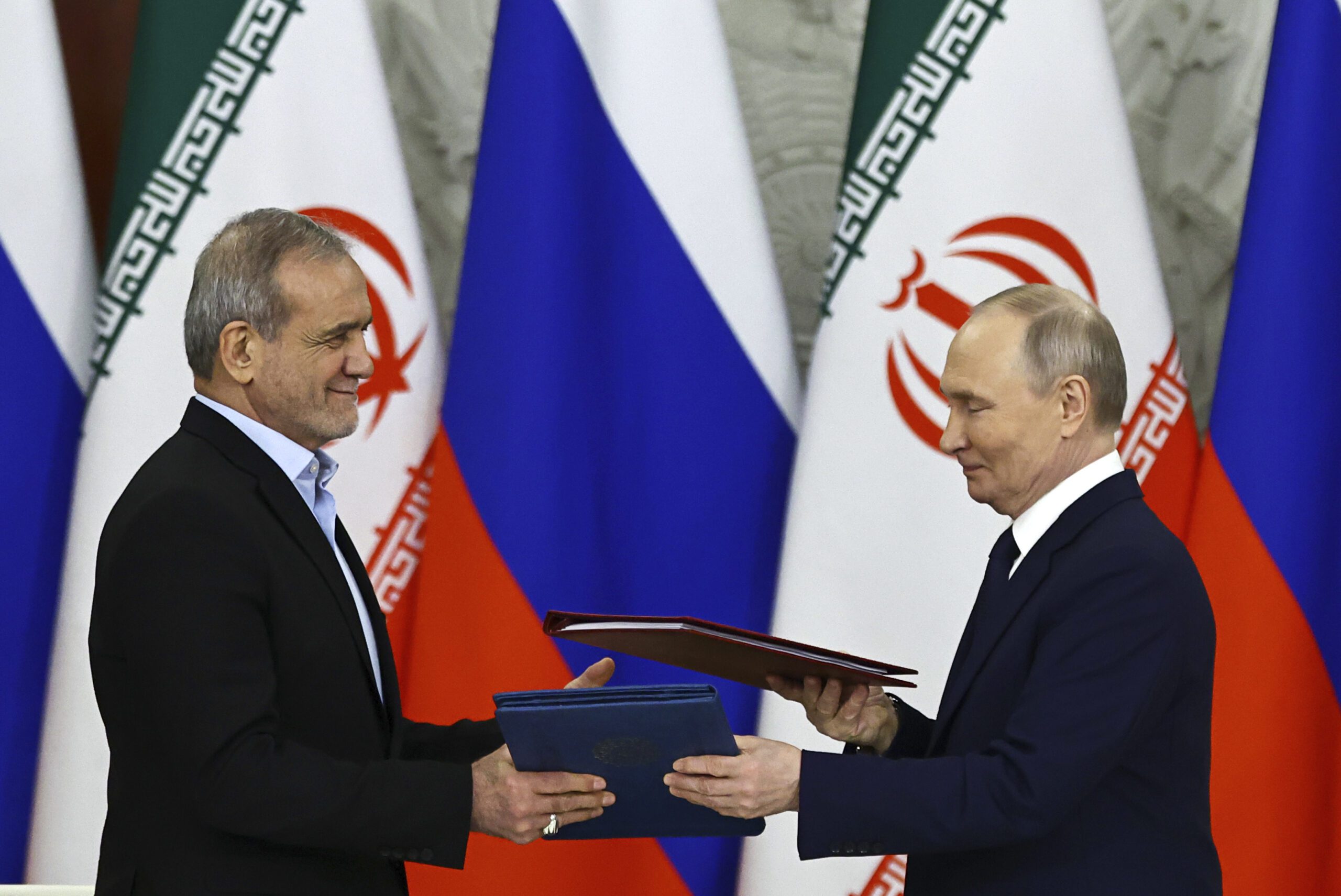
Putin’s meeting with Pezeshkian demonstrated that Moscow continues to enjoy direct access to Iran’s political leadership. The Russian President acknowledged that the two leaders had discussed the regional crisis privately and expressed hope for a positive outcome.
Pezeshkian, for his part, argued that regional countries should be able to resolve their problems without depending on the United States. Both leaders emphasised the importance of closer cooperation.
Putin also said bilateral trade had increased by 10.4 per cent during the first eight months of 2026. He confirmed that construction work at Iran’s Bushehr nuclear power plant was continuing.
These developments underline the durability of the Russia-Iran relationship. But diplomatic engagement should not be confused with the ability to dictate the terms of a settlement. Neither leader publicly announced a new ceasefire proposal or an agreed negotiating framework during the meeting.
Russia can communicate with Tehran, convey proposals and potentially help identify areas of compromise. Yet diplomatic access becomes genuine leverage only when it changes the calculations of the parties involved or helps produce an agreement that would otherwise remain out of reach.
Moscow’s relationship with Iran could make it a useful intermediary. At the same time, its close association with Tehran may generate suspicion in Washington about the neutrality of any Russian initiative. Russia’s own war against Ukraine further complicates its claim to be a constructive peacemaker, even though mediation does not always require complete impartiality.
Qatar and Pakistan emerge as important intermediaries
Russia is not the only country seeking a diplomatic role in the conflict. Qatar and Pakistan have emerged as important intermediaries, while Saudi Arabia and Turkey also possess regional influence and strategic interests that could shape the eventual outcome.
Putin’s separate meeting with Qatar’s Emir highlighted the importance of these diplomatic channels. The Russian President referred to the Islamabad Memorandum, reached with Qatari and Pakistani mediation, as a possible basis for advancing negotiations over the Iranian crisis.

Qatar has experience facilitating communication between Washington and Tehran. On October 25, it presented Iran with a draft proposal intended to end the war. An official briefed on the negotiations said Tehran was considering the proposal. However, a senior Iranian official reportedly described the ideas as unacceptable and disputed that they constituted a formal offer.
The differing accounts illustrate the gap between diplomatic activity and actual progress towards peace. Mediators can establish communication channels, prepare proposals and encourage negotiations, but they cannot guarantee that the parties will accept the terms.
Russia could cooperate with Qatar and Pakistan in pursuing a settlement. Alternatively, competition for diplomatic recognition and influence could complicate coordination among the intermediaries.
For Moscow, the challenge is to demonstrate that its involvement can contribute something beyond the diplomatic access already available to other regional players.
Can Putin shape the post-war order?
Putin’s Iran policy ultimately reflects an attempt to manage several competing objectives. Russia wants to preserve Tehran as a strategic partner, prevent the emergence of a regional order dominated by Washington and strengthen its own international standing. At the same time, it must navigate the economic consequences of a conflict that could either benefit or damage its energy interests, depending on how events unfold.
These objectives do not always complement one another. Iran may accept compromises that Moscow does not favour, reject proposals supported by Russia or emerge from the conflict with its capacity for strategic cooperation severely weakened.
The future of the relationship will also depend on how Tehran assesses its own security requirements. Iran is unlikely to subordinate its national interests entirely to Moscow’s geopolitical calculations. The partnership may be strategically valuable to both sides, but their interests are not necessarily identical.
The real test of Putin’s strategy, therefore, will not be the number of high-level meetings he holds or the diplomatic declarations issued after them. It will be whether Russia can help secure an outcome that reduces hostilities, preserves Iran’s strategic independence and safeguards Moscow’s position in the Middle East.
Putin may not necessarily need Iran to defeat the United States. What Russia needs is an Iran that emerges from the confrontation without falling decisively into Washington’s strategic orbit.
But that outcome is far from guaranteed. Moscow can maintain diplomatic channels, offer political support and seek to influence negotiations. It cannot assume that Tehran will follow its preferences or that other regional powers will accept a Russian-led settlement.
For now, Putin’s Iran gambit remains a strategic calculation rather than a diplomatic success. Russia has reasons to remain engaged, but whether it can convert its relationship with Tehran into decisive influence over the region’s future remains an open question.

