

The purpose of economics should be the fulfillment of legitimate human needs rather than the pursuit of unlimited accumulation,” asserted Prof. Goel
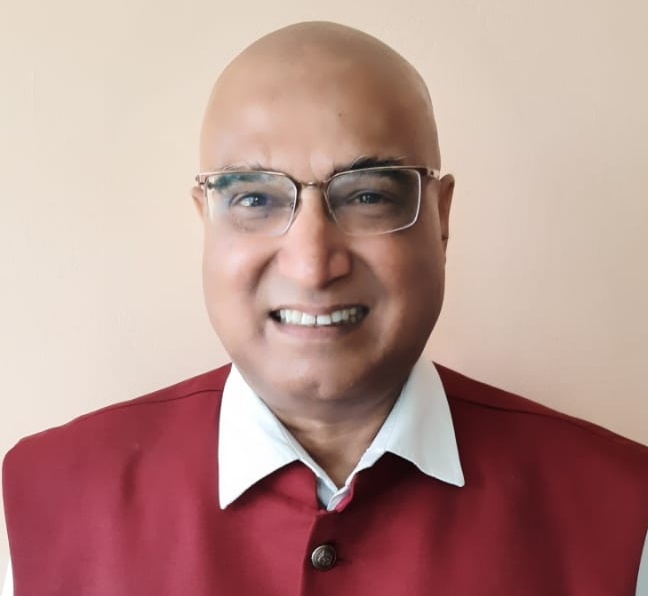 Dr. M. M. Goel
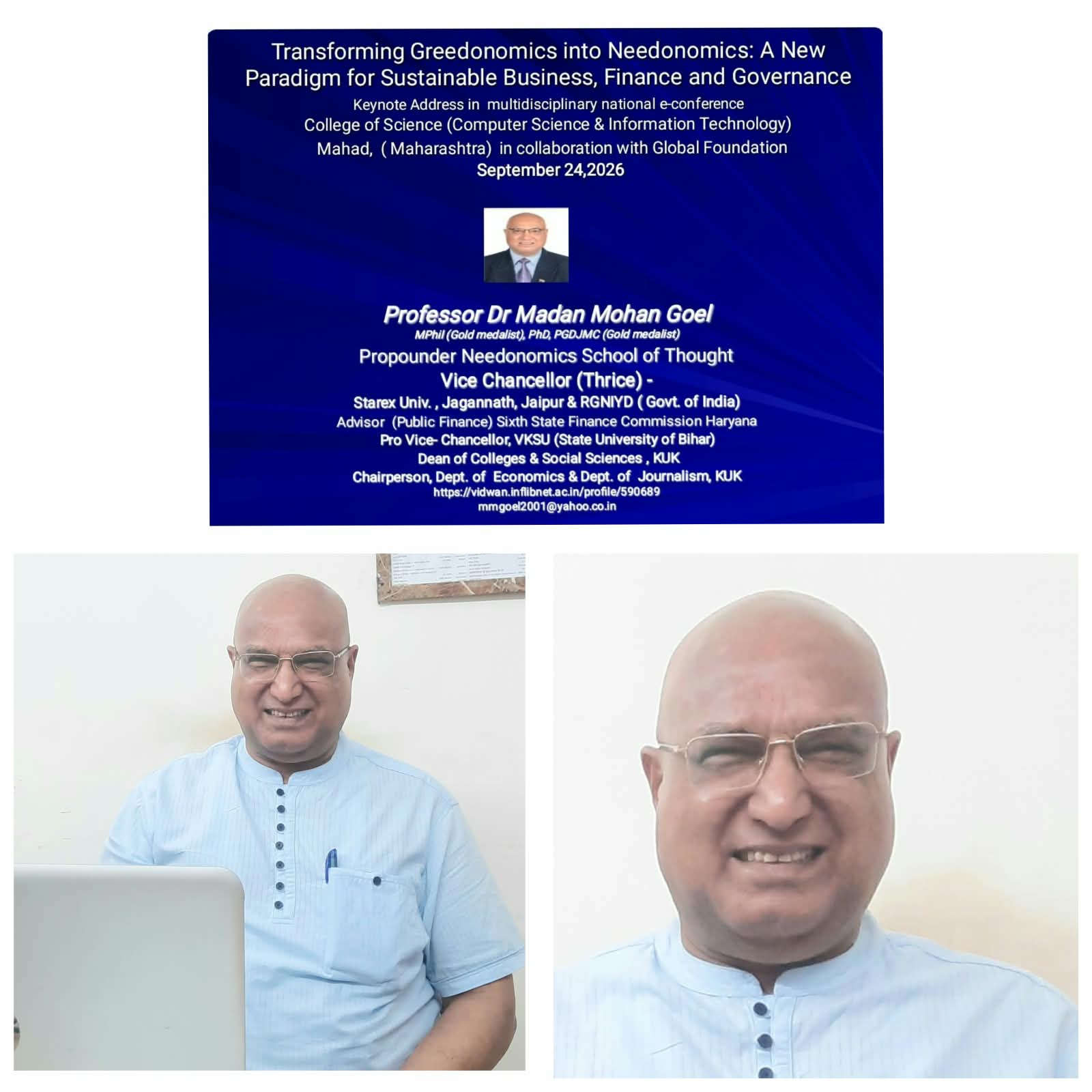
Mahad (Maharashtra) : Prof. Madan Mohan Goel, Former Vice-Chancellor, Propounder, Needonomics School of Thought and superannuated Professor of Economics, Kurukshetra University, delivered the keynote address on “Transforming Greedonomics into Needonomics: A New Paradigm for Sustainable Business, Finance and Governance” at a multidisciplinary national e-conference organized by the College of Science (Computer Science & Information Technology) Chambharkhind, Tal-Mahad, District Raigad, Maharashtra, affiliated to the University of Mumbai, in collaboration with Global Foundation.
Jyothi V. Poojary, Convener, delivered the welcome address and introduced Prof. M.M . Goel to the participants. Principal Sudesh N. Kadam presided over the programme, while Santosh P. Mane, President, Global Foundation India, Pune, proposed the vote of thanks.

Prof. Goel highlighted the contradictions of the contemporary economic order, marked by widening inequalities, excessive consumerism, financial stress, environmental degradation, corruption and declining trust in institutions.
“The purpose of economics should be the fulfillment of legitimate human needs rather than the pursuit of unlimited accumulation,” asserted Prof. Goel.
Presenting Needonomics as the “economics of needs,” Prof. Goel contrasted it with Greedonomics and emphasized its central principle: “Need over Greed.”
Prof. Goel clarified that Needonomics seeks not to reject markets, profits, entrepreneurship, wealth creation or finance, but to ethically reorient them towards social responsibility, sustainability and human welfare.
He underlined the Needonomics mandates “Needs before Noise, Values before Volumes” and “Growth with Goodness,” with the larger objective of achieving Peace, Progress and Prosperity (PPP).
Prof. Goel called for businesses, finance, governments, consumers and technology to prioritise value creation, genuine needs, accountability and human welfare.
He concluded that transforming Greedonomics into Needonomics requires not abolishing markets, but ethically reorienting them towards legitimate needs, responsible choices and sustainable prosperity.