


A Step Towards Stronger Bilateral Relations
 KRC TIMES Desk
Dr D. K. Giri
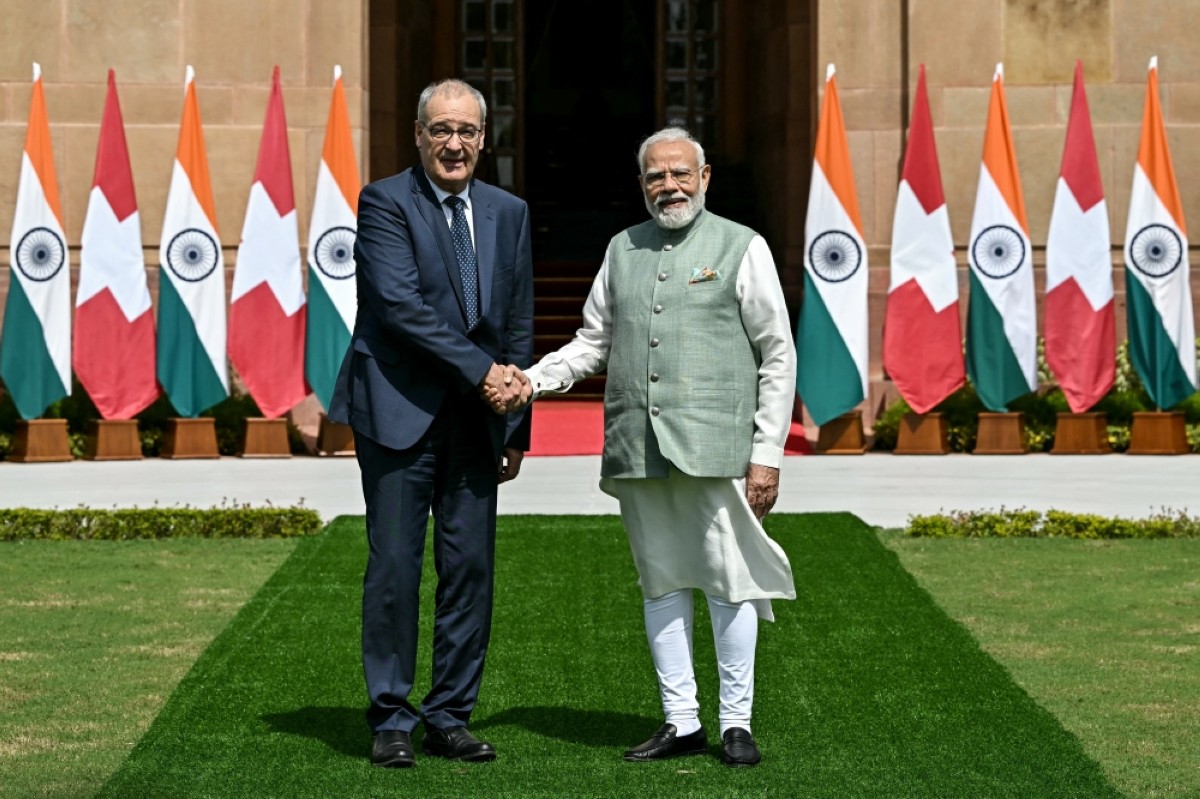
Responding to a question, Swiss Confederation President Guy Parmelin said, “It is a pleasure to return to India so soon, and it is also a testament to the excellent state of our bilateral relations.” Parmelin is in India on a three-day state visit. This is his second visit to the country, following his participation in the AI Impact Summit in February this year. It is understandable that several countries, particularly those in the West, are rediscovering India in view of its rapidly expanding market.
On October 7, the World Bank raised its GDP growth forecast for India to 7.1 per cent for FY27 in its October 2026 India Development Update. This is the fastest projected growth rate among the world’s major economies. It is hardly surprising, therefore, that a capital-intensive, technology-driven country like Switzerland should seek to engage seriously with the Indian market. Parmelin said, “The objective of my visit this time is to strengthen cooperation and unlock new opportunities for both our countries and our people.”
Parmelin’s visit must also be viewed against the backdrop of the India-European Free Trade Association (EFTA) Trade and Economic Partnership Agreement (TEPA), which completed one year of implementation on October 1, 2026. TEPA was signed on March 10, 2024, following 16 years of negotiations between India and the four EFTA countries-Iceland, Liechtenstein, Norway and Switzerland. It is worth recalling that EFTA committed to investing $100 billion over 15 years and creating one million direct jobs.
Switzerland is a leading member of EFTA and India’s largest trading and investment partner within the bloc. The visit provides an opportunity to review the progress of TEPA, and its timing coincides with the second India-EFTA Prosperity Summit scheduled to be held in New Delhi on October 7.

The information shared by Sibi George, Secretary (West) in the Ministry of External Affairs, during a media briefing on October 5 indicates that progress is being made on the ground, beyond formal policy frameworks. More than 340 Swiss companies have a presence in India through subsidiaries, joint ventures or liaison offices. Of these, 110 companies have established manufacturing operations, while 30 have set up research and development (R&D) centres. Another 74 companies use India as an export hub for other markets.
Investments made or under consideration by Swiss companies cover a wide range of sectors, including transport and logistics, financial services, manufacturing, pharmaceuticals, biotechnology, technology, precision instruments and electronics. Since 2024, Swiss companies and businesses from other EFTA countries have also undertaken 150 promotional activities.
Last Monday, TEPA moved to the next stage as India and Switzerland signed a series of significant agreements. Prime Minister Narendra Modi described TEPA as an “ambitious blueprint” for investment, innovation, jobs and shared prosperity. Five memoranda of understanding (MoUs) were announced across several areas, including sustainable infrastructure development, exchanges of young professionals, innovation, technology transfer and entrepreneurship.
The human dimension of the partnership is particularly promising. The Migration and Mobility Partnership Agreement, especially its Young Professionals Scheme, will facilitate exchanges of young professionals seeking temporary employment in the other country, enabling them to enhance their professional and language skills in their respective fields. Young Indians looking to work abroad for better opportunities, apply their skills and gain exposure to new environments are likely to find the scheme particularly useful.
According to the Ministry of External Affairs, the Young Professionals Scheme provides for the exchange of 300 individuals per country annually, with the number potentially rising to 500. It also stipulates timelines of 30 and 90 days for verification of nationality and residence status. For a country with an average age of around 28, this represents a significant opportunity.
An intent document has also been signed between India’s Department of Science and Technology and its Swiss counterpart, the Swiss National Science Foundation. The objective is to promote long-term cooperation between Indian and Swiss research communities by supporting exploratory scientific collaboration, building partnerships for future joint research and establishing a comprehensive framework to sustain long-term initiatives in mutually agreed priority areas.

This is particularly important because India needs such partnerships in R&D, given that it invests considerably less in innovative research than many Western countries. India spends approximately 0.7 per cent of its GDP on R&D, compared with more than 3 per cent in Switzerland. The development of vaccines during the COVID-19 pandemic may have been an exceptional achievement, but it earned considerable appreciation worldwide. Swiss precision in research and India’s scale of talent could prove complementary strengths.
On the Indian side, pharmaceutical companies have raised some concerns regarding intellectual property provisions. They fear that such restrictions could affect access to affordable generic medicines. The Swiss side has clarified that these concerns are unfounded. TEPA does not restrict access to medicines; on the contrary, it facilitates the availability of low-cost drugs. However, established standards and procedures must be respected.
Switzerland brings considerable expertise in pharmaceutical research and innovation, while India has a strong manufacturing base, scientific talent, excellence in information technology and a rapidly expanding biotechnology sector. With greater India-Switzerland cooperation, India could emerge as a pharmaceutical hub not only for generic medicines but also for novel biologics. Modi said that particular attention had been given to market access for Indian agricultural products, pharmaceuticals, textiles and engineering goods.
Another issue discussed during the visit was the exchange of financial account information between the two countries. For Indians, Swiss banks have long been associated with black money and undisclosed wealth. The automatic exchange of tax and account information has been in place since 2019, while the exchange of information upon request is also functioning effectively. Switzerland must continue to uphold the confidence of Indians who expect greater transparency regarding undisclosed assets.
President Droupadi Murmu, while hosting a banquet for President Parmelin at Rashtrapati Bhavan, emphasised that cooperation between the two countries extends to democracy, the rule of law and financial transparency. Kashmiri delicacies, including kanna guchhi pulao, tsok wangun and phirni, featured prominently on the menu.
On terrorism, a continuing concern for India, Switzerland has reiterated its support. It has pledged to uphold global standards, including the recommendations of the Financial Action Task Force (FATF), and to curb terrorist financing in all its forms, including through virtual assets and underground banking. President Parmelin said Switzerland works closely with international partners and the private sector to combat terrorism.
Finally, the symbolism of this visit extends beyond Hyderabad House. On October 7, President Parmelin is scheduled to visit the Noida International Airport at Jewar, a project involving Zurich Airport International AG, a wholly owned subsidiary of Zurich Airport. It is a tangible example of Swiss capital contributing to the development of Indian infrastructure.
As President Murmu noted, Swiss companies have a notable presence in the construction of roads, railway bridges and tunnels. The two countries can now explore further opportunities in clean and green technologies and artificial intelligence.
In short, this is not merely a ceremonial visit. It is a visit intended to follow through on earlier commitments. From the AI Impact Summit in February to the first anniversary of TEPA in October, Switzerland appears to be moving from its $100-billion investment pledge towards projects on the ground.
For India, which saw its exports to EFTA decline by 10.7 per cent to $1.75 billion in FY26 following the implementation of TEPA, the real test will be whether market access improves. For Switzerland, the challenge is whether its 340 companies can translate India’s projected 7.1 per cent growth into shared prosperity.
Both sides appear willing to make the effort.
Dr D. K. Giri Professor of Practice, Institute of Management, Bhubaneswar