

Bhagwat Would Have Done Well to Realise It Earlier
 KRC TIMES Desk
Pradip Dutta Roy
The movement led by the CJP, or Gen Z, over the NEET-UG question-paper leak shook the entire country. The movement was entirely justified—a fact that the chief of the Rashtriya Swayamsevak Sangh (RSS), Mohan Bhagwat, has acknowledged, albeit after much water has flowed under the bridge.
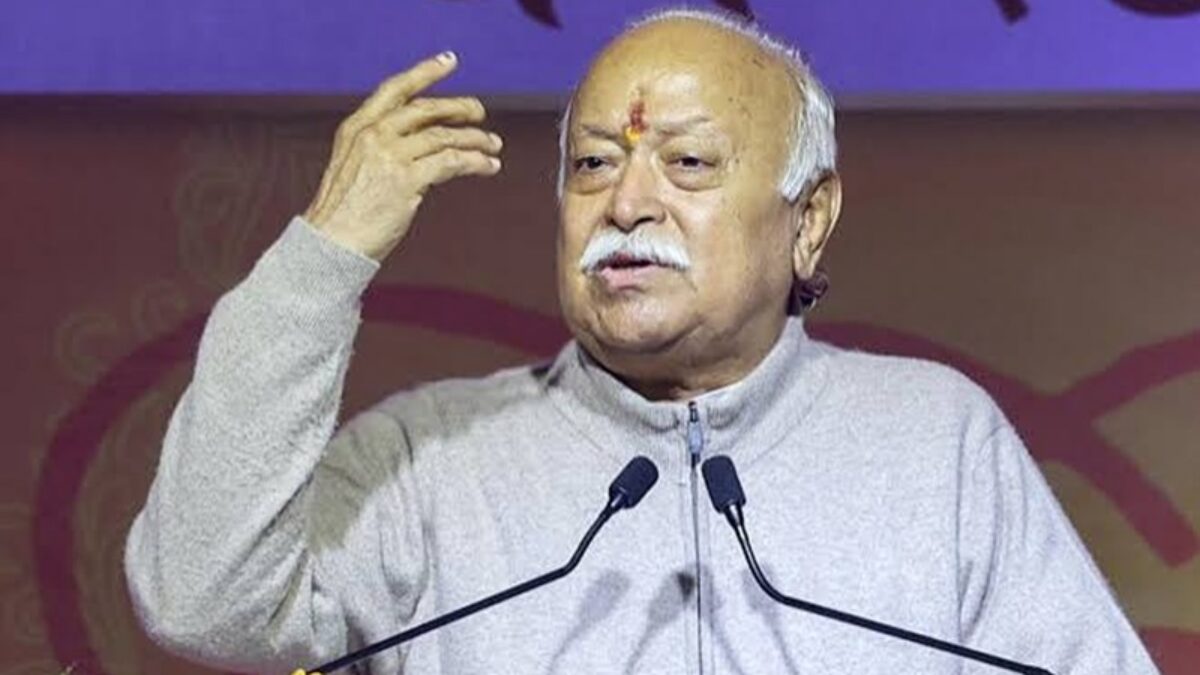
During an interaction with representatives of the younger generation in Mumbai, Bhagwat exchanged views with them on a range of issues. He said that whenever dissatisfaction arises over someone’s actions, people have every right to question them. Questioning, he emphasised, does not amount to sedition. Describing Gen Z as the future of the country, Bhagwat said that the issues over which the younger generation is protesting should be examined seriously. According to him, protest is a sign of a healthy democracy.
He also said that the commercialisation of education is in no way desirable for the country or society. Maintaining a healthy education system, he pointed out, is not solely the responsibility of the government; society as a whole also has a role to play. It is the responsibility of those in power to respond to the questions being raised by the younger generation. Their concerns cannot simply be ignored. The problems they have highlighted must be addressed.
Bhagwat made it clear that questions must be raised repeatedly if democracy is to remain vibrant. He therefore would not advise the younger generation to refrain from questioning. If they are compelled to raise their voices in protest, it should be understood that there is some flaw in the matter they are protesting against, and that flaw needs to be corrected. According to Bhagwat, questioning institutions is an essential duty of youth. Asking questions does not mean being anti-national.

Send your resume:
biswa@jigyasu.co.in
krcfoundation@gmail.com
In this sense, he has given legitimacy to the movement organised under the leadership of the Cockroach Janata Party (CJP) over the NEET-UG question-paper leak.
Before meeting members of Gen Z, Mohan Bhagwat had once remarked that in his generation, younger people would silently accept whatever their elders said and that there was little opportunity to question them. In doing so, he was referring to the traditional social values and practices of the country. However, the fact that such traditions are gradually changing is evident from the conduct and outlook of the present generation. There is no reason to regard this change negatively.
Times have changed. Today’s generation has learnt to think independently and to ask questions. Their questions cannot simply be brushed aside. They must be answered. The importance of the issues over which young people are taking to the streets must be recognised. If their demands are genuinely intended for the broader welfare of society, they should be accepted and the process of reform should begin.
The government cannot afford to adopt a one-sided approach. Following Bhagwat’s remarks, there appears to have been a decline in the tendency within the ruling camp to target the CJP with abusive attacks. Those MPs and others who had earlier used unparliamentary and derogatory language against CJP activists now appear to be discovering virtues among its members.
Yet, when the movement was underway at Jantar Mantar in Delhi, the ruling establishment left no stone unturned in maligning CJP leaders by portraying the agitation as being funded by foreign sources. Protesters were even branded anti-national.
It is true that some outsiders attempted to infiltrate the CJP movement and create disturbances. But the overwhelming majority of participants were patriotic citizens. Social workers, intellectuals and sections of the country’s farming community supported the movement. The government’s own statements have also made it clear that the movement was not backed by foreign funding.
At Jantar Mantar, Gen Z demonstrated through its united movement that the country could be given a new direction. In a single stroke, they shattered the monopoly of the BJP IT cell’s propaganda machinery, which had remained entrenched for nearly twelve years.
It would be entirely wrong to suggest that only students participated in the movement. People from various sections of society who felt deprived and neglected spontaneously joined the agitation. This left the ruling establishment visibly uncomfortable. It was something they could hardly have imagined even in their worst nightmares—that, responding to a call from India’s younger generation, people across the country would remain on the streets for 36 consecutive days, protesting against government decisions.
It was equally unprecedented that a prominent environmentalist like Sonam Wangchuk would undertake a hunger strike. In support of his programme, peaceful protest marches were organised in several major cities, including in the northeastern region. Various student and youth organisations came forward to organise these marches.

The united strength displayed by the younger generation eventually forced the ruling party to look at the matter differently. Accepting responsibility for the question-paper leak scandal, Education Minister Dharmendra Pradhan resigned. The police, citing directions from the court, took Sonam Wangchuk to hospital, where his hunger strike was subsequently brought to an end through government intervention.
After the Education Minister’s resignation, the CJP withdrew its movement and entered into discussions with the government. At the meeting, the students placed a condition that police cases registered against those who had participated in the agitation should be withdrawn. Accepting this demand, various state governments subsequently instructed the police to withdraw cases related to the movement.
However, during the hearing of petitions before the Supreme Court concerning alleged police excesses during the agitation, the court observed that those who already faced criminal cases could not simply be granted immunity. The CJP, however, has refused to accept this position.
A High Court in Chhattisgarh made an important observation in a case relating to a question-paper leak. The court refused to grant bail to an IAS officer accused of involvement in the leak. The court observed that an examination-paper leak can be considered an offence more devastating than even murder. In a murder, one person’s life is lost; when an examination paper is leaked, the dreams and aspirations of millions are destroyed. Such an offence cannot be treated lightly.
This observation by the court has undoubtedly sent an important message to society.
The question-paper leak scandal is also a glaring indication of the education syndicates that have emerged in different parts of the country. It is not merely the NEET-UG examination that has been affected. Similar incidents have occurred in various examinations across different states.
In Jharkhand, students have been protesting for a long time over the alleged question-paper leak in the JPSC examination. Although two rounds of discussions have been held with the government, the issue has not yet been resolved. The government has accepted several of the students’ demands. However, a state minister has stated that the government does not have the authority to dismiss from service those who have already secured government jobs after clearing the JPSC examination.
The state government is therefore attempting to find an alternative way out of the impasse. The CJP has extended its support to the student movement in Jharkhand. Neha Bora, national president of the All India Students’ Federation (AISF), joined the agitation in support of the students. Attempts were made to remove her from the site after ink was thrown at her. She was not, however, intimidated. She maintained that her determined opposition to injustice could not be suppressed through conspiracy or intimidation.

After the RSS chief expressed his views on the younger generation, his remarks also appear to have influenced the BJP. Prime Minister Narendra Modi too has articulated a somewhat different approach towards students.
Speaking at a convocation ceremony at the Indian Institute of Technology in Delhi, the Prime Minister advised students to preserve their curiosity. He urged them to examine and question things that are accepted without adequate thought or understanding. He went further, advising students not to stop merely at asking questions but to develop the courage and mindset necessary to search for solutions.
The Prime Minister rightly observed that every generation faces its own challenges and national responsibilities. The younger generation must come forward for the welfare of the country. In this context, he referred to India’s freedom movement and said that today’s Gen Z has a responsibility to contribute towards building a developed India in the years ahead.
If the Prime Minister’s position reflects a genuine realisation of this reality, then the same positive change in outlook should be visible across the ruling establishment. After all, it is today’s Gen Z that will inherit the country for decades to come, before eventually passing the responsibility on to the next generation.
It may therefore be said that, albeit belatedly, a realisation has dawned upon the ruling establishment.
The rot in our country is not confined to education. Healthcare, electricity, public utilities and government services too have been affected by various forms of systemic decay. Cleaning up these sectors requires the participation of people from every section of society. The responsibility cannot be left entirely to Gen Z.
Patriotic citizens belonging to both the ruling party and the opposition must come forward to eliminate corruption from public life. The participation of farmers, workers and intellectuals is equally essential.
At the same time, movements against corruption should preferably remain peaceful and non-violent. India has historically shown the world the power of peaceful political action. After Independence, through the Non-Aligned Movement, India demonstrated an alternative path to the developing world. Today, various international groupings formed around mutual trade and economic interests have assumed considerable importance in global politics.
If India is to emerge as a country capable of providing leadership to the world, it must first eliminate the corruption embedded in various institutions and eradicate the unhealthy practices that continue to afflict society. Violence and politics based on hatred can never bring about the overall development of society.
Steps must be taken to preserve the secular character of the country while ensuring the development and welfare of every community. The opposition parties in the country, too, are working in what they believe to be the national interest. The younger generation will not accept unwarranted and communal criticism directed against political opponents.
The ruling establishment must also remember that power is never permanent. Those who are in power today may not remain so tomorrow. Therefore, it is the responsibility of ordinary citizens to ensure that, even when political power changes hands, the larger interests of the country remain protected.
Gen Z has demonstrated through 36 consecutive days of protest that it is determined to cleanse the country’s education system of corruption and malpractice. Looking at the developments as a whole, it appears that this generation may well be the one capable of bringing about a new and truly developed India in the years ahead.
The views expressed are those of the author. The author is the founder-president of the student organisation AKSA and an advocate of the Gauhati High Court.