

From Jayaprakash to Anna-and Beyond
 KRC TIMES Desk
Dhurjati Mukherjee
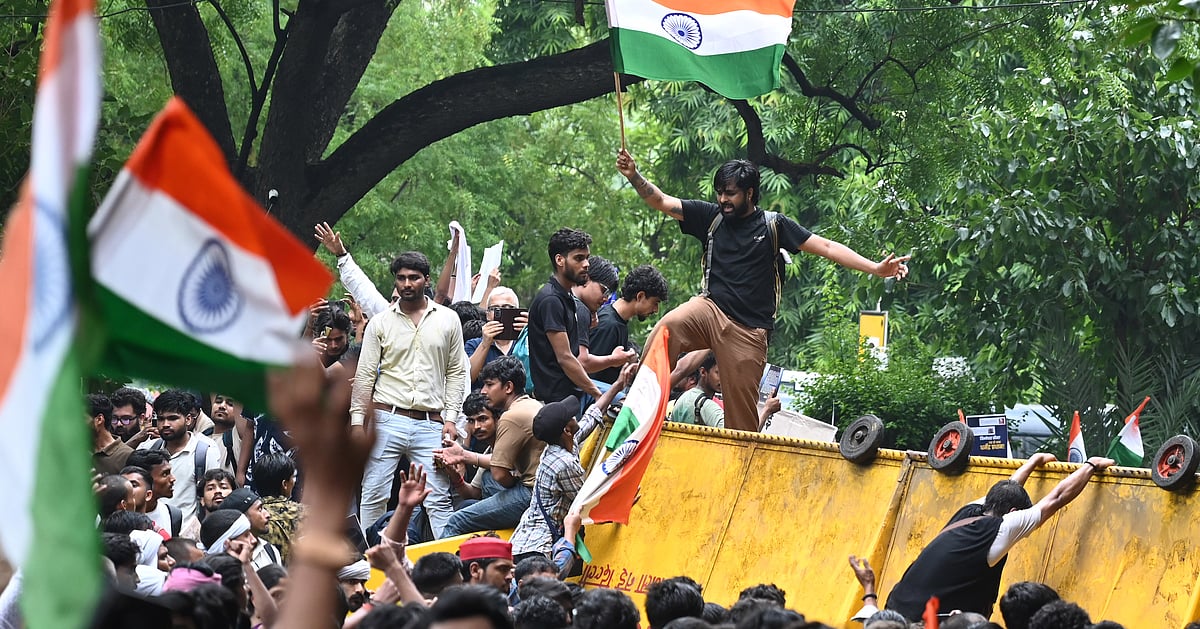
The ongoing agitation led by the Cockroach Janata Party (CJP), demanding accountability and sweeping reforms following the NEET examination paper leak, reached its peak with Monday’s “Chalo Parliament” march. In many ways, the movement evokes memories of the 2011 Anna Hazare movement.
At that time, the Jan Lokpal campaign against corruption, led by Anna Hazare, became a symbol of public outrage across Delhi and the rest of India. Rooted in the Gandhian tradition of non-violent satyagraha, it sought the establishment of an independent Lokpal institution to investigate corruption in public life impartially. The current movement, meanwhile, has succeeded in mobilising young people across the country around the issue of the NEET examination scandal.
Historically, however, the state’s response to mass movements has often been marked by indifference and neglect. The same pattern was evident during protests against demonetisation, the Citizenship (Amendment) Act (CAA), the farmers’ movement, and the wrestlers’ protests.
Rather than addressing the concerns of protesters through dialogue, successive governments have generally preferred to keep their distance. Anna Hazare drew upon the Gandhian tradition of satyagraha, portraying his campaign against a corrupt political system as India’s “second freedom struggle.”
Mass movements gain broad public support only when different sections of society provide them with moral and social legitimacy. The Anna movement received backing from retired judges, academics, former military officers, and other respected members of civil society, which lent the campaign considerable credibility. At the same time, in the early years of social media, educated middle-class youth joined the movement in large numbers, transforming it into a nationwide public mobilisation.
A closer examination reveals that large-scale political mobilisation is an essential feature of democratic protest. Mahatma Gandhi transformed protest through satyagraha into not merely a means of expressing dissent but an effective instrument of social change. According to Gandhi, every movement of resistance must be built upon three essential elements: purpose, commitment, and impact. In other words, satyagraha should be thoughtful, organised, and based on clear demands. This explains why Gandhian influence continued to shape collective movements even after India gained independence.
Although electoral politics became the principal foundation of democratic politics in independent India, political parties did not abandon social movements. Elections were viewed merely as one avenue for broader social transformation. During the 1970s, the politics of protest entered a new phase. Movements against displacement, struggles by Dalits and Adivasis for equality and dignity, and women’s campaigns against patriarchal oppression fundamentally altered both the direction and character of public movements in India.
The anti-Emergency movement of the same period paved the way for the formation of numerous organisations dedicated to protecting civil liberties. Jayaprakash Narayan’s movement against Indira Gandhi’s authoritarian policies emerged as one of the most significant popular mobilisations against state power. Its defining feature was that it was not the movement of any political party. During this period, protest acquired a broader meaning. Movements were no longer confined to expressing dissent; they became powerful instruments for public awareness and mass mobilisation.

The 1990s marked another turning point in the politics of public movements. It witnessed the rapid expansion of grassroots non-governmental organisations (NGOs), which opened new avenues for non-partisan social intervention. Rather than replacing mass movements, these organisations created platforms for dialogue on a wide range of social issues, enabling the participation of diverse stakeholders.
Gradually, however, traditional mass movements began to lose some of their capacity for broad public mobilisation. This transformation also benefited organisations such as the Vishva Hindu Parishad (VHP), which established a stronger presence within the social sphere.
Political analysts argue that the most significant difference between India of the 1970s and 1980s and India in 2026 lies in the changing basis of political legitimacy. In earlier decades, political scandals seriously undermined the legitimacy of governments because they were widely viewed as violations of established democratic norms. Today, however, the foundations of political legitimacy have undergone a substantial transformation.
During the Narendra Modi government, liberal developmentalism has increasingly given way to Hindu nationalism as the principal source of political legitimacy. This shift found symbolic expression during the inauguration of the Ram Temple on January 24, 2024, when Rashtriya Swayamsevak Sangh (RSS) chief Mohan Bhagwat described the occasion as India’s “real Independence Day.” One consequence of this transformation has been the gradual marginalisation of the social and economic dimensions of public movements.
In an environment shaped by a new definition of nationalism, public discourse on unemployment, underemployment, labour rights, the agrarian crisis, child malnutrition, and other fundamental issues has become comparatively weaker. Since resistance to the political establishment is often viewed with suspicion, the everyday concerns of ordinary citizens have increasingly receded into the background.

Send your resume:
biswa@jigyasu.co.in
krcfoundation@gmail.com
Voices raised against livelihood-related problems and what critics describe as the government’s pro-corporate policies have also faced sustained pressure. As a result, policies perceived to favour the country’s more privileged sections have not always been subjected to the level of public debate they might otherwise have attracted.
Clearly, citizens’ rights are more important than any religious identity or religious belief. Yet growing authoritarian tendencies have steadily narrowed the space for public discussion on issues relating to livelihoods and social justice. At the same time, the opposition has found limited opportunities to effectively raise concerns regarding institutional autonomy, the centralisation of power, and the shrinking democratic space for dissent.
Mahatma Gandhi firmly believed that the last person in society should be an active participant in the development process so that the state would remain sensitive to that individual’s needs and concerns. Yet it must also be acknowledged that as long as Hindu nationalism remains the principal source of the Indian state’s political legitimacy, the balance of dialogue between the state and society is likely to remain uneven.
If mass movements are to regain their effectiveness and if the economic and social concerns of ordinary people are to return to the centre of national discourse, this situation will need to change. The struggles waged by social reformers such as Jayaprakash Narayan, Anna Hazare, Baba Amte, and Medha Patkar, inspired by Gandhian ideals of social transformation, will continue to serve as enduring sources of inspiration in the history of Indian democracy.
Their vision of decentralised popular struggle, equality, and an inclusive society remains relevant for future generations. In a democratic system-particularly one as vast and diverse as India-the central focus of politics should be the people and their real-life concerns, rather than issues that divert attention from pressing social, economic, and environmental challenges.
At such a moment, the younger generation has a responsibility to carry forward the tradition of democratic mass movements and ensure that the genuine concerns of society occupy the centre of national debate. In this context, the current CJP movement may be seen as a fresh initiative in that direction