

An Integrated Strategy Is the Need of the Hour
 KRC TIMES Desk
Dhurjati Mukherjee
The nature and scale of disasters around the world are becoming increasingly alarming. Millions of people are being affected by them. The recent tragedy of a glacial flood in Nepal is a fresh and deeply disturbing example. The disaster was so severe that, according to Nepal’s disaster response agency, the death toll reached around 788, while more than 2,500 people were reported missing. Around 275 of them are believed to be Indians. It has been reported that the disaster began when a glacial lake formed after a landslide burst. A review of satellite images by The New York Times indicated that the lake’s natural dam had broken, unleashing a massive torrent of water that caused widespread devastation.
Scientists at the International Centre for Integrated Mountain Development (ICIMOD) estimate that the movement of large quantities of ice and rocky debris generated an extremely powerful flow of water, sediment and huge boulders downstream. Similar incidents have occurred in the Himalayas in the past. This brings back memories of the 2021 Chamoli tragedy in Uttarakhand, when a massive avalanche of rock and ice suddenly turned into a flash flood. Around 200 people were killed and two hydropower projects were destroyed in that disaster.
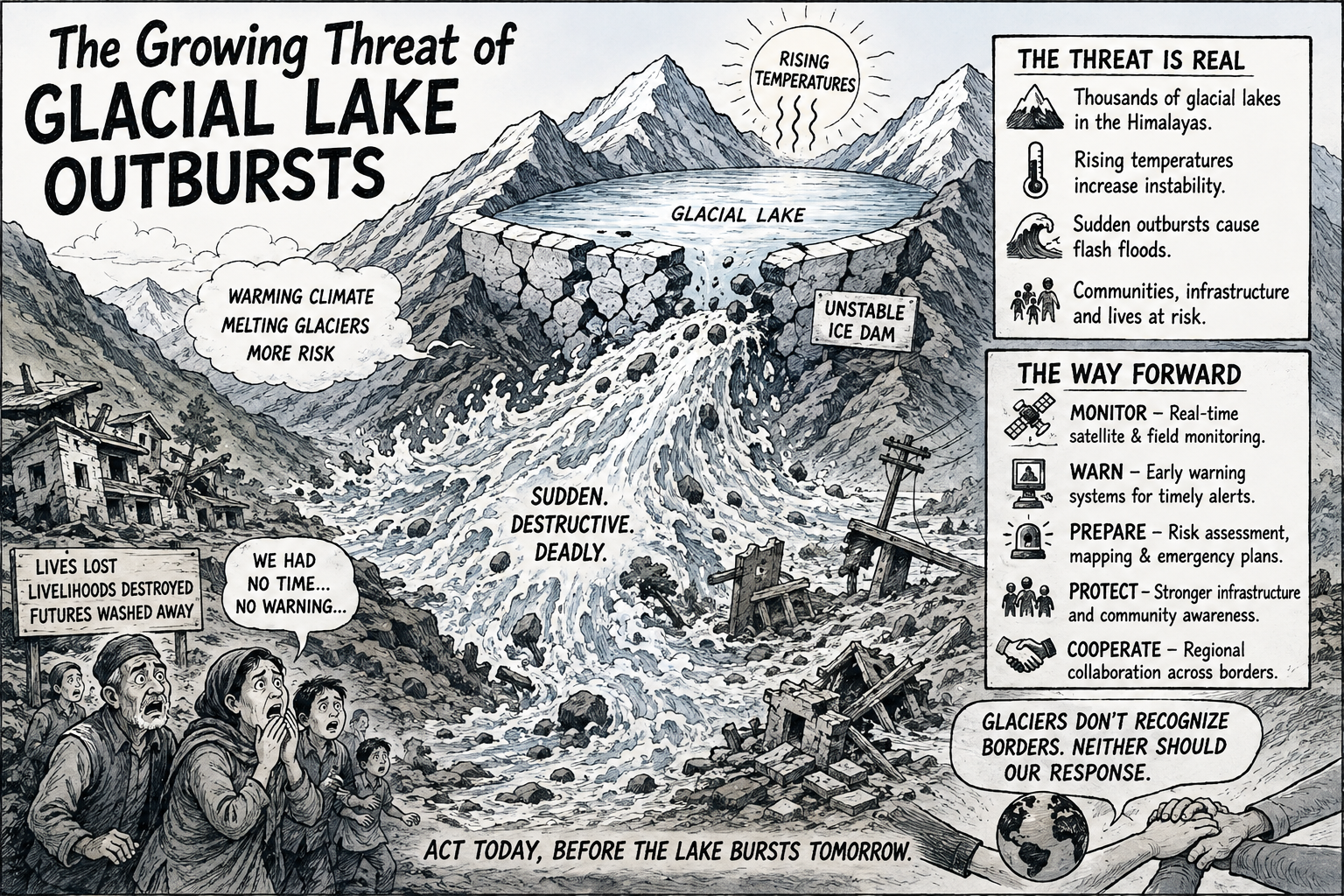
According to geologists, rock-and-ice avalanches are particularly dangerous because they can trigger an entire chain of events. Experts say that rising temperatures are further increasing the instability of high-altitude mountain regions.
Geologists believe that the sudden floods in Nepal and Tibet were triggered by a series of landslides and avalanches at high altitudes, which sent huge volumes of water rushing downstream. Disaster experts say that such events are extremely difficult to predict. Moreover, the sudden collapse of a lake or ice dam occurs so rapidly that there is often very little time to issue an advance warning.
Available data indicate that Nepal has 2,070 glacial lakes, of which 21 were classified as high-risk lakes in a 2020 report by the International Centre for Integrated Mountain Development. There are also numerous such lakes in the Himalayan regions of China and India. Between 1900 and 2000, a total of 135 glacial lake outburst flood (GLOF) events were recorded in the Karakoram region, while around 85 such incidents have already occurred in the present century.
Approximately 22,800 square kilometres of the Himalayas are covered by glaciers. This region is warming faster than the planet as a whole. As a result, the likelihood of such floods is increasing in the future. Rising temperatures and changes in rainfall patterns are accelerating this process. This is why such incidents are generally more common between June and August. Scientists estimate that a large number of glaciers will melt rapidly in the coming years, and according to some assessments, nearly 65 per cent of the region’s ice reserves could disappear by 2100.

In such a situation, around one million people living within a 10-kilometre radius of glacial lakes face an increasing disaster risk. They therefore need to be relocated to safer areas away from narrow river valleys. Greater caution is also required while undertaking infrastructure projects in mountainous regions.
The Intergovernmental Panel on Climate Change’s Special Report on the Ocean and Cryosphere needs to be taken seriously. The report warns that, as temperatures rise, glacial lake outburst floods could occur more frequently. This is because the same warming that is causing glaciers to shrink is also increasing the amount of water in lakes beneath and around them, while making these lakes increasingly unstable.
According to an assessment by the Indian Institute of Tropical Meteorology, between 1951 and 2024, average southwest monsoon rainfall over the Gangetic plains declined by around 0.5 millimetres per day per decade. This indicates a clear trend towards increasing dryness across the region, including Bihar. However, this does not mean that episodes of heavy rainfall are becoming less frequent. On the contrary, despite the decline in average monsoon rainfall, precipitation is occurring in shorter, more intense and highly concentrated spells.
In the Indian context, it is noteworthy that India records the highest number of deaths from GLOF events such as those witnessed in Nepal. Experts from a global group comprising specialists from six or seven countries have also drawn attention to this. A study titled Glacial Outburst Flood Risk, Response Strategies and Adaptation in the Hindu Kush Himalayan Region analysed data from 1995 to 2025. According to the study, China recorded 199 GLOF events, Pakistan 152, India 62 and Nepal five.
The study rightly highlights that climate-related factors-particularly the rapid rise in temperatures since the beginning of this century-have played a significant role in increasing the frequency of such avalanches. It also points out that the predominance of moraine- and ice-dammed lakes in the Hindu Kush Himalayan region is a major reason behind GLOF events and the deaths they cause. The inherent instability of such natural dams in a warming climate is a matter of serious concern.
Today, we have access to satellite-based monitoring, which puts us in a much better position than before. However, as experts have made clear, accurately predicting such events remains difficult. Nevertheless, countries connected to mountainous and glacial regions-such as China, Pakistan, Nepal and Bhutan-must establish better coordination to ensure the safety of people across borders. Unfortunately, effective coordination of this kind has not yet been achieved.
Under India’s National GLOF Risk Mitigation Programme, 195 glacial lakes have been identified as high-risk lakes. The programme has five key priorities: risk assessment, monitoring, early warning, risk mitigation and community awareness. A high-level coordination committee has also been constituted to reduce GLOF risks.

In October 2023, around 14.7 cubic metres of rocky debris fell into South Lhonak Lake in Sikkim, generating a displacement wave nearly 20 metres high. The wave destroyed several hydropower assets and settlements located downstream. Subsequently, the Government of India took a positive step by allocating Rs 150 crore under the National GLOF Risk Mitigation Programme for four Himalayan states with high-risk glacial lakes.
The government has begun paying attention to the threat posed by glacial lake outbursts, but the Sikkim tragedy, the subsequent Chamoli incident in 2025, and the recent disaster in the neighbouring country provide serious lessons that must be learned. Equipment capable of transmitting real-time data directly to monitoring centres should be installed to continuously monitor glacial lakes and glaciers in mountainous regions. In addition, artificial intelligence (AI)-based systems can be used to detect changes in glaciers and prepare their risk profiles. Several countries around the world have already adopted such systems.
Experts warn that if safety measures are not strictly implemented and populations at risk are not relocated to safer areas, a disaster on a much larger scale could strike the region. It would be advisable to rehabilitate vulnerable populations in safe areas at least 5 to 10 kilometres away from glaciers and glacial lakes.
The time has come to develop an intergovernmental mechanism involving India, Bhutan and Nepal and, if possible, China as well. Its objective should be to establish a long-term, coordinated strategy for continuous monitoring of glaciers, risk assessment, and preventing GLOF events or reducing their impact.
Glaciers and glacial lakes do not recognise national boundaries. Therefore, this shared natural risk can only be confronted through cooperation that extends beyond borders. Regional cooperation, real-time data sharing and effective early-warning systems are no longer options; they are necessities.