


The timing is significant. India and the United States have been negotiating trade arrangements amid disagreements over tariffs, market access, agriculture and industrial protection
 KRC TIMES Desk
Ruchi Mehta
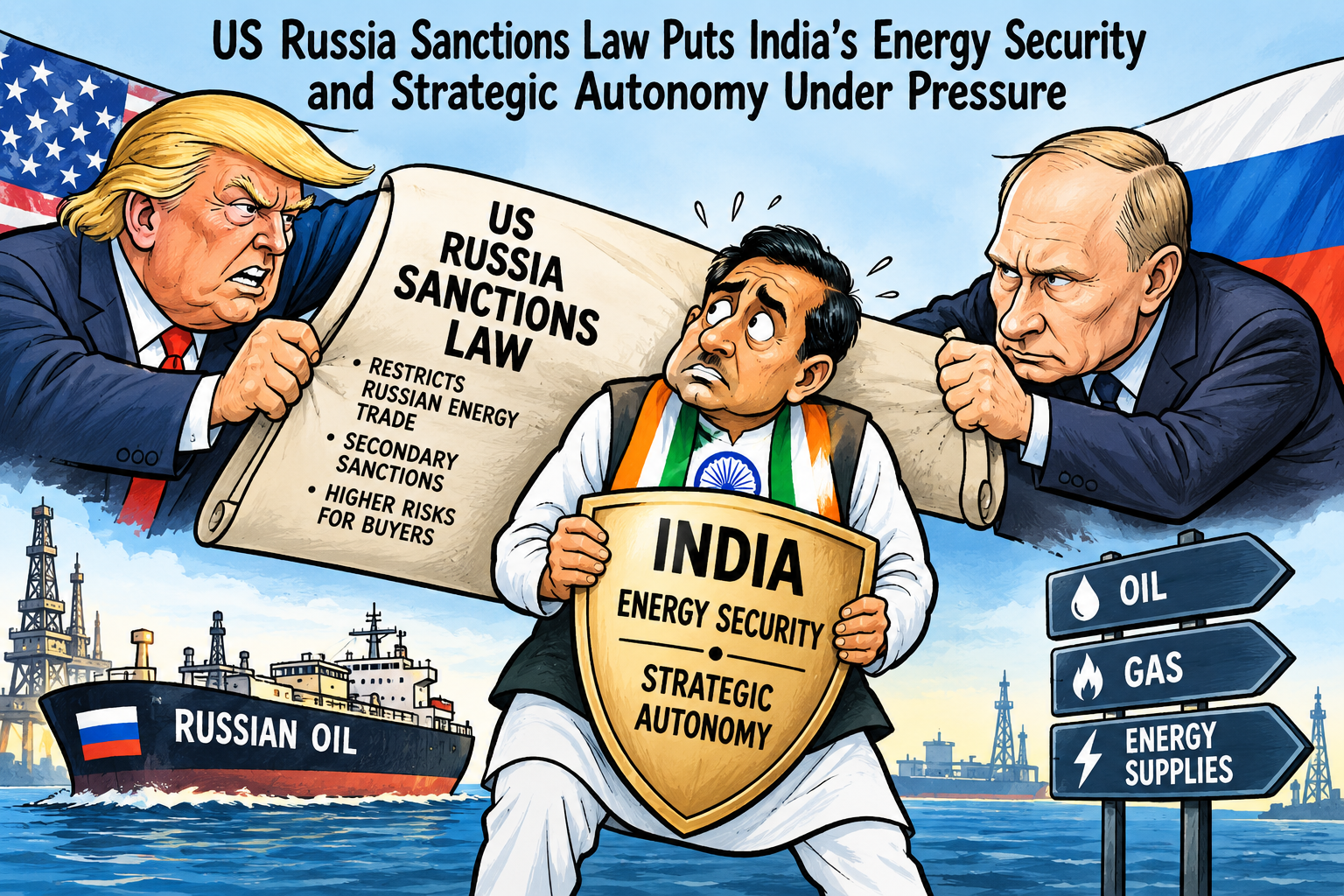
The United States’ latest Russia sanctions law has opened a new front in its economic and geopolitical relationship with India, with Washington now possessing a statutory route to impose tariffs of up to 100 per cent on countries that continue to purchase Russian energy under specified conditions. For New Delhi, the issue goes beyond trade. It touches energy security, strategic autonomy and the extent to which one country can use access to its market to influence another country’s foreign-policy choices.
US President Donald Trump signed the Lindsey O. Graham Sanctioning Russia and Iran Act of 2026 into law on September 18, after it passed the Senate 86-11 and the House of Representatives 262-159. The White House said the law expands statutory sanctions, tariffs and prohibitions targeting Russia and extends existing sanctions on Iran.
The law does not automatically impose a 100 per cent tariff on Indian goods. Instead, it gives the US administration expanded authority to impose punitive duties on countries meeting specified criteria related to purchases of Russian crude oil and natural gas. This distinction is important because the actual impact on India will depend on how the Trump administration implements the law.
India has already indicated that it will protect its energy, trade and economic interests. New Delhi has maintained that its crude purchases are guided by energy-security requirements, market conditions and supply availability, rather than by political endorsement of Russia’s actions in Ukraine.
That position reflects a broader principle of Indian foreign policy: strategic partnerships with the United States need not require abandoning long-standing relationships with Russia or accepting the automatic extraterritorial application of US sanctions.
The economic stakes are substantial. According to data cited by the Global Trade Research Initiative, Russia accounted for 30.3 per cent of India’s crude-oil imports in financial year 2025-26, with purchases worth about $40.8 billion out of total crude imports of $134.7 billion. Russian supplies rose further during 2026, accounting for more than half of India’s imported crude in July, according to GTRI-based estimates.

The importance of Russian crude has increased because Indian refiners have been able to obtain supplies at competitive prices amid disruptions in global energy markets. The conflict in West Asia has added another layer of uncertainty, making the availability, cost and transportation of crude particularly sensitive issues for a major energy-importing economy such as India.
Replacing Russian supplies would therefore not be an overnight exercise. India has several alternative suppliers, including Saudi Arabia, Iraq, the United Arab Emirates, the United States, Brazil and Venezuela. But switching sources on a large scale could alter procurement costs, shipping patterns and refinery economics.
The consequences could extend beyond the oil sector. If Indian goods face substantially higher US tariffs, exporters could come under pressure across a range of industries, including textiles, engineering products, chemicals, pharmaceuticals and smaller manufacturing units. Such a development would add another complication to already difficult India-US trade negotiations.
The timing is significant. India and the United States have been negotiating trade arrangements amid disagreements over tariffs, market access, agriculture and industrial protection. The new Russia sanctions law introduces another source of uncertainty into those discussions. Washington now has a statutory instrument through which access to the US market can potentially be used as leverage over countries maintaining significant energy ties with Moscow.
At the same time, the legislation reflects a larger US objective: reducing the revenue available to Russia from energy exports and increasing the economic cost of its war in Ukraine. Supporters of the law have argued that stronger sanctions and tariff powers can increase pressure on Moscow and its international partners. The administration has also described the tariff authority as a tool to encourage a negotiated resolution to the conflict.
The policy, however, carries potential complications for the global oil market. If Indian purchases of Russian crude are sharply reduced, the displaced Russian barrels will not necessarily disappear from the international market. They could be redirected to other buyers through alternative trading networks. At the same time, restrictions on supply could contribute to higher global oil prices, potentially increasing costs for consumers and import-dependent economies.
For India, the central challenge is consequently to balance three interests: maintaining affordable and reliable energy supplies, protecting access to important export markets and preserving room for independent foreign-policy decisions.

China’s position makes the situation even more consequential. Beijing is also a major buyer of Russian energy and is therefore exposed to the same broader US strategy. The law consequently has implications beyond the India-US relationship. It raises a wider question about the ability of Asian economies to determine their energy sources while remaining deeply integrated into the US-led financial and trading system.
For New Delhi, the immediate response is likely to involve diversification rather than an abrupt rupture with Moscow. India can increase purchases from other producers when commercial conditions make that viable while continuing to assess the costs and risks associated with Russian supplies.
Such diversification would be consistent with India’s longstanding effort to avoid excessive dependence on any single supplier or geopolitical bloc. But there is an important difference between diversification driven by market conditions and a forced reduction imposed through external tariff pressure.
The dispute could also affect the broader India-US strategic relationship. The two countries have expanded cooperation in defence, technology, trade and the Indo-Pacific, partly in response to their shared concerns about China. Pressure over Russian energy creates a difficult contradiction: Washington seeks closer strategic alignment with New Delhi while simultaneously placing pressure on an area in which India has repeatedly asserted independent decision-making.
The new law therefore represents more than another chapter in the sanctions regime against Moscow. It tests the limits of economic statecraft in an increasingly fragmented global economy.
India is unlikely to view the issue solely through the lens of Russia. For New Delhi, the larger question is whether its energy policy can remain based on domestic requirements, market conditions and national interest without being dictated by external sanctions.
The coming months will show how aggressively Washington uses the new powers and how India responds. The outcome could influence crude-oil flows, export costs, bilateral trade negotiations and the broader trajectory of India-US relations.
Ultimately, the dispute is about the intersection of energy security, trade pressure and strategic autonomy. The United States wants to increase the economic pressure on Russia; India wants to secure affordable energy while retaining an independent foreign policy. How those two objectives are managed will determine whether the latest sanctions law becomes a temporary point of friction or a deeper challenge to the India-US relationship.