

The report identifies India’s eastern borders as the most vulnerable entry points for narcotics originating from this expanding production zone
 KRC TIMES Assam Bureau
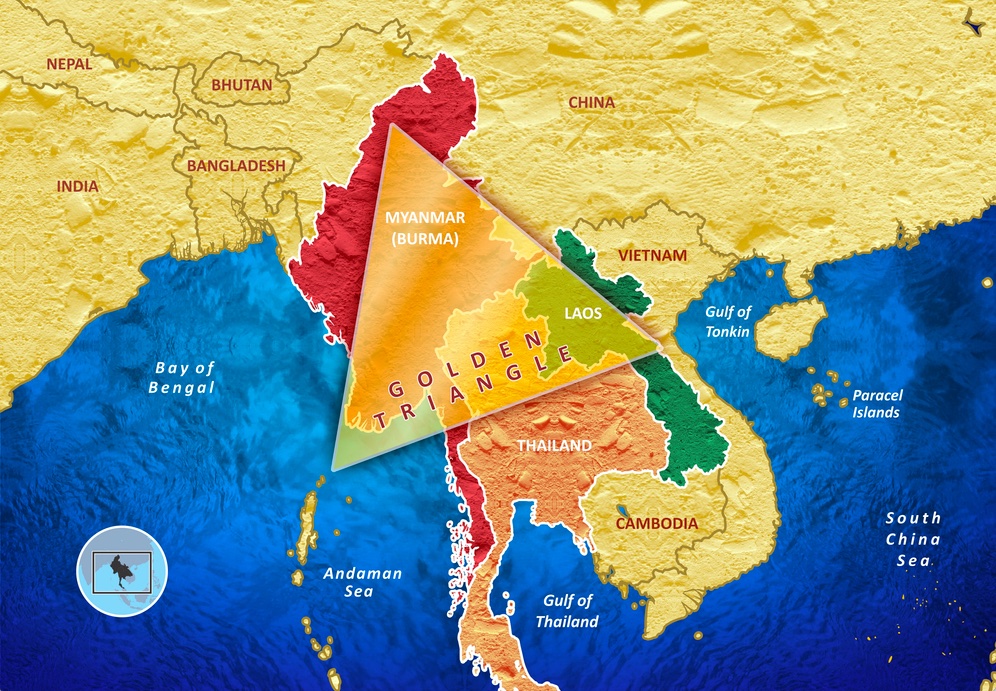
NEW DELHI/GUWAHATI | India’s northeastern region is facing a growing narcotics challenge as drug trafficking networks linked to the Golden Triangle expand their operations, with Assam emerging as the leading state in opium seizures, according to the Narcotics Control Bureau’s (NCB) Annual Report 2025.
The report, released on Friday, indicates a significant shift in global narcotics trafficking patterns, with the Golden Triangle-covering parts of Myanmar, Laos and Thailand-overtaking the Golden Crescent as the primary source of illicit drugs entering India.
The NCB noted that while opium cultivation in the Golden Crescent region, comprising Afghanistan, Iran and Pakistan, has witnessed a dramatic decline, Myanmar has recorded a sharp increase in illicit poppy cultivation, creating new challenges for India’s eastern frontier.
According to the report, Afghanistan’s illicit opium cultivation dropped from nearly 2,33,000 hectares in 2022 to around 10,000 hectares in 2023. In contrast, Myanmar saw a 56 per cent increase in opium cultivation between 2021 and 2023, expanding from 30,200 hectares to 47,100 hectares.
The report identifies India’s eastern borders as the most vulnerable entry points for narcotics originating from this expanding production zone.
Reflecting this trend, Assam recorded the highest opium seizures among all northeastern states during 2025. Authorities seized 371 kilograms of opium in the state, while morphine seizures reached 46.51 kilograms, second only to Manipur’s 139.95 kilograms.

Know More | Apply Here
The state also registered the seizure of 152 kilograms of amphetamine-type stimulants (ATS) and one kilogram of cocaine, underscoring the presence of multiple trafficking routes and networks operating through Assam.
The report highlights distinct trafficking patterns across the Northeast. While traditional narcotics such as opium and morphine continue to dominate seizures in Assam and Manipur, synthetic drugs are increasingly flowing through Mizoram and Tripura.
Mizoram emerged as the country’s largest ATS interception state, accounting for 1,477 kilograms of ATS seizures-approximately 42 per cent of the national total of 3,485 kilograms. Manipur recorded 535 kilograms of ATS seizures, while Tripura reported 129 kilograms.
Elsewhere in the region, Arunachal Pradesh seized 27 kilograms of opium, Nagaland recovered 16 kilograms, and Meghalaya reported 25 kilograms of ATS.
The NCB observed that India’s ATS seizures have surged by 140 per cent between 2020 and 2025, with 8.2 tonnes of synthetic drugs confiscated in 2024 alone. The agency described the rise as a clear indicator of the evolving nature of drug trafficking networks operating along the eastern border.
“India’s eastern borders at present are the most direct and porous entry point for this expanding production base,” the report noted, warning that the growing volume of synthetic drugs represents a serious security and law-enforcement challenge.
The report identified Manipur, Mizoram and Nagaland as states facing the greatest frontline exposure due to their proximity to Myanmar and the existence of difficult-to-monitor border stretches.

According to the NCB, porous border mechanisms, including the erstwhile Free Movement Regime (FMR) along the India-Myanmar border, have enabled drug syndicates to transform these states from transit points into active staging grounds for narcotics distribution across the country.
The report also mapped key trafficking corridors used by organised criminal networks.
One of the most significant routes is the Champhai corridor in Mizoram, which borders Myanmar’s Chin State. Narcotics entering through this route are transported through Aizawl and adjoining road networks before reaching Silchar in Assam’s Barak Valley.
From Silchar, consignments are moved onward through Meghalaya to Guwahati, which the report identifies as an increasingly important distribution hub for the Indian hinterland.
Another major trafficking route passes through Manipur, where National Highway-102 serves as a critical land corridor for heroin and methamphetamine tablets entering India from Myanmar.
The findings underscore the growing strategic importance of the Northeast in India’s anti-narcotics efforts and highlight the need for enhanced border surveillance, inter-state coordination and intelligence-driven operations to counter increasingly sophisticated trafficking networks operating from the Golden Triangle region.