Assam CM says Silchar ambulance was held for 30 seconds, denies link to patient’s death
 KRC TIMES Barak Valley Bureau
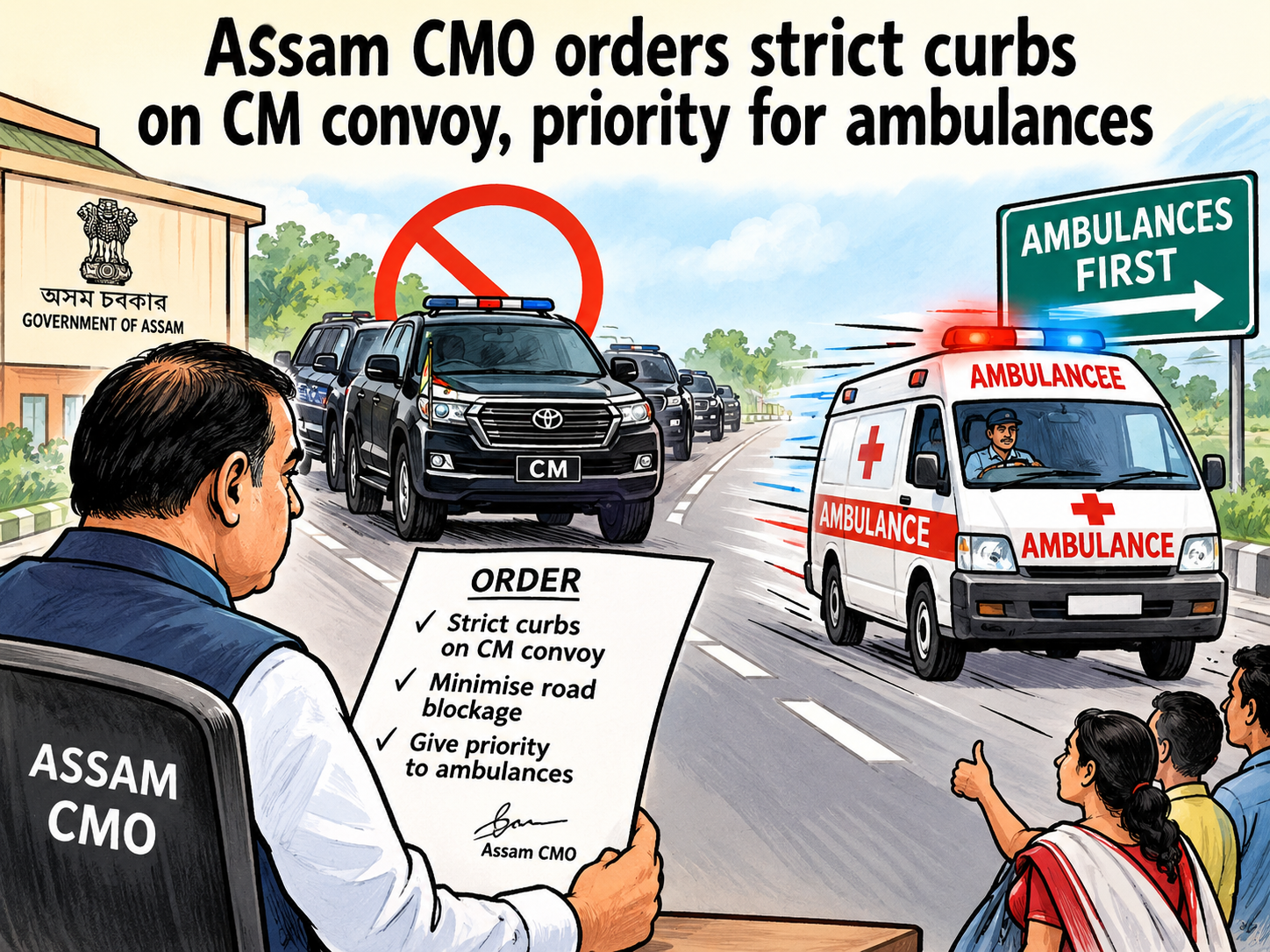
Silchar | The Assam Chief Minister’s Office (CMO) has reiterated strict instructions to district administrations and police to ensure that the Chief Minister’s convoy does not obstruct ambulances, fire tenders or other emergency vehicles.
The directions, issued on September 30 and reiterated on October 1, came a day after an ambulance carrying a patient was stopped in Silchar to allow Chief Minister Himanta Biswa Sarma’s convoy to pass. Four police personnel were subsequently suspended for alleged negligence of duty, while Sarma apologised to the patient and the family and termed the incident “unacceptable”.
According to the CMO order, district commissioners and senior superintendents of police have already been instructed to ensure that VIP convoy arrangements do not interfere with emergency services.
“It is once again emphasised that under no circumstances should the movement of ambulances or other emergency vehicles be impeded on account of VIP carcade arrangements,” the order stated.
The CMO directed officials to ensure that emergency vehicles receive unhindered passage during VIP movements. If necessary, the Chief Minister’s convoy should be stopped to allow such vehicles to pass immediately.

“Emergency vehicles, particularly ambulances, fire tenders and police response units, must be given unhindered passage at all times, irrespective of convoy movement,” the order said. The instructions also seek to minimise disruption to normal traffic and reduce inconvenience to the public during the Chief Minister’s movement.
Officials responsible for traffic and security arrangements have been asked to personally monitor compliance and ensure accountability for any lapse.
CM convoy to be kept to minimum
The CMO has also ordered that the Chief Minister’s convoy be restricted to the minimum number of vehicles required for security and essential operational purposes.
Ministers, MLAs, government officials and other dignitaries attending the same programmes as the Chief Minister have been directed not to join or travel alongside his convoy. Their vehicles must either reach the destination beforehand or proceed separately after the Chief Minister’s convoy has passed.
The directions have been issued as standing instructions and circulated among subordinate officials for strict compliance. The order warned that any deviation would be viewed seriously. In a social media post, the CMO said the instructions had been reiterated following the Chief Minister’s directions after the Silchar incident. It also said the convoy had been “curtailed to a minimum compliant with security needs”.
The Silchar incident has thus prompted a renewed emphasis by the Assam government on balancing VIP security arrangements with uninterrupted movement of emergency services and routine traffic.
Assam Chief Minister Himanta Biswa Sarma on October 1 said an ambulance carrying a critically ill patient in Silchar was stopped for no more than 30 seconds to allow his convoy to pass, and maintained that the brief halt was unrelated to the patient’s subsequent death.
“The patient was suffering from a liver ailment and the ambulance did not stop for more than 30 seconds, so both do not have any relation,” Sarma said while responding to questions about the incident that triggered widespread criticism across the state.
The remarks came after Rasuraj Chakraborty, a resident of Bangar in Sribhumi district, died at Silchar Medical College and Hospital on the morning of October 1. Chakraborty, who was suffering from a liver-related ailment, had been brought to the hospital after his condition reportedly deteriorated.