


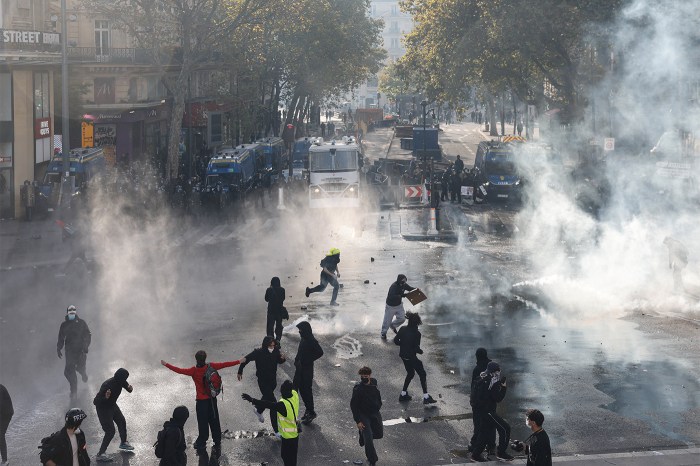
Police used tear gas and water cannons to disperse crowds, while incidents of looting, arson and attacks on public property were reported in several locations
 KRC TIMES Desk
France is once again witnessing the power of street protests to bring the country’s political and economic fault lines into sharp focus. What began in late September with thousands of high school students taking to the streets over teacher shortages and deteriorating school buildings has evolved into a wider movement against the rising cost of living, mounting economic pressures and uncertainty over the country’s future.
The protests spread from Marseille in southern France to Paris and other parts of the country. Clashes between demonstrators and riot police soon followed. The government accused the far-left party France Unbowed, led by Jean-Luc Mélenchon, of encouraging the agitation. Yet, despite acknowledging the poor condition of many secondary schools, particularly the shortage of teachers, the authorities struggled to offer a convincing response to the students’ grievances.
By mid-October, the movement had broadened considerably. Workers and other sections of society joined the demonstrations, turning a dispute over public education into a wider expression of economic discontent. Police used tear gas and water cannons to disperse crowds, while incidents of looting, arson and attacks on public property were reported in several locations.
Cars were set ablaze in Paris, shops were looted and municipal buildings, including historic town halls, came under attack. The violence has complicated the political message of the protests. President Emmanuel Macron, whose second and final term is due to end in May 2027, condemned the destruction in a televised address.
While public anger may have legitimate causes, he argued, it cannot justify arson and looting. Far-right leader Marine Le Pen, a potential presidential contender, also criticised the violence, insisting that destruction cannot be treated as a form of political expression. The distinction matters.
A government’s failure to address public grievances can explain the growth of popular anger, but it does not legitimise attacks on people or property. Equally, condemning violence cannot substitute for confronting the economic and social problems that have brought people onto the streets.
A long tradition of protest Street demonstrations have deep roots in French political history. The French Revolution of 1789 established the popular uprising as a powerful symbol of resistance to political authority. The storming of the Bastille on July 14 that year, now commemorated as France’s national day, remains central to the country’s political imagination.

That revolutionary legacy continues to influence the language of protest. During the recent demonstrations, a protester in Marseille reportedly invoked the Bastille as demonstrators forced their way into a mayoral office. Such references reflect the enduring appeal of revolutionary symbolism, although contemporary economic grievances cannot simply be equated with the struggle against the monarchy Student movements, too, have repeatedly challenged French governments.
The protests of May 1968 remain a defining moment in the country’s modern political history. Subsequent demonstrations by school students in 1990, 1998 and 2006 reinforced the tradition of youth-led resistance. The 2006 student movement proved particularly consequential. Demonstrations against a controversial employment law, which would have made it easier for employers to dismiss young workers during an initial period of employment, forced the government to withdraw the measure.
That episode remains a reminder that sustained public mobilisation can compel political leaders to reconsider policies even after they have passed through the legislative process. The current protests, however, are driven by a broader set of concerns. The grievances extend beyond education to the everyday pressures facing households, workers and farmers. Their common thread is the perception that the existing political and economic system is failing to provide security or a credible path towards improvement.
The widening gap between national pride and economic reality France occupies a distinctive place in the European imagination. Its history as a colonial power, its cultural influence and its longstanding claims to intellectual and artistic leadership have shaped a strong sense of national identity. Yet that historical prestige sits uneasily alongside the economic difficulties confronting many French citizens.
The country faces persistent challenges across several sectors, including agriculture, services and manufacturing. French farmers have demanded protection against competition from agricultural imports within the European Union, while businesses and workers face pressure from changing market conditions and the cost of maintaining established living standards.
Even the fashion industry, traditionally associated with French luxury and global influence, faces intense international competition, including from Italian brands. The contrast between national expectations and economic realities has contributed to public frustration. For many people, France’s international standing offers little comfort when household expenses rise, employment prospects remain uncertain and public services appear unable to meet basic needs.
There is also a growing perception that economic hardship is distributed unequally. Protesters believe that wealthier sections of society are better placed to absorb rising costs, while ordinary households struggle to maintain their standard of living. Whether expressed through demands for better schools, higher wages or more affordable essentials, the underlying complaint is that economic growth and national prosperity are not translating into a sufficient sense of security for everyone.

Economic pressures and an unresolved political crisis The country’s economic indicators underline the scale of the challenge. The figures cited in the debate include an unemployment rate of around 8.2 per cent and a budget deficit exceeding 5 per cent. At the same time, France’s extensive welfare system, particularly its pension commitments, places substantial demands on public finance Reforming the pension system has repeatedly proved politically explosive.
Attempts to rationalise expenditure or change retirement arrangements encounter strong resistance from citizens who regard social protection as a defining achievement of the French model. For many workers, pensions represent not merely a budgetary obligation but a promise of security after decades of employment. This creates a difficult dilemma for successive governments. Public finances require greater discipline, but measures intended to contain expenditure can provoke opposition from people who already feel economically vulnerable.
Without a convincing explanation of how reforms will distribute costs fairly and protect lower-income households, even technically defensible policies can become politically untenable. The agricultural sector presents a similar problem. Farmers want protection from imports and stronger safeguards for their livelihoods, while France must operate within the rules and competitive framework of the European Union. Reconciling domestic demands with broader European commitments is a difficult task, particularly when economic pressures are already fuelling public resentment.
Political fragmentation makes these chal lenges harder to manage. France’s traditional divide between the left and the right has widened into a more complicated contest involving the far left, centrists, conservatives and the far right. No political formation has secured the decisive parliamentary strength needed to impose a coherent programme without negotiating with others. The result is a system of uneasy alliances and competing priorities.
Centrist and conservative groups have struggled to find common ground with the left, while cooperation with the far right remains politically contentious. Govern ments are consequently vulnerable to parliamentary resistance, policy reversals and public dissatisfaction. The far right gains, but offers no easy answer The political uncertainty has created opportunities for Marine Le Pen’s National Rally, which has consolidated its position as a major force in French politics.
The party can capitalise on anger over living costs, immigration, public services and the perceived failure of established parties.Yet the rise of the far right does not automatically translate into a solution to France’s economic problems. National Rally faces the same fundamental questions as its rivals: how to reduce the deficit, sustain the welfare state, protect workers and farmers, improve public services and restore confidence in the economy. Political rhetoric may provide a clear target for public anger, but governing requires difficult choices.

A party that promises protection from economic insecurity must still explain how it intends to finance that protection and reconcile competing demands on public resources. The coming presidential contest will therefore be shaped not only by dissatisfaction with Macron’s government but also by the credibility of the alternatives. Voters may be increasingly willing to punish established political forces, yet dissatisfaction alone cannot produce a workable economic programme.
The latest protests reveal a crisis that cannot be reduced to public disorder or attributed solely to political agitation. The original complaints about teacher shortages and deteriorating school buildings have opened a window into wider anxieties over employment, living costs, inequality and the future of France’s social contract The government has a responsibility to restore public order and prevent violence.
But it must also demonstrate that the concerns expressed by students, workers and farmers are being heard. Improving schools, strengthening public services, addressing the pressure on household budgets and explaining the costs and benefits of economic reforms would be more meaningful responses than treating the demonstrations merely as a law-and-order problem. The protesters, for their part, face a similar challenge. Sustained public pressure can force governments to respond, as previous student movements have demonstrated.
But violence and destruction risk alienating potential supporters and allowing political leaders to focus on disorder rather than the grievances behind it. The warning from student leader Ryad Rani captures the intensity of the mood. The head of the French high school student union said the government was trembling and argued that public anger would not easily subside. That anger is unlikely to disappear through force alone.
France’s streets are reflecting a deeper fear that the country’s economic future may be less secure than its citizens had expected. The protests are therefore not simply a recurrence of the country’s long tradition of revolutionary dissent. They are also a test of whether its political institutions can translate public frustration into credible reforms. For Macron’s government and the political forces preparing for the next presidential election, the central question is no longer how to contain the demonstrations. It is how to restore confidence in a system that many citizens increasingly believe is failing them.

