Under the new strategy, the government is seeking greater private investment in processing and distillation facilities close to production centres
 KRC TIMES Assam Bureau
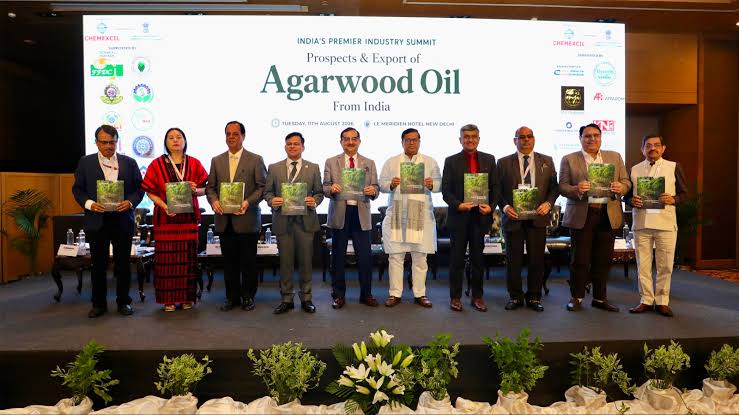
Guwahati | The Centre has unveiled a roadmap to transform the Northeast’s vast agarwood resources into a globally competitive industry, with emphasis on processing, technology, branding and exports rather than the supply of raw material to international luxury markets.
The roadmap was released at an industry summit on the prospects and export of agarwood oil from India, organised by the Ministry of Development of North Eastern Region (MDoNER) and CHEMEXCIL in New Delhi on August 11.
The Northeast accounts for more than 96 per cent of India’s estimated 139.89 million agarwood trees. Assam has around 114.3 million trees, while Tripura accounts for approximately 15.15 million. Agarwood is also cultivated and found in Manipur, Nagaland, Meghalaya and other northeastern states.
Under the new strategy, the government is seeking greater private investment in processing and distillation facilities close to production centres. It is also pushing for advanced extraction technologies, scientific cultivation, quality standards, traceability and origin-based branding to help the region capture a larger share of the high-value global oud and fragrance market.
Minister of State for DoNER Sukanta Majumdar urged industry stakeholders to invest in the sector, develop globally competitive brands and establish commercial partnerships in international markets.
In a message read out at the summit, DoNER Minister Jyotiraditya M. Scindia said the Northeast should move beyond its role as a supplier of raw agarwood and emerge as the “origin, the standard, the science and the brand of Indian agarwood”.

Send your resume:
biswa@jigyasu.co.in
krcfoundation@gmail.com
Scindia identified five key priorities for the sector: developing long-term market linkages with farmer producer organisations and clusters; expanding processing and distillation capacity in production areas; promoting technology partnerships; establishing standards, certification and traceability; and creating a strong global identity for Indian oud.
The broader objective is to ensure that a greater share of the economic value generated by agarwood remains with growers and local communities in the Northeast.
“Khushboo Bhi Humari Ho, Aur Naam Bhi Humara,” Scindia said, highlighting the government’s push to establish an Indian identity for agarwood in global markets.
The initiative comes as international demand for agarwood and oud oil continues to grow, particularly in Gulf markets. Demand for the products in premium fragrances is also expanding across Europe, the United States and East Asia.
The newly released Roadmap for Agarwood Export Promotion from the North Eastern Region aims to streamline export procedures, strengthen market linkages and facilitate regular and compliant trade in agarwood and its value-added products.
Several measures have already been initiated under the broader strategy. These include an increase in the agarwood export quota, digitisation of Certificates of Origin, resource mapping in Assam and Tripura, validation of inoculum suppliers, and efforts to establish geographical indication (GI) registration and standards for agarwood oil.
The government has also backed an Agarwood Cluster Development Project in Assam and Tripura under the PM-DevINE scheme, along with an Agarwood International Trade and Research Centre in Agartala under schemes of the North Eastern Council (NEC).
An Agarwood Export Promotion Cell, constituted in May this year, brings together the Ministry of Commerce and export promotion councils CHEMEXCIL and SHEFEXIL to facilitate exporters and develop international markets.
The Centre’s latest initiative marks a shift towards an industry-driven export strategy, with the Northeast being positioned not merely as a source of raw agarwood but as India’s key hub for production, processing, research and branding of agarwood and oud.