

The Kaziranga–Karbi Anglong landscape forms one of Northeastern India’s most critical contiguous ecosystems
 Sushanta Roy
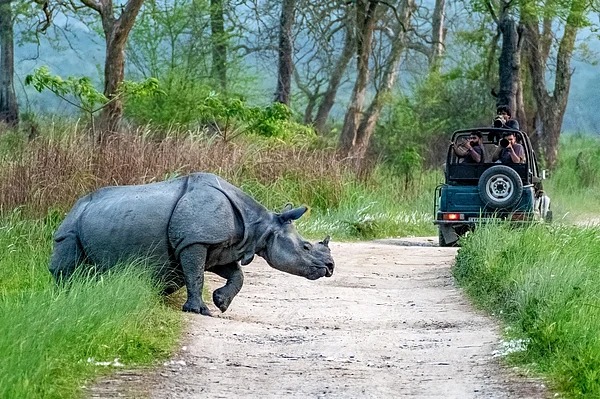
Diphu : Research and visual documentation published by conservation tracking groups have highlighted that the year-round movement of wildlife between Kaziranga National Park and the hills of Karbi Anglong is directly challenging the government’s proposal for a strict 1-kilometer Eco-Sensitive Zone (ESZ).
Recent field data and tracking indicate that animal migration into the Karbi Anglong hills is a continuous, multi-season phenomenon rather than a movement restricted solely to the annual monsoon flood season.

Send your resume:
biswa@jigyasu.co.in
krcfoundation@gmail.com
Tracking data reveals that key species including Asian elephants, tigers, and rhinos regularly utilize ecological corridors connecting Kaziranga to the adjoining highlands throughout all twelve months of the year, relying on the hills for forage, seasonal mating, and thermal refuge.
Conservationists argue that limiting the Eco-Sensitive Zone buffer to just 1 kilometer fails to cover critical contiguous forest tracts and movement corridors essential for maintaining ecological connectivity.
Unregulated infrastructure development and land-use shifts within the broader landscape outside the proposed 1-km zone pose severe risks of fragmenting vital wildlife passages.
The Kaziranga–Karbi Anglong landscape forms one of Northeastern India’s most critical contiguous ecosystems. Historically, animals have used the elevated terrain of the Karbi Anglong hills as natural high-ground refuges during severe seasonal flooding of the Brahmaputra floodplain.
Over decades, conservation management primarily focused on flood-time relief corridors; however, historical ecological studies have consistently said otherwise.
The Karbi Anglong hills were an integrated part of the larger native range for native megafauna long before administrative boundaries separated the national park from the surrounding hill districts.
As pressure mounts from infrastructure projects and human settlement, environmental groups are urging policymakers to re-evaluate the static 1-km boundary and adopt a dynamic, corridor-based protection framework.