


Trials Planned for 18 More Varieties
 KRC TIMES NE Desk
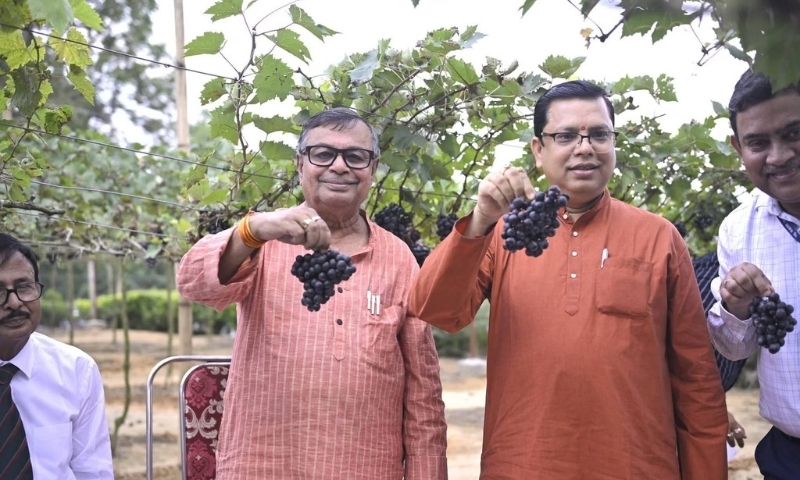
Agartala | Buoyed by the successful cultivation of sweet grapes in the state, the Tripura government has announced an ambitious plan to expand grape farming through large-scale varietal trials, research initiatives and farmer training programmes.
Agriculture and Farmers’ Welfare Minister Ratan Lal Nath said the state would undertake trials on 18 additional grape varieties while strengthening scientific research and technological support to promote commercial grape cultivation.
The minister made the announcement while addressing a field day-cum-awareness programme on commercial grape cultivation and the launch of projects funded by National Bank for Agriculture and Rural Development (NABARD) at Chandipur in Unakoti district.
During the programme, Nath visited an orchard where sweet grapes have reportedly been cultivated successfully for the first time in the region, marking a significant milestone for horticultural diversification in the state. Agricultural equipment was also distributed among farmers to encourage modern farming practices.

Highlighting the potential of grape cultivation, the minister noted that India’s average grape productivity stands at around 24 metric tonnes per hectare and said Tripura is exploring ways to replicate such success under its agro-climatic conditions.
He said scientists in the state have already developed four grape varieties through research efforts, including two varieties suitable for wine production.
“We will explore how best to support grape growers and ensure proper training is provided for scientific cultivation practices. After nearly two decades, Krishi Vigyan Kendra, Unakoti, revived its research and development work on grape cultivation in 2024, and early results show promising improvements in sweetness, yield and fruit quality,” Nath said.
According to the minister, six grape varieties sourced from the ICAR-National Research Centre for Grapes were introduced in Tripura in September 2024 as part of experimental cultivation trials.
Officials said the state’s grape cultivation programme faces several challenges, including high rainfall, elevated humidity levels, poor sweetness in some grape varieties, limited access to agrochemicals and a lack of technical expertise among farmers.
To overcome these obstacles, researchers have introduced specialised agronomic practices such as scientific nutrient management and the use of growth regulators aimed at improving fruit sweetness, quality and productivity.
The government’s future roadmap includes:
” Conducting trials on 18 additional grape varieties.
” Expanding research and technology development activities.
” Providing intensive training programmes for farmers.
” Establishing grape cultivation clusters and vineyards.
” Ensuring access to quality planting materials and technical guidance.
” Promoting value-added products such as grape juice and Ready-to-Serve (RTS) beverages.
Nath also announced plans to strengthen post-harvest management and establish cluster-based small-scale juice processing units to help farmers secure better returns and generate local agro-industrial employment opportunities.
The initiative is expected to diversify Tripura’s horticulture sector and create new income streams for farmers by introducing a high-value crop traditionally associated with western and southern India. Officials believe the early success of sweet grape cultivation could pave the way for the development of a viable grape industry in the state if ongoing trials continue to produce encouraging results.

Send your resume:
biswa@jigyasu.co.in
krcfoundation@gmail.com