A City in Motion: What Guwahati Has to Offer
 North East Integration Rally
For context, Dispur, the capital of Assam, sits within the greater Guwahati area and serves as the seat of the state government. Guwahati doesn’t fit into a neat category. It isn’t a mountain town, a river city, a cultural capital, or a business hub alone.
It’s all of that at once, shifting shape depending on which part of it you stand in and what hour of the day you meet it. That’s what makes Guwahati complicated, messy, magnetic, and impossible to define with a single phrase. It’s the Northeast’s busiest gateway, but it’s also a place where ancient rituals unfold with a stillness that feels untouched by time.
The river here isn’t decoration. It’s an active presence. Broad, moody, and powerful, the Brahmaputra shapes how the city thinks, breathes, and grows. Watch it in the morning from the Saraighat Bridge and you’ll see fishermen heading out in narrow boats, ferries drifting toward North Guwahati, and sunlight breaking over the water like a quiet announcement.

Stand by Uzan Bazaar in the evening and the river has a different tone—soft, patient, almost contemplative. People sit along the ghats, teenagers take photos, elders watch the water as if it’s telling them something only they can hear.
The Brahmaputra gives Guwahati a sense of scale few Indian cities possess. It commands respect because it can shift moods without warning. Floods in the monsoon remind the city that nature calls the shots here. That awareness humbles the place in a way concrete never could.
Guwahati expanded before it learned how to manage its own growth. Hills sliced into for new neighbourhoods. Wetlands reclaimed and built upon. Traffic that swells and knots without mercy. The city’s geography—its hills, lakes, wetlands, and riverbanks—makes urban planning a daily negotiation rather than a fixed blueprint.

Yet the city keeps moving. New malls rise beside old markets. High-rises cast shadows over narrow lanes. Cafes sit above hardware stores. It feels chaotic, but beneath the noise is a city constantly adjusting, improvising, and reimagining itself.
If you walk through Pan Bazaar early in the morning, before the traffic wakes up, you feel the older Guwahati. Bookstores opening shutters, porters unloading sacks of goods, cafes preparing milk tea, temple bells ringing from nearby lanes.
Move into Uzan Bazaar, and suddenly the city turns nostalgic. Old Assam-type houses with sloping roofs and timber frames sit quietly between modern apartments. Narrow roads bend toward riverfronts that feel unchanged despite everything around them shifting.
Climb the steps to Umananda Temple—set on a tiny island in the Brahmaputra—and you see the city from a different angle entirely. Ferries, bridges, traffic, and skyscrapers look small from here. The temple’s hillock, legend says, was shaped by Shiva himself. Whether or not you believe the story isn’t the point. The point is that Guwahati’s spiritual geography is as alive as its physical one.

Nilachal Hill carries the weight of mythology, devotion, and identity. Kamakhya Temple isn’t just a pilgrimage site. It’s the place that stitches Guwahati to centuries of Shakti worship. The architecture is distinctive, with its beehive-shaped shikhara, its complex of smaller shrines, and its sanctum built around a natural spring.
The Ambubachi Mela transforms the hill into a sea of red-clad devotees. But even on ordinary days, Kamakhya holds a quiet gravity. Stand on the hilltop and you see Guwahati stretch in every direction—dense, restless, expanding. The contrast between the ancient temple and the fast-growing city below shows exactly how layered Guwahati is.

Guwahati’s population mix gives it a tone different from Shillong, Imphal, or Kohima. It’s less curated, more porous. Assamese communities form the core, but every lane carries languages: Bengali from migrants who arrived generations ago, Hindi from traders, Nepali from the hills, Bodo from the plains, and tribal dialects from across the state.
The mix doesn’t come with spectacle. It’s woven into daily life—in markets, in offices, in local festivals. Take Bihu, for instance. The city celebrates it with an energy that spills across neighbourhoods. But during Durga Puja, the city transforms again, with pandals glowing late into the night. On Eid, markets around Hatigaon fill with buyers choosing clothes and sweets. Guwahati accommodates all of this without making the differences feel loud.

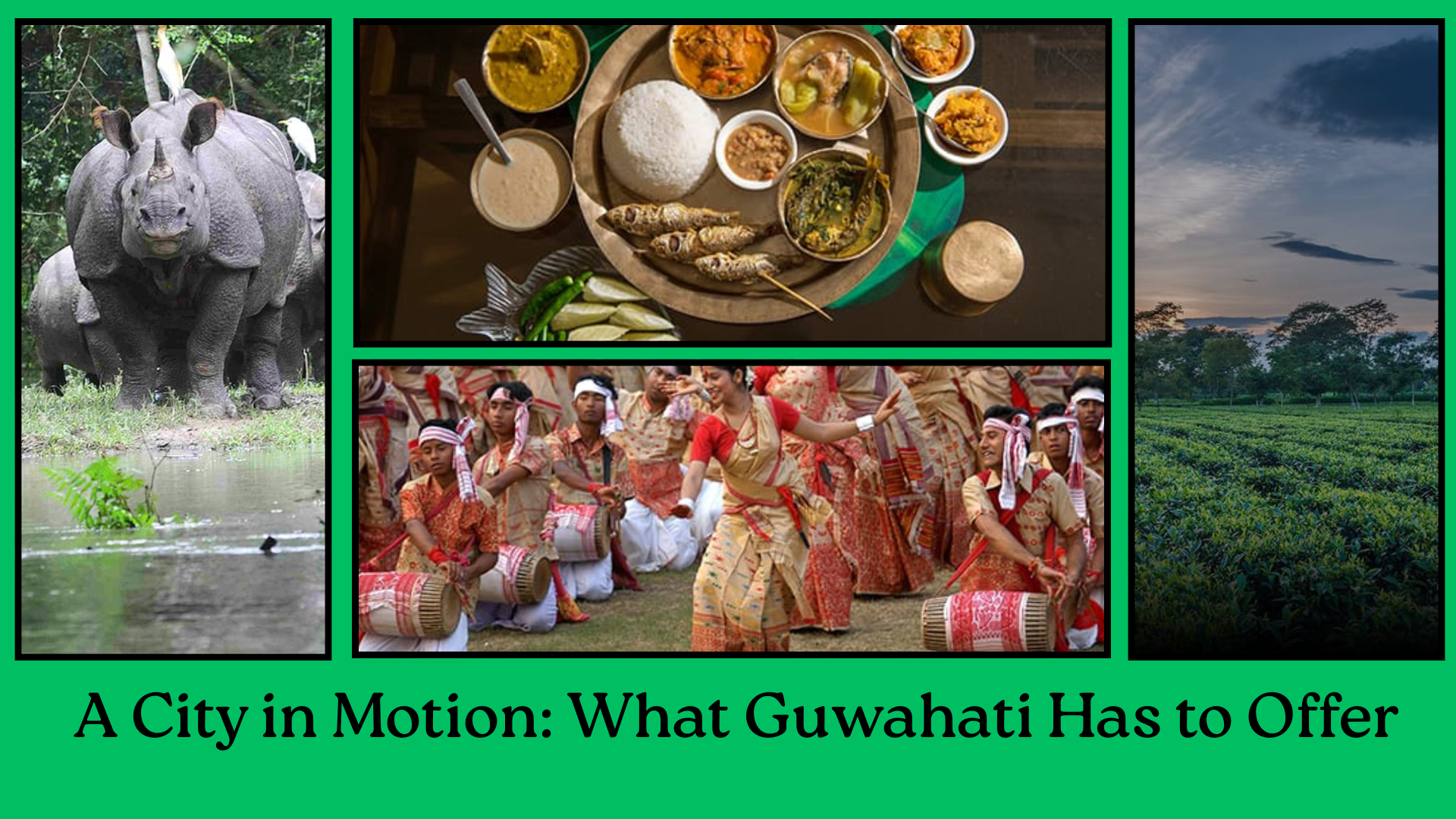
Food in Guwahati is honest. It reflects the state’s simplicity and its ecological richness. Fish from the Brahmaputra. Duck cooked with ash gourd. Chicken or pork stewed with black sesame. Bamboo shoot lending its sharpness. Mustard greens that carry the season’s flavour without extra effort.
You find these dishes in homes and small eateries, not in big restaurants. Meanwhile, the city’s younger crowd gravitates to cafes around Ganeshguri, Six Mile, and Christian Basti—places with strong coffee and soft lighting where students debate politics and musicians rehearse.

But the real heart of Guwahati’s food lies in its markets. Fancy Bazar bursts with color and noise. Uzan Bazaar’s fish vendors can tell you a fish’s story just by touching it. Paltan Bazaar carries spices that have travelled from Bhutan, Arunachal, and Nagaland.
Guwahati’s hills are more than viewpoints. They are green lungs the city desperately needs. Narengi, Kharguli, Hengrabari, Jatia—each neighbourhood rises and falls with the hills that frame it. Monsoon mornings often begin with clouds sliding down their slopes like a curtain being drawn.
Then there are the wetlands: Deepor Beel, Silsako, Borsola. These are havens for birds and buffers for the city. Deepor Beel, a Ramsar site, draws migratory birds every winter. Watching them settle on the water while trains pass in the distance gives you a glimpse of how nature and infrastructure coexist uneasily here.

Guwahati holds contradictions without trying to resolve them. A centuries-old temple beside a busy flyover. A modern government building facing a shrinking wetland. An age-old market surviving beside a new mall. Students preparing for competitive exams while musicians form indie bands in basement studios. Activists staging protests while families gather for evening river cruises.
What ties these layers together is movement. Guwahati rarely pauses. It absorbs, reacts, reshapes, and pushes forward.Traffic that swells beyond capacity. Hills cut recklessly for construction. Urban flooding that returns each monsoon. Pollution rising with the expanding vehicle population. Pressure on wetlands. Land prices that push communities outward.
The city knows its problems. The question is whether its pace will allow it to solve them before they shape its future too sharply.
Guwahati isn’t a city you fall for instantly. It doesn’t charm you the way smaller hill towns do. It doesn’t stay frozen in time. It doesn’t pretend to be perfect. What it offers instead is momentum. A sense of becoming. A place where stories collide—tribal, urban, spiritual, political—and generate a kind of restless energy you won’t find anywhere else in the Northeast.
This city grows on you because it mirrors the region’s complexity. Walk long enough along the Brahmaputra, climb the hills, sit in the markets, join the crowds during festivals, and you’ll understand. Guwahati isn’t the Northeast’s gateway because of geography. It’s the gateway because it holds everything—ancient belief, modern ambition, ecological vulnerability, and cultural diversity—and keeps moving forward anyway.
Promotional | North East Integration Rally