


When an Epic Becomes Geography
 KRC TIMES Desk
Rishov Bhattacharjee
For most Indians, the Ramayana enters our lives long before we are old enough to understand history, philosophy or religion.
We hear of Rama, Sita, Lakshmana and Hanuman from our grandparents. We watch their stories during festivals and on television. We encounter them in temples, books, paintings and everyday expressions. Over time, the Ramayana becomes so deeply embedded in our cultural consciousness that we rarely stop to ask a fascinating question:
What happens when you actually travel through the landscapes associated with the epic?
A recent journey through Madurai, Rameshwaram, Dhanushkodi, Kanyakumari and, later, the Jatayu Earth Centre in Kerala gave me an unexpected answer.
The Ramayana begins to transform. It is no longer merely an epic that one reads. It becomes a landscape that one can walk through. Rameshwaram: Where Rama Seems to Be Everywhere
Few places demonstrate this more powerfully than Rameshwaram.
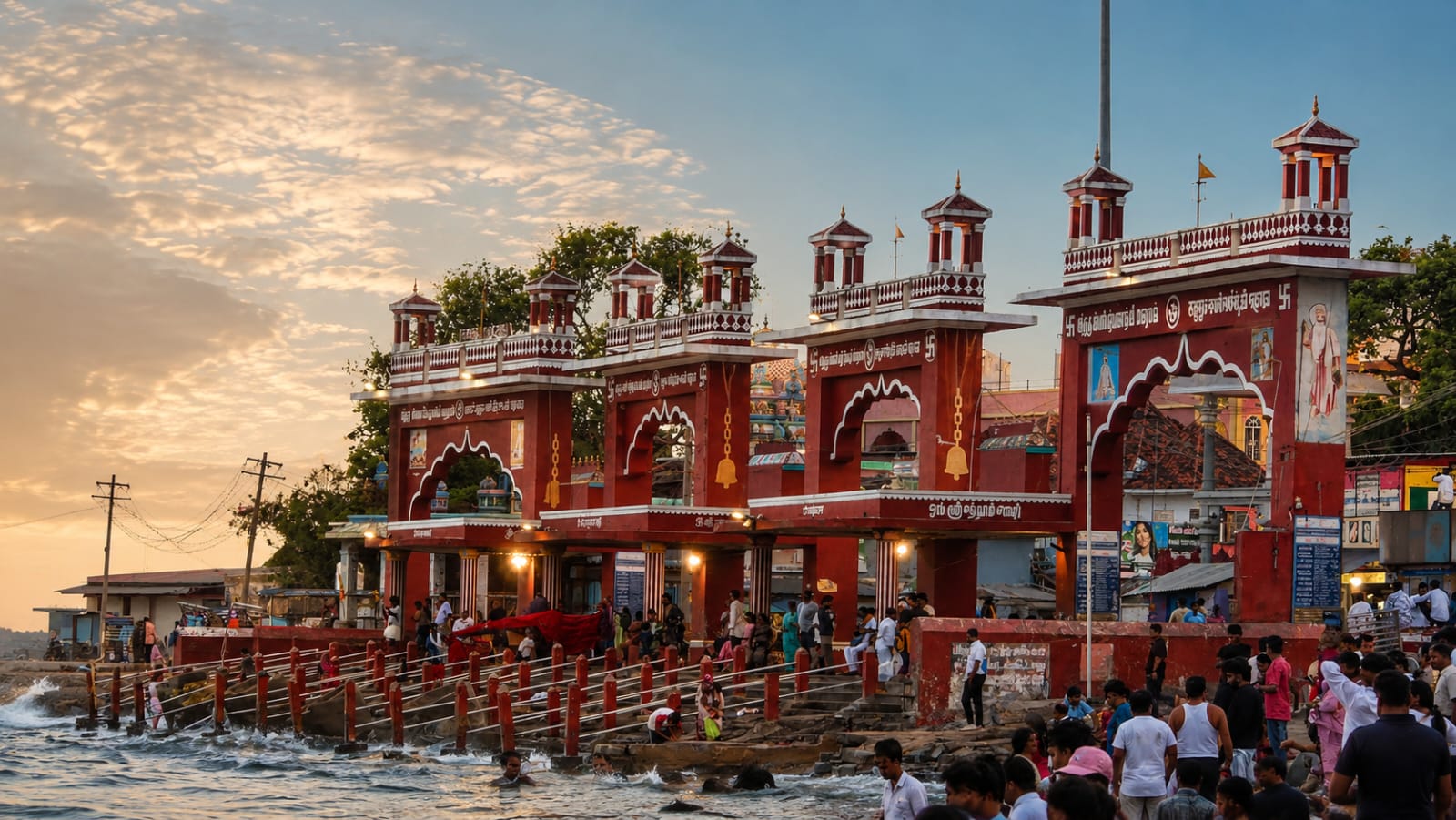
According to the traditions surrounding the Ramayana, this region represents one of the most important geographical turning points in Rama’s journey. Lanka lay across the sea. Sita had been taken there by Ravana, and Rama’s southward journey had reached the edge of the Indian mainland.
Today, memories associated with that journey survive across an extraordinary concentration of temples, teerthams and local traditions.
At Ramar Padam, tradition associates the hill with the footprints of Lord Rama. Standing there, overlooking the island, one begins to understand why geography matters so much to religious memory. Whatever one’s interpretation of the historicity of the epic, the landscape gives the narrative a physical dimension that reading alone cannot provide.
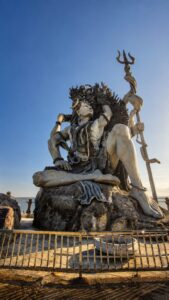
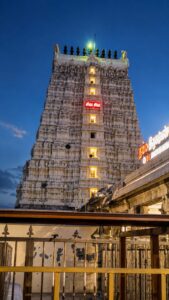
Then comes the magnificent Ramanathaswamy Temple, home to one of India’s twelve Jyotirlingas.
Its association with the Ramayana creates one of the most beautiful intersections within Hindu tradition: Rama, regarded as an incarnation of Vishnu, worshipping Shiva.
Tradition holds that Rama worshipped Shiva here before or around his campaign towards Lanka, while other traditions connect the worship with his return after defeating Ravana. The details vary across tellings, but the underlying idea is remarkable.
Even the divine bows before the divine.
Perhaps that is one reason Rameshwaram occupies such a unique position in India’s sacred geography. It is simultaneously a great Shaiva pilgrimage centre and inseparable from the memory of Rama.
Following Rama Towards the Sea
Travel further towards Dhanushkodi and the Ramayana associations become even more pronounced.
The Kodanda Ramar Temple, surrounded by an austere coastal landscape, is traditionally associated with Vibhishana’s surrender to Rama.
Vibhishana, Ravana’s brother, chose dharma over family allegiance and sought refuge with Rama. His decision remains one of the epic’s most interesting moral dilemmas.
What does one do when loyalty towards one’s family conflicts with what one believes to be right?
Thousands of years after the story was composed and retold, that question remains surprisingly contemporary.
Nearby, Lakshmana Teertham preserves another connection with Rama’s younger brother. Across Rameshwaram, such teerthams create a remarkable sacred map. Wells, ponds, temples, seashores and freshwater springs are woven into stories associated with the epic.
Among the most intriguing is Villoondi Teertham.
Local tradition says that Rama shot an arrow into the ground here to obtain fresh water for Sita. What makes the place fascinating even to a visitor approaching it simply as a traveller is its setting – a freshwater tradition surviving amid a landscape surrounded by the sea.
Myth, faith and geography meet at the same spot.
And then there is Dhanushkodi.
Few places on this journey possess its atmosphere.
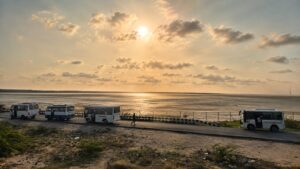
Today it is remembered partly as the ghost town devastated by the catastrophic cyclone of 1964. But in the sacred imagination of India, this coastline carries a much older memory.
Beyond these shores lies Sri Lanka.
Standing near the edge of the land, with the ocean stretching towards the horizon, it becomes remarkably easy to understand why generations associated this region with Rama’s army preparing to cross the sea and with the legendary Rama Setu.
Whether one approaches the Ramayana as scripture, literature, cultural memory or a subject of historical curiosity, Dhanushkodi forces the imagination to engage with geography.
For once, Lanka does not feel like an abstract kingdom somewhere beyond the pages of an epic.
It lies across the water.
Hanuman: The Presence Behind Rama’s Journey
The Panchmukhi Hanuman Temple adds another dimension to the journey.
Hanuman is perhaps the character who transforms the Ramayana from a story of exile and loss into one of hope and possibility.

His devotion to Rama is legendary, but reducing Hanuman merely to devotion misses something important. He represents courage combined with intelligence, extraordinary strength restrained by purpose, and power without ego.
The five-faced, or Panchmukhi, representation of Hanuman belongs to later devotional traditions surrounding him and demonstrates something equally important about the Ramayana.
The epic did not remain frozen in the era in which it was composed.
Over centuries, communities across India expanded, interpreted and localised its stories. Temples and regional traditions became additional layers of a civilisation’s memory.
This may explain why travelling through Ramayana-associated places feels different from simply tracing locations on a historical map.
One is travelling through layers of memory accumulated over generations. From Rameshwaram to Jatayu. That feeling returned strongly at the Jatayu Earth Centre in Kerala.
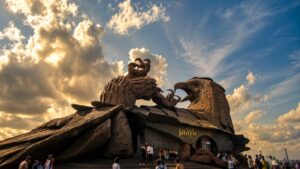
The enormous sculpture of the fallen Jatayu immediately recalls one of the Ramayana’s most moving episodes. When Ravana abducted Sita, the aged Jatayu attempted to stop him. He knew the difference in their strength. He knew the odds were overwhelmingly against him.
And yet he fought. Ravana eventually mortally wounded him, but Jatayu lived long enough to tell Rama what had happened and the direction in which Sita had been taken. Jatayu’s importance in the Ramayana does not come from victory.
He loses the battle. Yet morally, he triumphs. His story asks another timeless question: Is an action valuable only when we are certain of victory, or is standing against injustice itself worthwhile?
Perhaps that is why the gigantic sculpture in Kerala feels appropriate. It commemorates not merely a mythological bird, but an idea – that courage is sometimes measured by the willingness to act even when success appears impossible.
Kanyakumari: Where the Journey Turns Inward. Kanyakumari provided a different conclusion.
The Vivekananda Rock Memorial does not belong directly to the geography of the Ramayana. Yet after travelling through landscapes saturated with the epic, reaching the southern tip of India felt strangely appropriate.
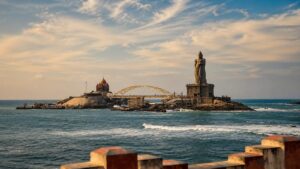
Here, surrounded by the sea, stands the memorial to Swami Vivekananda, who meditated on the rock before embarking upon the phase of his life that would eventually take India’s philosophical traditions to a global audience.
Rameshwaram had made me think about India’s ability to preserve stories through sacred geography. Kanyakumari made me think about how those ideas travel beyond geography.
Perhaps this is one of the most fascinating characteristics of Indian civilisation. Stories survive not only inside books. They survive through places.
A hill becomes associated with Rama’s footprints. A coastal temple remembers Vibhishana’s surrender. A freshwater source preserves a story about Rama and Sita. A stretch of ocean recalls the journey towards Lanka. A giant sculpture in Kerala keeps alive the sacrifice of Jatayu.
Generation after generation visits these places, hears these stories and passes them forward. Between History, Faith and Civilisational Memory.

Modern discussions about the Ramayana often become trapped inside a single question: Did every event happen exactly as described?
It is an understandable question, but perhaps it is not the only interesting one. There is another question worth asking. How did a civilisation remember the same story across thousands of kilometres for so long?
From Ayodhya in the north to Chitrakoot, Nashik, Hampi, Rameshwaram and traditions extending towards Sri Lanka, communities separated by enormous distances have preserved geographical associations with the same epic.
Different regions naturally possess different versions and traditions. Archaeology, textual history, faith and folklore should not be casually treated as interchangeable forms of evidence.
But the existence of this vast cultural geography is itself extraordinary. My journey through Rameshwaram and southern India did not provide simple answers about where history ends and sacred memory begins.
Instead, it made the question more interesting. Because standing at Dhanushkodi, looking across the ocean towards Sri Lanka, the Ramayana suddenly feels very different from the epic encountered on a bookshelf.
You realise that for millions of people across centuries, this was never merely a story. It was a map of values.
Rama represented dharma. Lakshmana represented loyalty. Hanuman embodied devotion and purposeful strength. Vibhishana represented the difficult choice of conscience over kinship. Jatayu represented courage without guarantee of victory.
And the landscapes preserved their memories. Perhaps that is the greatest impression I carried home from the journey. I went south as a traveller visiting temples and monuments. Somewhere along the way, I found myself walking through one of India’s oldest living stories.