


Military and Energy Developments
 Sangram Datta
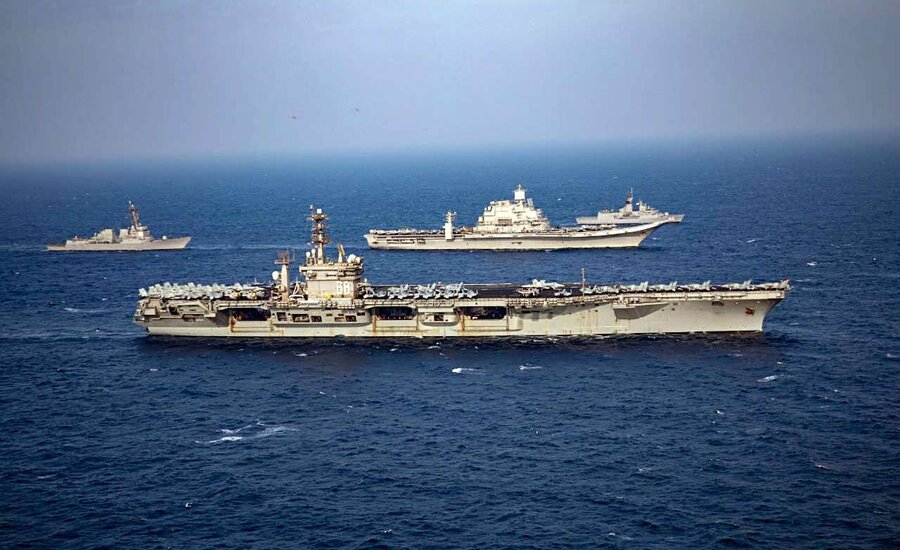
India is intensifying its strategic presence in the Indian Ocean through military upgrades and energy exploration projects. Recent initiatives in the Andaman and Nicobar Islands, the Bay of Bengal, and beyond reflect a broader effort to secure maritime interests and strengthen regional influence.
Military Infrastructure in the Andaman and Nicobar Islands-
The Andaman and Nicobar Islands have long been central to India’s maritime security strategy, offering proximity to vital sea lanes in the eastern Indian Ocean. On 11 April 2024, The Indian Express reported: “Strategic military infra upgrade in the works for Andaman & Nicobar Islands.” A day later, 12 April 2024, Indian Defence News emphasized: “Andaman & Nicobar Undergoes Major Military Infra Upgrade Amidst Rising Chinese Influence.”
Upgrades include facilities to accommodate larger warships, enhanced missile batteries, and expanded deployment of aircraft and troops. These developments are viewed as part of India’s efforts to counter Chinese activities in the region, particularly those linked to Myanmar’s Coco Islands, located just 55 kilometers north of the Andaman and Nicobar chain.
India’s existing bases — INS Jarawa in Port Blair (commissioned in 1964) and INS Kardip on Kamorta Island (commissioned in 1973) — have served as the backbone of operations. The current expansion seeks to transform the islands into a more formidable forward operating hub.
At the same time, concerns over ecological and cultural impacts have surfaced. On 7 February 2024, The Guardian reported: “India’s plan for untouched Nicobar isles will be ‘death sentence’ for isolated tribe.” The piece highlighted academic warnings that a proposed $9 billion port, airport, and military project on Great Nicobar Island could threaten the survival of the Shompen, one of the world’s most isolated tribes.
Oil Exploration in the Bay of Bengal-
India’s energy strategy is also advancing offshore. The state-owned Oil and Natural Gas Corporation (ONGC) recently commenced production from the Krishna Godavari basin project (Block KG-DWN-98/2) in the Bay of Bengal. According to official estimates, the project will deliver 45,000 barrels of oil and 10 million cubic meters of gas per day, bolstering energy security after years of declining output.
Meanwhile, three new offshore blocks in the Kerala-Konkan basin have been approved under the Open Acreage Licensing Policy. Oil India Ltd (OIL) and ONGC have been awarded contracts, with exploratory drilling set to reach depths of 6,000 meters, supported logistically through Cochin Port.
Regional dynamics, however, remain complex. In August 2025, Bangladesh canceled agreements with ONGC Videsh Limited and Oil India Limited, citing unsatisfactory progress in exploration activities. The move reflects the competitive and sensitive nature of hydrocarbon development in the Bay of Bengal.
Expanding Partnerships in the Indian Ocean-
India’s influence is also extending to island nations. On 11 September 2025, Reuters reported: “India pledges $680 million in economic support for Mauritius.” The following day, 12 September 2025, The Times of India added: “India announces $680 million package to boost Mauritius’ infra, security; Mauritius backs Indian presence in Chagos.”
The financial package is aimed at infrastructure and security cooperation, underscoring India’s intent to maintain a strong presence in the southwestern Indian Ocean. The support also reflects Mauritius’ backing of India’s engagement in the strategically contested Chagos Archipelago.
Regional Implications-
Together, these initiatives highlight India’s multi-dimensional approach: strengthening military readiness, securing energy resources, and deepening partnerships with regional states. The strategy reflects both opportunities and challenges — balancing security imperatives with ecological concerns, and cooperation with competition in resource exploration.
Conclusion-
India’s current trajectory in the Indian Ocean — from the Andaman and Nicobar Islands to the Bay of Bengal and into the wider region — underscores its long-term commitment to maritime security and energy independence. Documented by reports from The Indian Express, Indian Defence News, The Guardian, Reuters, and The Times of India, these moves are likely to shape not only India’s national strategy but also the evolving geopolitical balance of the Indian Ocean in the years ahead.
Promotional | North East Integration Rally