

Amit Shah at Rajbhasha Sammelan in Tripura
 KRC TIMES NE Desk
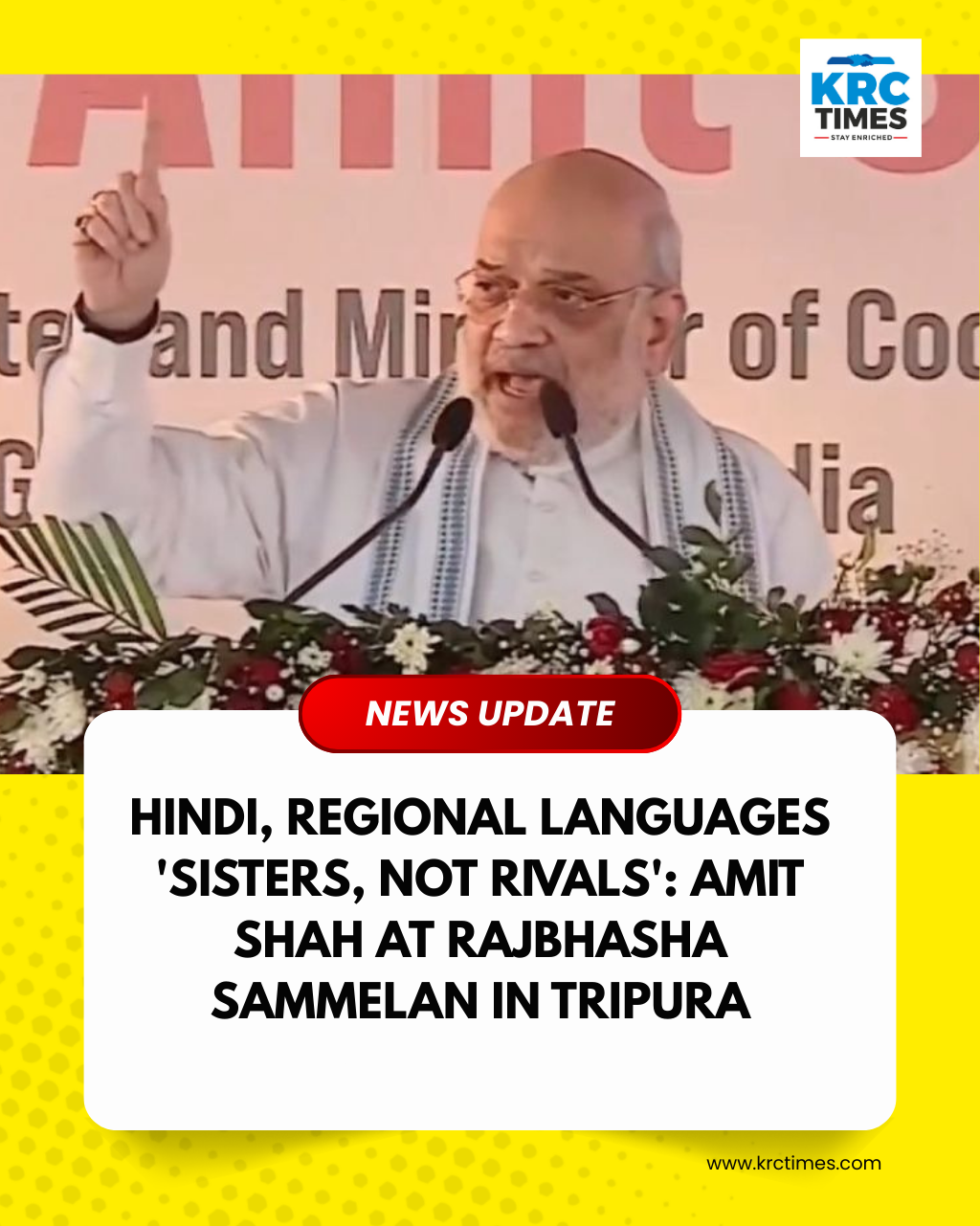
Agartala : Union Home Minister Amit Shah on Saturday asserted that Hindi and regional languages are “sisters born of the same mother” and not competitors, maintaining that the promotion of Hindi strengthens rather than undermines India’s rich linguistic diversity.
Addressing the Rajbhasha Sammelan in Agartala, Shah rejected what he described as a long-standing “false narrative” that Hindi was being imposed on non-Hindi-speaking populations. He said the misconception had been effectively dismantled over the past decade.
“There can be no dispute between Hindi and other local languages. They are sisters born of the same mother and have grown together,” he said, adding that neither language nor script should ever become a cause of conflict.
Shah emphasised that language should function as a vehicle for development and national integration, not division. He urged policymakers, scholars and administrators to work proactively towards the advancement of both official and regional languages, underscoring their importance in governance and nation-building.

The Home Minister appealed to families to speak to their children in their mother tongue at home, warning that neglecting native languages would deprive future generations of access to their literature, traditions and cultural values.
“Using our mother tongue at home is essential for preserving cultural identity,” he said, stressing that linguistic heritage forms the foundation of civilisational continuity.
Addressing representatives from the Eastern, North Eastern and Northern regions, Shah said the preservation of indigenous languages must be prioritised, particularly in the North East.
In a key intervention, Shah urged North Eastern states, including Tripura, to consider preserving their indigenous languages through the Nagari script. He argued that script plays a crucial role in language conservation and standardisation.
“Indigenous languages cannot be safeguarded through foreign scripts,” he said, adding that efforts to preserve such languages would be more effective and enduring if carried out in Nagari.
Shah noted that several North Eastern states had already taken steps in this direction and called upon Tripura to arrive at a “clear and unambiguous decision” on the matter.
He further observed that more than 2,000 languages across India – especially those without their own scripts – could potentially be preserved through Nagari. The script, he said, can aid in documentation, institutional development and broader dissemination of such languages.

Highlighting what he described as a broader transformation of the North East under the leadership of Prime Minister Narendra Modi, Shah said the region had moved from an era of vivad (dispute) to vikas (development).
Since 2014, he said, 21 peace accords have been signed with insurgent groups, and nearly 11,000 “misguided youths” have returned to the mainstream, leading to significant improvements in peace and stability.
He credited sustained efforts by the Centre and state governments for the improved security environment and development momentum in the region.
The conference was attended by Tripura Chief Minister Manik Saha, Members of Parliament Biplab Kumar Deb and Rajib Bhattacharjee, along with representatives from multiple states.
Reiterating that decades of “propaganda” had created unnecessary apprehensions about Hindi, Shah maintained that the growth of Hindi does not threaten regional languages. Instead, he said, it can help expand their reach and foster mutual enrichment.
“Language must be a bridge, not a barrier,” the Home Minister said, urging a balanced approach that promotes Hindi while safeguarding India’s diverse linguistic heritage.