


Will Crime Be Controlled and Can the New Government Meet Public Expectations?
 KRC TIMES Desk
Col (Dr.) Ashwani Kumar, MiD, VSM (Retd).
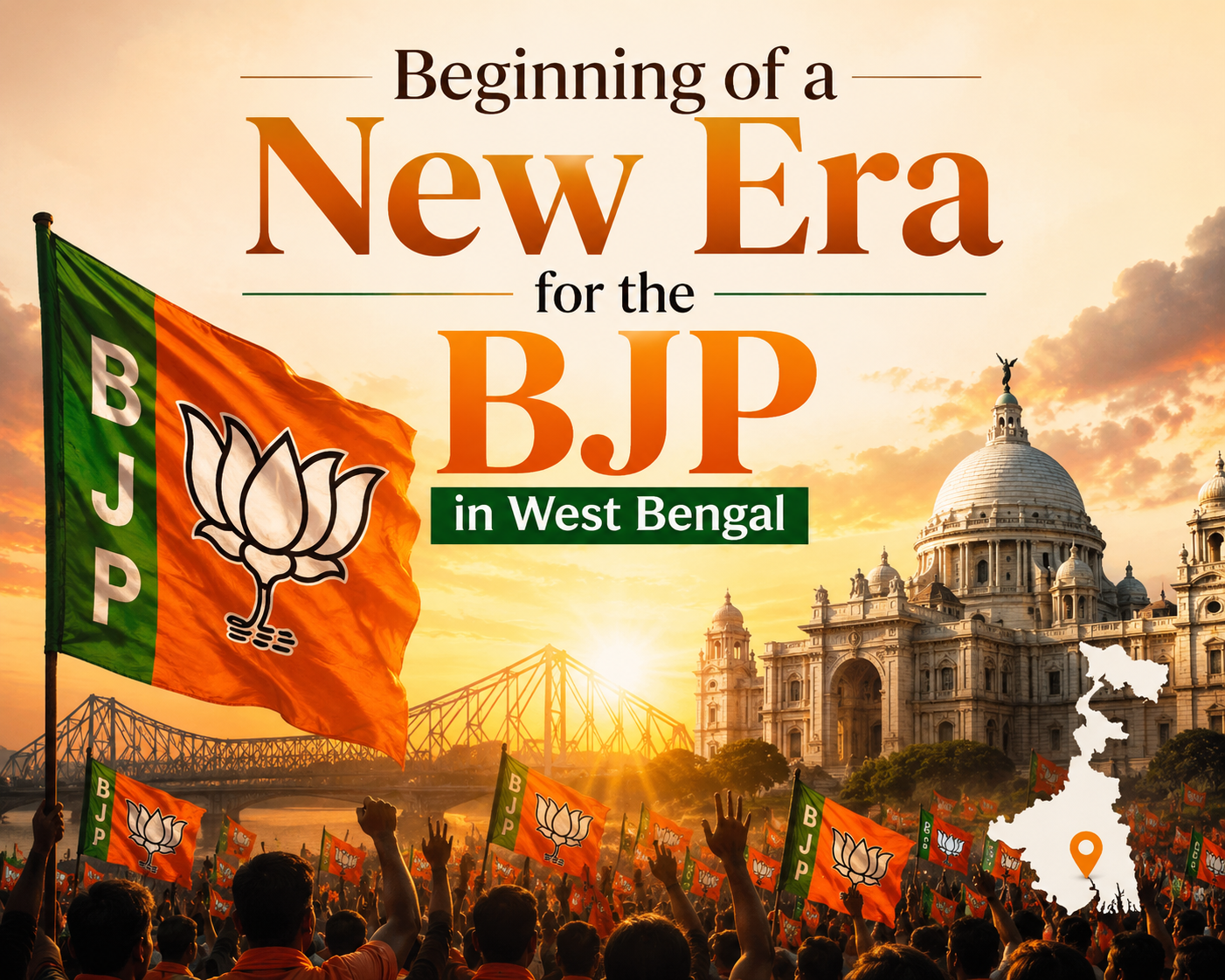
The political map of Eastern India has undergone a dramatic transformation with the Bharatiya Janata Party (BJP) forming its first-ever government in West Bengal. The swearing-in of BJP leader Suvendu Adhikari as Chief Minister marks not merely a change of government, but the possible beginning of a new political and administrative era for one of India’s most politically sensitive and strategically important states.
For decades, West Bengal remained outside the BJP’s sphere of governance. The state moved from prolonged Left rule to the dominance of the Trinamool Congress under Mamata Banerjee. Now, with BJP securing a commanding majority in the Assembly, the political message from Bengal has echoed across the entire eastern and northeastern region.
This victory is not merely a state-level event. It reflects the wider consolidation of the BJP across Eastern and Northeastern India, Assam, Tripura, Arunachal Pradesh, Manipur and now West Bengal.
The emergence of what is now being called a “double-engine sarkar” in Bengal has created enormous expectations among the public. For supporters, it represents political stability, stronger coordination with the Centre and the promise of accelerated development. For critics, however, it raises concerns about political centralisation and the future of opposition politics in the state.

The Bengal Verdict: More Than an Election.
The Bengal mandate reflects several layers of public sentiment:
Fatigue with prolonged political violence,
Anger over corruption allegations,
Frustration regarding unemployment,
Desire for administrative accountability,
And aspirations for stronger economic growth.
The BJP successfully projected itself as the party capable of delivering governance aligned with the Centre’s infrastructure and development agenda. The slogan of “Sonar Bangla” was carefully linked with nationalism, cultural identity and economic revival.
The symbolism during the oath ceremony was politically significant. Cultural depictions of Bengal’s heritage, including Dakshineswar Temple, Durga motifs, Chhou performances and references to Rabindranath Tagore, were prominently showcased. BJP attempted to send a clear message that Bengali cultural pride and national political integration can move together.
Can Crime and Political Violence Be Controlled?.
The biggest challenge before the new government is whether it can genuinely restore law and order and end Bengal’s long-standing culture of political violence. For years, allegations involving:
Political killings,
Cadre intimidation,
Extortion syndicates,
Corruption,
Illegal local networks,
and partisan policing, have dominated Bengal’s political discourse.
The BJP repeatedly accused the previous regime of allowing fear-based politics to flourish, while the Trinamool Congress accused central agencies and institutions of acting in a partisan manner during the elections.
Now the BJP can no longer function as an opposition force. Expectations are immediate and extremely high.
The people will judge the government on:
(i) Reduction in political violence.
(ii) Safety of political workers irrespective of party affiliation.
(iii) Women’s security.
(iv) Neutral functioning of police.
(v) Elimination of extortion networks.
(vi) Speedy justice and anti-corruption measures.
(vii) Restoration of investor confidence.
However, Bengal’s political violence is deeply rooted in local structures involving land, trade, labour unions, municipal systems and district-level political influence. Dismantling entrenched systems without creating fresh confrontation will require administrative maturity and political restraint.
If the BJP succeeds in establishing impartial governance, it may permanently reshape Bengal politics. But if one patronage structure merely replaces another, public disappointment may emerge rapidly.

Economic Expectations from the New Government.
The Bengal electorate has also voted with economic aspirations. Despite its rich intellectual, cultural and historical legacy, West Bengal has struggled with:
(i) Industrial stagnation,
(ii) Declining manufacturing,
(iii) Migration of skilled youth,
(iv) Weak private investment,
and unemployment.
The BJP has promised:
(i) Industrial revival,
(ii) Infrastructure expansion,
(iii) IT and logistics growth,
(iv) Investment corridors,
(v) Tourism development,
(vi) Port-led trade,
and enhanced connectivity with the Northeast.
The strategic importance of Bengal is immense. It serves as India’s gateway toward Bangladesh, Bhutan, Nepal and the Northeastern states. A stable and economically vibrant Bengal could become central to India’s Act East Policy and regional trade expansion.
If coordinated properly with the Central government, the state could witness rapid infrastructure development in highways, railways, ports, border trade and urban modernisation.

This is where the “double-engine government” narrative becomes politically crucial. BJP supporters argue that policy coordination between the Centre and the state can reduce administrative friction and accelerate growth.
However, economic revival requires more than political slogans. The real test will be:
(i) Employment generation,
(ii) Industrial investment,
(iii) Improvement in ease of doing business,
and reduction of bureaucratic corruption.
Is Mamata Banerjee’s Political Era Over?.
One of the most important political questions emerging from this election is whether the defeat marks the end of the political dominance of Mamata Banerjee or merely the beginning of a different political role for her.
For over fifteen years, Mamata Banerjee remained the undisputed face of Bengal politics. She defeated the mighty Left Front and established herself as a powerful grassroots leader with strong emotional connect among large sections of society.
Even in defeat, she remains a significant political personality.
Several possibilities now emerge:
Will Mamata Banerjee move to the Rajya Sabha and play a larger national opposition role?
Will she continue as a street fighter and mobilise public opinion against the BJP government?
Will she transform herself into the principal watchdog questioning the new ruling establishment?
Or will the Trinamool Congress witness internal restructuring and leadership transition?
Much will depend on the performance of the BJP government during the coming years.
If the BJP succeeds in:
Controlling violence,
Ensuring stable governance,
Reducing corruption,
Improving the economy,
and maintaining communal harmony, then it may permanently consolidate itself in Bengal and strengthen its national political position for the 2029 Lok Sabha elections.
However, if governance failures emerge, if public expectations remain unmet, or if political tensions increase, opposition forces led by Mamata Banerjee may regain momentum quickly.
Thus, Bengal has now become more than a state political battleground. It has become a national political laboratory whose outcome may influence the future direction of Indian politics before 2029.
BJP’s “Jadhu” in Eastern India.
The BJP’s rise in Eastern India did not occur overnight. It was built through years of organisational expansion, welfare outreach, ideological messaging and strategic alliances.
The “jadhu” or political magnetism of BJP in the East rests upon several pillars:
Strong Leadership.
The popularity of Narendra Modi continues to remain a major electoral factor across the region.
Welfare Politics.
Direct benefit schemes, rural housing, electricity, healthcare and food distribution strengthened BJP’s support among economically weaker sections.
National Security Narrative.
Issues relating to infiltration, border management and internal security became politically influential in Bengal and Assam.
Organisational Expansion.
The BJP invested heavily in booth-level structures and grassroots mobilisation across Eastern India.
Cultural Integration.
The party increasingly adopted local cultural narratives and regional icons while linking them with broader national identity.
The Northeast became a testing ground for BJP’s coalition-building and governance model. Successes in Assam and Tripura provided confidence for expansion into Bengal.
Challenges Before the New Government.
Despite the historic mandate, the BJP government faces formidable challenges:
Managing a highly polarised political environment,
Balancing aggressive politics with democratic restraint,
Reassuring minority communities,
Handling bureaucratic resistance, and delivering visible economic results quickly.
The people of Bengal have not voted merely for a political party, they have voted for change, stability and expectation.
The coming years will determine whether the promise of “Sonar Bangla” becomes reality or remains a powerful electoral slogan.
The BJP’s success in Bengal can redefine Indian politics for the next decade. Its failure, however, may equally become a turning point before the 2029 national elections. The true examination of governance begins after victory not before it.

Author’s Note.
The author has closely observed the political, security and social dynamics of Eastern and Northeastern India for several decades. Having served in sensitive assignments connected with national security, intelligence and conflict management, the author has also witnessed electoral processes in challenging environments, including local government-related election management exposure in Sri Lanka during 1989 and security-linked democratic processes in Jammu & Kashmir.
This article is an analytical assessment of the emerging political landscape in Eastern India, especially West Bengal, based on available reports, political developments, public discourse and open-source information. The intention is to encourage informed democratic discussion on governance, stability, development and national integration.
About the Author
Colonel (Dr.) Ashwani Kumar, M-in-D, VSM (Retd.), writing under the pen name is a veteran military intelligence officer, strategic affairs commentator and author known for his writings on national security, Eastern and Northeastern India, border affairs, governance and socio-political developments.
He has served in challenging operational and intelligence assignments in India and abroad, including appointments connected with Military Intelligence, Cabinet Secretariat and internal security environments. His writings combine field experience, strategic insight and socio-cultural understanding of India’s frontier and sensitive regions.
Disclaimer:
This article is an independent analytical opinion piece based on open-source information, publicly available reports and political developments. The views expressed are personal and intended solely for academic, journalistic and democratic discussion purposes.

