

A Fearless Revolutionary of Bengal’s Armed Freedom Movement
 Sangram Datta
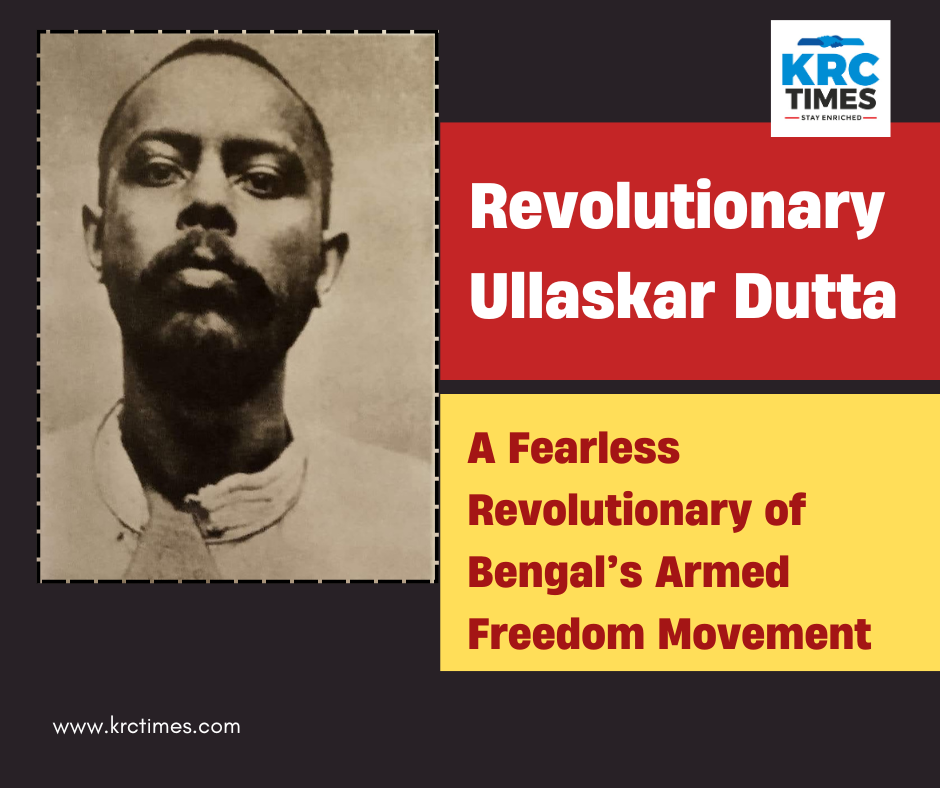
Revolutionary Ullaskar Dutta was one of the early armed revolutionaries of the Indian independence movement who risked his life fighting British imperialism. He was an expert bomb-maker and used the pseudonym “Abhiram.” His famous statement was:
“I do not want any help from any Government.”
Birth and Family Background
Ullaskar Dutta was born on 16 April 1885 in Baghbari of Kalikaccha village under Sarail Upazila of present-day Brahmanbaria District in Bangladesh, then part of British India. He was born into a wealthy, educated, and aristocratic family.
His father, Dr. Dwijadas Dutta, was the first Indian Principal of the Shibpur Engineering College in Howrah.
Kalikaccha village was widely known during British rule as a highly educated village and a center of anti-British revolutionary activities. Many notable personalities hailed from this village, including freedom fighters, political leaders, lawyers, scholars, engineers, artists, and academics.
Among them were Akhil Chandra Nandi, Rabindra Mohan Nag, Ananda Chandra Nandi, communist leader Amitabh Nandi, Advocate Jagat Chandra Nandi, Advocate Narendra Chandra Dutta—the founder of Comilla Banking Corporation—Advocate Apurba Kanchan Nandi, and Mahim Chandra Bhattacharya.
The village also produced engineer Tapabrata Chakraborty, after whom a street named “Tapabrata Street” exists in Baltimore, USA. Other distinguished personalities from Kalikaccha include Professor Dr. Kalipada Sen, education researcher Sheikh Shahbaz Riyad, Prabodh Chakraborty—the builder of Agartala Airport, Dr. Mahendra Chandra Nandi known as the “Tolstoy of Bengal,” Kailash Singha, Biraj Mohan Dev (Bagha Biraj), former Tripura Governor Tathagata Roy, former Deputy Speaker of the Tripura Legislative Assembly Pabitra Kar, former Kolkata University Chemistry Professor Dr. Sunil Kumar Talapatra, senior advocate of Tripura High Court Shankar Kumar Dev, and National Award-winning artist Prabhat Chandra Sen.
The famous Bengali writer Nirad C. Chaudhuri also had his maternal family home in Kalikaccha.
Ullaskar Dutta’s younger brother was Advocate Bijoy Kar Dutta. Bijoy Kar Dutta’s daughter married Flight Lieutenant Pranab Kumar Nandi Majumdar, son of educationist Jogendranath Nandi of Bejura village in Madhabpur Thana under Habiganj district in present Bangladesh.
Student Life and Revolutionary Activities
After passing the Entrance Examination in 1903, Ullaskar Dutta enrolled at Presidency College in Kolkata. An English professor named Russell frequently insulted Bengalis. Enraged by these racist remarks, Ullaskar attacked Professor Russell and was expelled from the college.
Following his expulsion, his anger against British rule intensified, and he gradually became involved in revolutionary politics.
He joined the revolutionary organization Jugantar and began making bombs himself, gaining recognition as a skilled explosives expert.
On 1 May 1908, revolutionary Prafulla Chaki was killed while attempting a bombing operation, and Ullaskar Dutta was seriously injured. Bombs manufactured by Ullaskar Dutta were later used by Khudiram Bose and Hemchandra Das in the attack on Magistrate Kingsford.
On 2 May 1908, police arrested Ullaskar Dutta along with many members of the Jugantar group.
Alipore Bomb Case and Cellular Jail
In 1909, Ullaskar Dutta and Barindra Kumar Ghosh were sentenced to death in the famous Alipore Bomb Case. Later, their sentences were commuted.
During his imprisonment in the notorious Cellular Jail of the Andaman Islands, Ullaskar Dutta was subjected to severe torture and forced labor. He had to work at grinding mustard seeds, making bricks under the scorching sun, cutting trees, and performing other exhausting tasks.
If he refused to work, he was brutally punished, often tied up with both hands stretched apart. Continuous torture and inhuman labor destroyed his physical and mental health. He suffered from convulsions and gradually lost mental stability.
Around 1914, he was admitted to a mental hospital in Madras presently Channai.
Release and Later Political Life
In 1920, Ullaskar Dutta was released from the Madras Mental Hospital. However, due to his deteriorated physical and mental condition, he could no longer actively participate in revolutionary politics.
Until 1930, he had to report weekly at Sarail Police Station.

In 1931, he was arrested again and imprisoned for eighteen months.
Partition of India and Personal Life
After the Partition of India in 1947, Ullaskar Dutta returned to his birthplace, Kalikaccha village in Brahmanbaria of East Pakistan. The Government of West Bengal arranged financial assistance, housing, food, and medical treatment for him. Even when West Bengal Chief Minister Dr. Bidhan Chandra Roy requested him to stay in Kolkata, Ullaskar Dutta rejected all offers. He could not accept the partition of India.
In 1948, at the age of 63, he married Leela Rani Pal, the widowed daughter of renowned Congress leader and orator Bipin Chandra Pal of Pail village in Habiganj subdivision in East Pakistan. Leela Rani Pal suffered from partial paralysis, and several of her fingers were permanently bent. Dr. Bidhan Chandra Roy personally arranged for her medical treatment.
Migration to India and Final Years
In 1958, disturbed by the political situation in Pakistan, Ullaskar Dutta left behind his vast ancestral property in Kalikaccha and moved to Kolkata in India. Later, he settled in Silchar of Assam, where he spent the rest of his life.
While living in Silchar, both the Government of India and the Government of Assam offered him financial support and rehabilitation facilities as a freedom fighter. He firmly rejected all such assistance and declared:
“I do not want any help from any Government.”
His wife Leela Devi died in 1962.

Death and Legacy
On 17 May 1965, revolutionary freedom fighter Ullaskar Dutta passed away in Silchar, Assam. His death cast a shadow of grief across Silchar and many parts of India.
Indian President Dr. Sarvepalli Radhakrishnan, Prime Minister Lal Bahadur Shastri, West Bengal Chief Minister Prafulla Chandra Sen, Assam Chief Minister Bimala Prasad Chaliha, and Member of Parliament Jyotsna Dutta expressed deep condolences upon his death.
Books Written by Ullaskar Dutta
Two books named Dvipantarer Katha and Amar Kara Jiban were written on him.
Memorials and Recognition
A road in Alipore, Kolkata, has been named “Ullaskar Dutta Smarani” in his honor. A road in Silchar also bears his name. Silchar city has a statue and memorial plaque dedicated to him, and an educational institution named “Biplabi Ullaskar Vidyabhavan” has been established there.
However, in his own district of Brahmanbaria, there is still no major memorial commemorating him.
Local residents believe that his ancestral home in Kalikaccha village, popularly known as Baghbari, should be preserved and transformed into a museum with the assistance of the Department of Archaeology.
Ullaskar Dutta and Khudiram Bose were close relatives. The partition of India in the name of independence was never acceptable to him.