He said reconciliation and confidence-building measures remain central to the government’s approach
 KRC TIMES Manipur Bureau
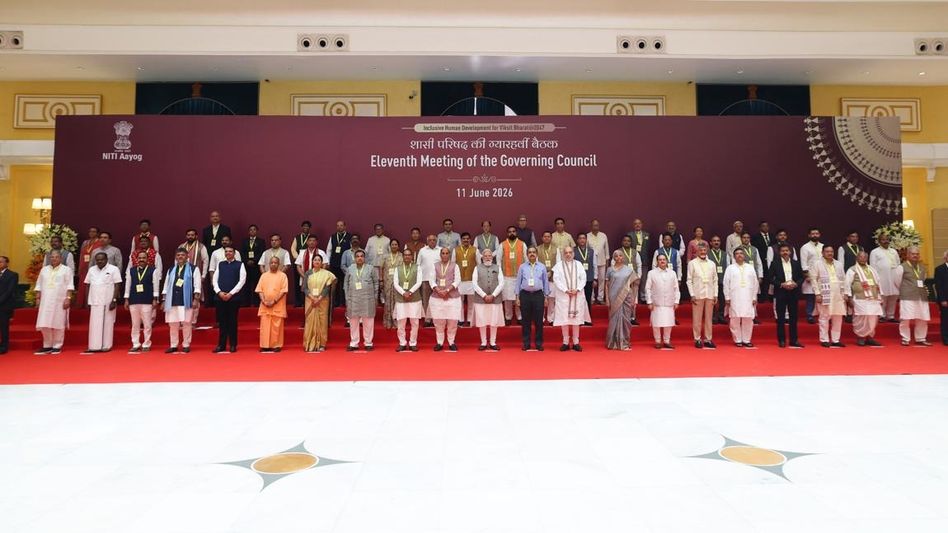
New Delhi/Imphal | Manipur Chief Minister Yumnam Khemchand Singh on Thursday outlined the state government’s progress in restoring peace, rehabilitating internally displaced persons (IDPs), strengthening border security and advancing development initiatives during the 11th Governing Council Meeting of NITI Aayog in New Delhi.
The meeting, chaired by Prime Minister Narendra Modi, was held under the theme “Inclusive Human Development for Viksit Bharat@2047” and brought together Union ministers, state chief ministers, lieutenant governors and senior policymakers to discuss development priorities across the country.
Addressing the gathering, Khemchand Singh expressed gratitude to the Prime Minister for his continued support for Manipur and said coordinated efforts by the Centre and the state government, along with interventions led by Union Home Minister Amit Shah, have contributed to an improvement in the law-and-order situation in the state.
Focusing on the rehabilitation of people displaced by the ethnic violence that has affected Manipur, the Chief Minister said substantial humanitarian assistance has been provided with Central government support. He informed the council that nearly 11,000 displaced families have already been resettled under the ongoing Resettlement and Rehabilitation Package.
Khemchand Singh said the state government is working to ensure the return and rehabilitation of the remaining displaced families at the earliest. He also acknowledged the Centre’s approval of 5,000 additional houses under the Pradhan Mantri Awas Yojana-Gramin for 2026-27 and sought further assistance to strengthen rehabilitation efforts.

The Chief Minister noted that since assuming office on February 4, 2026, his administration has prioritised not only the restoration of peace but also rebuilding trust among communities affected by the conflict. He said reconciliation and confidence-building measures remain central to the government’s approach.
Detailing his outreach initiatives, Khemchand Singh said he visited relief camps in Jiribam and Imphal and travelled through Kangpokpi district to Senapati to assess ground realities. He also held interactions with representatives of Naga and Kuki communities during a visit to Ukhrul district and conducted virtual meetings with displaced persons from Kangpokpi and Churachandpur districts.
Highlighting developments in Jiribam, the Chief Minister said the district has emerged as a positive example of community cooperation. He noted that members of Meitei, Kuki, Paite and Hmar communities have worked together peacefully, enabling displaced families to begin returning to their original homes.
According to him, the government aims to replicate the Jiribam model of peace-building and rehabilitation in other parts of the state to facilitate the return of displaced persons and restore normalcy.
Turning to security concerns, Khemchand Singh stressed the importance of strengthening surveillance and border management along the Indo-Myanmar frontier. He called for coordinated action to tackle cross-border challenges, including drug trafficking, arms smuggling and human trafficking.

He informed the meeting that the Ministry of Home Affairs has completed fencing work along 50 kilometres of the international border, while construction on an additional 80 kilometres is currently underway.
On healthcare, the Chief Minister said more than 1.4 lakh treatments worth over ?181 crore have been provided free of cost under the Ayushman Bharat programme and the Chief Ministergi Hakshelgi Tengbang scheme. He also stated that Manipur currently records the lowest Infant Mortality Rate in the country.
In the education sector, Khemchand Singh highlighted that Manipur’s Gross Enrolment Ratio in higher education stands at 35.5 per cent, significantly above the national average of 28.4 per cent. He said recruitment of teaching faculty is being carried out on a mission mode basis and educational institutions are implementing reforms under the National Education Policy 2020 and the National Credit Framework.