

The areas of Jammu and Kashmir under Pakistan’s illegal occupation are witnessing unprecedented unrest
 KRC TIMES Desk
G L Raina
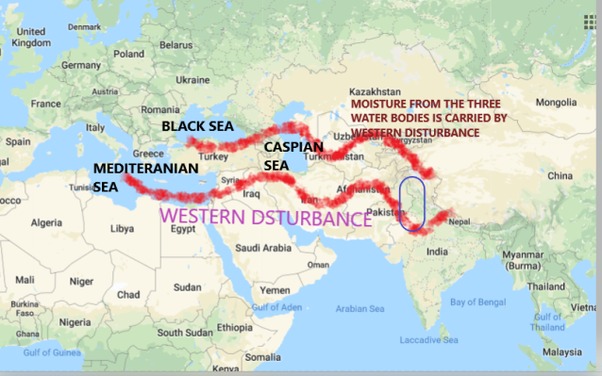
For centuries, India has endured disturbances from the West. Waves of invasions, imperial ambitions, ideological extremism, and geopolitical intrigues entered the subcontinent through its western frontiers. The scars of those disturbances are visible even today-in unresolved borders, terrorism, religious radicalism, and regional instability. Yet history has a peculiar way of turning upon itself.
Today, the West-both in the broader global sense and in India’s immediate western neighbourhood-appears increasingly trapped in crises of its own making. The very forces that were once exported across continents are now rebounding upon their creators. Climate change, geopolitical instability, resource conflicts, mass migration, and fractured political systems are no longer problems confined to distant lands. They have returned to haunt the societies that helped create them.
Nowhere is this phenomenon more visible than in Pakistan.
Pakistan today stands at a constitutional and political crossroads. Once again, questions about the country’s unity, federal structure, and long-term viability have resurfaced. Ethnic tensions simmer across provinces. Balochistan remains in open rebellion. Khyber Pakhtunkhwa struggles with militancy and political alienation.
The areas of Jammu and Kashmir under Pakistan’s illegal occupation are witnessing unprecedented unrest. The very state that spent decades exporting instability beyond its borders now finds itself consumed by instability within. The most striking development is the growing revolt in Pakistan-occupied Jammu and Kashmir (POJK).
For decades, the people of POJK were encouraged to subordinate their economic and political interests to narratives of religion, nationalism, and hostility towards India. Today, many of them have begun to see through that illusion. Their grievances are no longer hidden beneath slogans. They are demanding accountability, representation, and dignity.
These aspirations have found expression through the Jammu Kashmir Joint Awami Action Committee (JAAC), which has emerged as the principal platform of popular resistance. The movement’s demands are remarkably basic: affordable electricity, access to essential commodities, an end to elite privileges, and genuine political representation.
Yet Islamabad’s response has been anything but democratic.
Reports indicate that protests have been met with force, arrests, and violent suppression. Particularly disturbing were incidents in Rawalakot, where unarmed protesters allegedly faced lethal action by security forces. JAAC has been prescribed as a terrorist organisation. Such responses reveal a fundamental contradiction at the heart of Pakistan’s governance model: while democracy is celebrated rhetorically, meaningful challenges to centralized authority are often met with coercion.
At the centre of the unrest lies a deeply flawed political arrangement. The so-called Azad Jammu and Kashmir Legislative Assembly consists of 53 seats, of which eight are nominated and twelve are reserved for a peculiar category known as “Kashmiri migrants” residing in different parts of Pakistan. These seats have long served as instruments through which Islamabad exerts control over political outcomes in Muzaffarabad.

Send your resume:
biswa@jigyasu.co.in
krcfoundation@gmail.com
The mathematics of power is revealing. A governing majority requires the support of twenty-seven members. Islamabad effectively begins with control over twenty seats through nominated members and migrant constituencies. It therefore needs to influence only a handful of directly elected representatives to determine who governs. Under such circumstances, real power inevitably resides not in Muzaffarabad but in Islamabad.
The JAAC’s demand to abolish these reserved seats is therefore far more than an electoral reform proposal. It is a challenge to the entire mechanism through which Pakistan manages and controls POJK. Against this backdrop comes the debate surrounding Pakistan’s proposed 28th Constitutional Amendment.
If enacted in its reported form, the amendment would represent one of the most consequential constitutional transformations in Pakistan’s history. The proposals reportedly include rolling back provincial autonomy established under the landmark 18th Amendment, revising revenue-sharing arrangements in favour of the federal government, raising the voting age from eighteen to twenty-five years, and redrawing provincial boundaries while strengthening Islamabad’s control over peripheral regions.
Viewed in isolation, each proposal is controversial. Viewed together, they reveal something much larger: a systematic attempt to recentralize political authority.
The significance of this shift becomes clearer when one recalls the importance of the 18th Amendment of 2010. That reform was widely regarded as a milestone in Pakistan’s democratic evolution. It transferred substantial authority over education, health, culture, and local governance to the provinces. More importantly, it reflected an acknowledgment that Pakistan’s ethnic and regional diversity could be better managed through federalism rather than centralization. The proposed 28th Amendment appears to reverse that philosophy.

Returning key subjects to federal control would weaken provincial governments and diminish local accountability. Altering the National Finance Commission Award would further erode provincial autonomy by tightening Islamabad’s grip over financial resources. Political autonomy without fiscal autonomy is little more than symbolism.
Perhaps the most startling proposal is the reported plan to raise the voting age from eighteen to twenty-five years. Such a move would disenfranchise millions of young Pakistanis in a single stroke.
At a time when democracies around the world are exploring ways to expand youth participation, Pakistan appears poised to move in the opposite direction. The message would be unmistakable: political participation is welcome only when it produces acceptable outcomes.
The debate over redrawing provincial boundaries raises equally troubling questions. Administrative efficiency may be the stated objective, but boundary changes in ethnically sensitive regions invariably affect representation, resource distribution, and political power. For provinces already suspicious of federal intentions, such measures are unlikely to inspire confidence.
Equally significant are discussions regarding deeper integration of Pakistan-occupied Jammu and Kashmir and Gilgit-Baltistan into Pakistan’s federal structure. Beyond their regional implications, such proposals reinforce the perception that constitutional evolution in Pakistan is moving steadily toward greater centralization rather than greater autonomy.
The foundations were laid through earlier constitutional changes that altered the balance between the judiciary, elected institutions, and the military establishment. Critics argue that recent amendments weakened judicial independence, expanded political influence over judicial appointments, and reduced institutional checks on executive authority. The cumulative pattern is difficult to ignore.

First came the dilution of judicial autonomy. Then came the consolidation of executive and military influence. Now come proposals to curtail provincial autonomy, tighten control over resources, and potentially restrict democratic participation.
Many analysts describe this process as a constitutional counter-revolution. The phrase may sound dramatic, but it captures a deeper reality. Constitutional democracies depend upon a balance among competing centres of power. Federalism restrains excessive centralization. Independent courts check executive overreach. Broad electoral participation ensures democratic legitimacy. When all three are simultaneously weakened, the character of the state itself begins to change.
The irony is striking.
For decades, Pakistan sought strategic depth beyond its borders while neglecting democratic depth within them. It exported instability while suppressing diversity at home. It manipulated identities abroad while denying representation to many of its own citizens. Today, the consequences are becoming visible.
The disturbances that once flowed eastward are now turning inward. The West that disturbed others increasingly finds itself disturbed. Pakistan’s constitutional turmoil, provincial unrest, and growing resistance in POJK are not isolated developments. They are symptoms of a deeper crisis-one rooted in the refusal to accommodate diversity, decentralize power, and trust the democratic aspirations of its own people.
History offers a simple lesson: nations can suppress grievances for a time, but they cannot govern indefinitely against the aspirations of their citizens. The choice before Pakistan is whether it learns that lesson through reform or through further turmoil.
The answer may determine not merely the fate of a constitutional amendment, but the future of the Pakistani state itself.