


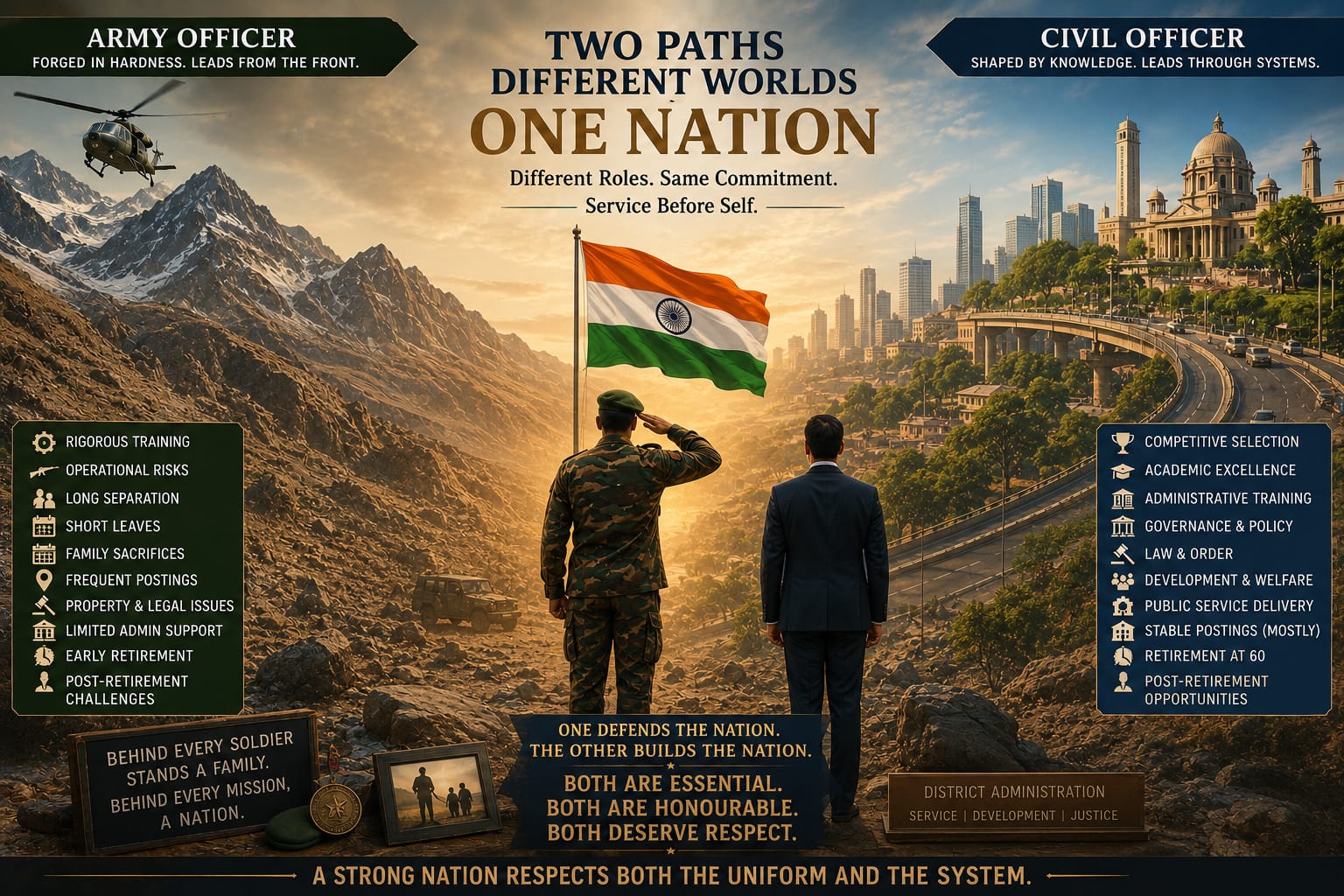
TWO GROOMINGS, TWO WORLDS, ONE NATION
 KRC TIMES Desk
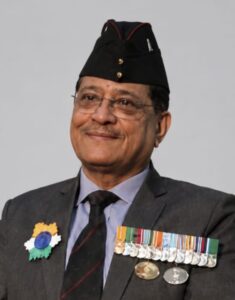
Col (Dr.) Ashwani Kumar, MiD, VSM (Retd.)
A Comparative Reflection on Leadership, Sacrifice, Service and Life Beyond Uniforms.
India’s strength rests not merely on its economy, institutions, or democratic framework but on the dedicated men and women who serve the nation through different avenues. Among these, two pillars stand prominently the Armed Forces and the Civil Services. One safeguards the sovereignty and territorial integrity of the nation, while the other ensures governance, administration, and public welfare.
Both are indispensable to the functioning of the Republic. Both demand commitment, competence, and integrity. Yet the journey, grooming, lifestyle, responsibilities, and post retirement realities of an Army officer and a Civil officer are profoundly different.
The contrast begins on the first day of training and continues throughout their careers and beyond. It shapes not only the officers themselves but also their families, aspirations, and relationships with society.
This article seeks to explore these differences not to create a hierarchy of service, but to foster understanding and appreciation of two distinct worlds that work towards the same national objective.
The Making of an Army Officer.
An Army officer is not merely educated, he is transformed. The journey begins at institutions such as the National Defence Academy, Indian Military Academy, Officers Training Academy, and other military establishments. Here, young men and women are subjected to rigorous physical, mental, emotional, and moral conditioning designed to prepare them for leadership under the most adverse circumstances.
The day starts before dawn. Cadets endure long runs, obstacle courses, route marches, weapon training, tactical exercises, field craft, and survival training. Sleep is limited, comforts are absent, and discipline is uncompromising.
Every aspect of military training is aimed at one objective creating leaders capable of making correct decisions under pressure when lives depend upon them.
The military academy teaches courage, integrity, teamwork, sacrifice, and responsibility. It develops the ability to function under stress and uncertainty. It teaches officers to lead from the front and accept responsibility without hesitation.
The military ethos can be summed up in the timeless principle:
“The safety, honour and welfare of your country come first, always and every time. The honour, welfare and comfort of the men you command come next. Your own ease, comfort and safety come last, always and every time.” Few professions demand such selflessness.
The Making of a Civil Officer.
Civil officers enter service through one of the world’s most competitive examination systems. Success requires intellectual excellence, perseverance, analytical ability, and academic discipline.
Training at institutions such as the Lal Bahadur Shastri National Academy of Administration focuses on governance, public policy, economics, law, management, administration, and leadership.
Unlike military training, the emphasis is not on physical endurance but on understanding systems, institutions, laws, and public administration. Civil officers are groomed to manage districts, implement policies, supervise development projects, maintain law and order, and coordinate government machinery.
Their leadership operates within a legal and administrative framework. They are trained to balance competing interests, navigate political realities, and ensure the delivery of public services.
Both systems produce leaders. However, the nature of leadership they cultivate is fundamentally different.
Leadership: Command versus Administration.
An Army officer commands men in environments where mistakes can cost lives. Whether deployed in high-altitude areas, deserts, counter-insurgency operations, border posts, or peacekeeping missions, military leadership is intensely personal. Soldiers follow officers not because of rank alone but because of trust. A soldier watches whether his officer shares hardships, takes risks, and stands by his men in difficult situations. Military leadership is earned every day.
Civil officers exercise leadership through institutions and systems. Their authority is derived from law, governance structures, and constitutional responsibilities. A District Magistrate, Commissioner, Secretary, or Superintendent of Police influences the lives of thousands or even millions through administrative decisions.

Send your resume:
biswa@jigyasu.co.in
krcfoundation@gmail.com
Their leadership requires policy understanding, negotiation, coordination, crisis management, and long-term planning.
The Army officer often faces immediate operational challenges. The Civil officer faces complex governance challenges. Both are leaders, but they operate in entirely different environments.
The Soldier’s Life: A Story Beyond the Uniform.
To the average citizen, the soldier represents courage, discipline, and patriotism. What remains largely unseen is the personal cost of military service. An Army officer spends much of his career away from home. He serves wherever the nation requires him whether on snow covered mountains, remote deserts, dense forests, conflict zones, or inhospitable border regions.
He misses birthdays, anniversaries, school functions, weddings, and family celebrations.
His commitment to duty often comes at the expense of personal life. The nation sees medals and ceremonial uniforms. The family experiences sacrifice.
The Burden of Separation.
One of the most difficult aspects of military life is prolonged separation from family. In many operational and field areas, family accommodation is unavailable. Officers and soldiers spend months, sometimes years, away from their spouses, children, and elderly parents. Communication may be irregular. Emergencies at home often have to be handled by spouses alone.
The emotional strain is significant.
While the soldier remains focused on operational responsibilities, his family fights its own battles far from public view. Short Leave, Endless Responsibilities
Many civilians assume that military personnel enjoy extended vacations. The reality is quite different. Operational commitments frequently reduce leave opportunities. Even when leave is granted, it is seldom restful. The soldier returns home carrying months of accumulated responsibilities.
(i) There are property disputes to settle.
(ii) Banking matters to address.
(iii) Court appearances to attend.
(iv) Children’s education to review.
(v) Family issues to resolve.
(vi) Medical concerns of ageing parents to manage.
In a span of a few days or weeks, he attempts to accomplish tasks that civilians handle gradually throughout the year. Often, he returns to duty physically and mentally exhausted.

The Silent Strength of Military Families.
Every successful soldier stands upon the sacrifices of his family.
Military spouses perform extraordinary roles under difficult circumstances.
They raise children independently.
They manage households.
They care for elderly family members.
They handle emergencies.
They make important decisions in the absence of their partners.
Many military wives spend years functioning as single parents despite being married. Their resilience and contribution remain largely unrecognised. Yet they form the invisible backbone of military effectiveness.
Children of Soldiers: Growing Up in Motion my Military children develop adaptability, confidence, and resilience at an early age. However, these qualities emerge from constant disruption. Every two or three years, they change schools, cities, languages, and social environments.
Friendships are repeatedly interrupted.Educational continuity becomes challenging. Competitive examinations often become more difficult due to changing curricula. While these children gain exposure to India’s diversity and develop exceptional adaptability, they often sacrifice stability and continuity. They learn to say goodbye far more often than most children.
Property Disputes and Administrative Challenges.
Among the most painful challenges faced by serving personnel and veterans are property-related disputes. Because military personnel spend years away from their hometowns, their land and property often become vulnerable.
(i) Encroachments occur.
(ii) Fraudulent transactions are attempted.
(iii) Revenue records may be manipulated.
(iv) Local disputes remain unresolved.
Unfortunately, many soldiers find that obtaining assistance from local authorities is neither easy nor timely. Police intervention is often delayed. Revenue matters take years to resolve. Court proceedings become lengthy and expensive. The irony is striking.
A soldier who protects national territory may struggle to protect his own property. Many veterans believe that there should be dedicated mechanisms within district administrations to address grievances of serving soldiers and ex-servicemen on priority.
Political Influence and Professional Challenges.
The Armed Forces operate on principles of professionalism, neutrality, and constitutional loyalty. However, military operations frequently intersect with political narratives and administrative considerations.
Internal security operations, disaster response, and aid to civil authorities often place military officers in situations where professional judgments are scrutinised through political lenses.
Despite these pressures, military officers are expected to remain apolitical and focused solely on their mission. This requires exceptional institutional discipline and maturity.
The Great Divide: Retirement.
Perhaps the most significant difference between Army officers and Civil officers emerges after retirement. Most Civil officers retire at sixty years of age after long careers within administrative structures. Many continue serving through commissions, tribunals, advisory positions, think tanks, consultancies, and public institutions.
Army officers often retire much earlier. Many leave active service in their forties or early fifties. At an age when they possess tremendous energy, experience, and leadership capability, they must begin a second career. Unfortunately, opportunities matching their skills are limited.
Despite proven expertise in leadership, crisis management, logistics, planning, training, and administration, veterans often struggle to find positions that fully utilise their capabilities. This represents a significant loss for the nation.
The Need for Greater Support.
India possesses one of the largest communities of military veterans in the world. These veterans represent a national resource. Their experience can strengthen governance, disaster management, education, infrastructure, security, and public administration. Greater integration of veterans into civil institutions would benefit both society and the nation.
Similarly, dedicated mechanisms for resolving property disputes, family grievances, educational challenges, and post retirement employment concerns would significantly improve the welfare of military families. A nation that honours its soldiers must support them not only during service but throughout their lives.
Mutual Respect: The Way Forward.
Comparisons between Army officers and Civil officers often become emotional and unproductive. The reality is simple. The Army cannot govern districts. The Civil Services cannot defend borders under hostile fire. Each institution performs functions that the other cannot. The soldier and the civil servant are not competitors. They are partners in nation-building.
The Army officer protects the nation from external threats. The Civil officer ensures stability, governance, and development within. The strength of India lies not in choosing one over the other but in ensuring mutual respect and cooperation between both.
To Conclude, the Army officer and the Civil officer serve the same Republic through different paths.
One is forged in hardship, uncertainty, and sacrifice. The other is shaped through governance, administration, and policy.
Both deserve admiration. Yet it is important for society to understand that military service imposes unique burdens not only on the individual soldier but also on his family.
Frequent relocations, prolonged separations, disrupted education, property disputes, limited post retirement opportunities, and constant uncertainty are realities that military families endure throughout their lives. A nation truly honours its soldiers not merely through parades, medals, and ceremonial speeches, but through meaningful support systems that protect their families, secure their rights, and value their experience.
For while the Civil officer helps administer the nation, it is the soldier who stands watch day and night, in peace and war to ensure that the nation remains free, secure, and strong. That responsibility carries a weight few will ever know and a sacrifice that can never be fully repaid.
Author’s Note.
This article is not intended to diminish the invaluable contribution of the Civil Services, nor does it seek to create divisions between two institutions that serve the same nation. It is a reflection based on decades of personal experience in uniform and extensive interaction with civil administration before and after retirement. The objective is to highlight the unique challenges faced by soldiers and their families, challenges that often remain unseen by society.
If this article encourages greater understanding, empathy, and cooperation between military and civil institutions, it will have served its purpose.
‘Ashk Machhanvi’.
About the Author.
Col (Dr.) Ashwani Kumar, MiD, VSM (Retd.), popularly known by his pen name Ashk Machhanvi, is a decorated Indian Army veteran, intelligence professional who served in the Cabinet Secretariat an elite organisation, he is an author, and curative historian.
During a distinguished military career spanning operational, intelligence, training, and strategic assignments, he served in Military Intelligence, national security establishments, and various government organisations like Bureau of Police Research and Development, MHA. A recipient of several military and civilian honours, including the Mention-in-Despatches (MiD) FOR Gallantry and Vishisht Seva Medal (VSM), he continues to contribute through writing, research, veteran welfare, and public discourse on national security, governance, history, and culture.
Disclaimer:
The views expressed in this article are solely those of the author and are based on personal experiences, observations, and research. They do not necessarily represent the official views or policies of the Indian Army, the Government of India, or any organisation with which the author is or has been associated.
The article is intended to promote informed discussion, mutual understanding, and appreciation of the distinct roles played by both the Armed Forces and the Civil Services in nation-building.