


In Bangladesh, the Awami League (AL), long the country’s pre-eminent political force, had its activities banned on May 10-12 2025 under the Anti-Terrorism Act
 KRC TIMES Desk
Pushp Saraf
What does it say when a ruling party and its rivals train their fire on a third outfit they have already outlawed altogether – one whose leaders and senior workers are either behind bars or in exile? Ordinarily, this would be a textbook case of flogging a dead horse.
Reality can be stranger. In Bangladesh, the Awami League (AL), long the country’s pre-eminent political force, had its activities banned on May 10-12 2025 under the Anti-Terrorism Act. The proscription followed the ouster of its leader, former Prime Minister Sheikh Hasina, who was driven into exile on August 5, 2024.
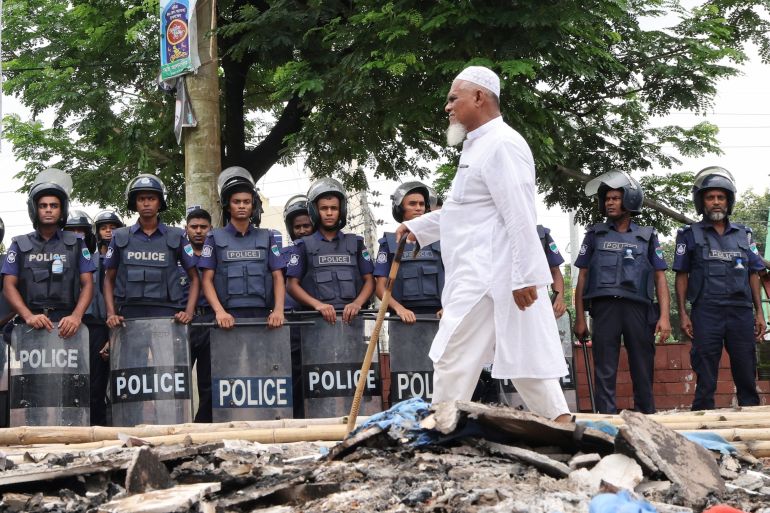
And yet, on 23 June 2026, the party’s 77th founding anniversary, the entire state machinery was once again mobilised against the AL. The army and the Border Guard, a paramilitary force, were deployed across six districts. Police armoured vehicles took up position, most pointedly outside the historic Dhanmondi 32 residence of the late Sheikh Mujibur Rahman, Father of the Nation and the face most identified with the party.
Armed forces officers were granted special executive-magistracy powers to dispense justice on the spot – arresting offenders, dispersing unlawful assemblies, conducting searches and taking preventive measures to keep order. In effect, it amounted to a second ban on an already banned party, designed to pre-empt any celebration.
Dozens of party workers were rounded up as they tried to mark the day, in some cases simply by cutting cakes. No disorder was reported. In short, the security forces appeared to have denied the AL any chance of turning the anniversary to its advantage. They had been directed to keep the pressure on till June 30.
The political class joined in. The ruling Bangladesh Nationalist Party (BNP), the opposition Jamaat-e-Islami (BJI) and the National Citizens Party (NCP) all took to the streets to hound AL activists. The BNP told its leaders and cadres to stay vigilant, hold their localities, organise rallies and sit-ins, take out processions and alert the security forces to any “evil activity” or conspiracy by the AL. Home Minister Salahuddin Ahmed branded the party a “mafia group” and confirmed that the BNP and its associated bodies had been instructed accordingly. The BJI-led alliance, for its part, held a rally denouncing the enforced disappearances and killings of the AL years.

What does all this underline, if not the enduring importance of the AL? The party built its identity on a secular, regionally cooperative and development-oriented agenda, and on close ties with India. The scale of the security operation is itself the clearest proof that it remains a major factor in national politics. Evidently, more than a year of efforts to silence it have not yet succeeded.
Whatever conciliatory words Prime Minister Tarique Rahman offered in Kuala Lumpur days before the anniversary were plainly not meant for the AL. Addressing Bangladeshi expatriates in Malaysia, he declared that he would not use state power to avenge the suffering he and his family endured during years in opposition.
During the AL’s tenure, Tarique lived in exile while his mother, former Prime Minister Khaleda Zia, struggled with the ill health that ultimately led to her death. As he put it: “Now, at this very moment, BNP is in charge of running the country. I am the Prime Minister. If I want, I can take revenge out of personal anger. But if I do that, can you tell me what the benefit would be? There would be no benefit.”
However, while Tarique himself has neither formally banned the AL nor explicitly sought to bar it from political life, he has done little to unwind the harsh measures inherited from the interim government that preceded him.
The party’s senior leadership remains in exile or in custody, facing prosecution on charges ranging from corruption to murder. Hasina herself was sentenced to death in absentia by the International Crimes Tribunal (ICT) in Dhaka on November 17, 2025, after being found guilty of crimes against humanity and incitement to murder. She has dismissed the tribunal as a “kangaroo court” and denounced the proceedings as politically motivated.
Neither Tarique nor the BNP has shown any inclination to soften the pressure on Hasina or the AL. Indeed, the BNP has benefited politically from the party’s marginalisation, securing victory in the February 2026 general election in the absence of its principal rival.
Nor is the AL likely to find sympathy among the other major political forces. Both the BJI and the NCP, now prominent actors in the political landscape, remain deeply critical of the AL and its leadership. NCP convener Nahid Islam ruled out the AL’s return to politics in Bangladesh, describing it as a “fascist, genocidal and terrorist organisation”.
The hostility between the BJI and the AL is rooted in longstanding ideological differences over the religious and political character of the Bangladeshi state. Their occasional alliances in the 1990s were driven more by political expediency than by shared principles.
They had first joined hands against President Hussain Muhammad Ershad’s military-backed regime and later in the campaign that helped unseat the BNP in 1996. Ironically, the BNP itself had once stood alongside the AL in the broader opposition movement against Ershad.
For now, however, those historical alignments appear largely irrelevant. Bangladesh’s political landscape has been reshaped by the dramatic fall of the AL, leaving old rivalries, alliances, and ironies overshadowed by a new and deeply polarised reality.
To the AL’s credit, battered and bruised though it may be, the party remains determined to fight on. Its greatest asset is its formidable record in the nation’s political life. The party proudly describes itself as the driving force behind every major democratic milestone in Bangladesh’s history, from the Language Movement of 1952 and the Six-Point Movement of 1966 to the mass uprising of 1969 and, ultimately, the Liberation War of 1971 under the leadership of Sheikh Mujibur Rahman. Few would deny its claim to having played a decisive role in transforming Bangladesh from an aid-dependent country into one of South Asia’s most dynamic economies during Hasina’s tenure.

The party characterises the campaign against it as a calculated exercise in vengeance that belies official claims of democratic restoration. Deprived of the guidance of many of its imprisoned or exiled leaders, its rank and file nevertheless continues to organise sporadic displays of defiance. In the first half of June alone, activists of the Bangladesh Chhatra League (BCL), its student wing, staged a procession on the Dhaka-Chattogram Highway, leading to the arrest of 45 participants.
Around the same time, more than a hundred BCL members reportedly gathered for a meeting and torchlight procession in Chattogram, prompting authorities to file cases against dozens of them on allegations of subversive activities. Earlier, AL activists and members of affiliated organisations used the funeral procession of veteran leader and freedom fighter Tofail Ahmed in Dhaka to raise slogans such as “Joy Bangla, Joy Bangabandhu” and “Tofail Bhai, Bhoy Nai, Rajpoth Chhari Nai” (brother Tofail, there is no fear. We have not abandoned the streets), resulting in further detentions.
The AL’s enduring imprint on Bangladesh’s political consciousness is evident even in the language of its opponents. Its name remains the benchmark against which political rivals are measured. BJI chief and Leader of the Opposition Shafiqur Rahman, for instance, has repeatedly taunted the BNP by accusing it of following the path of the AL without possessing either its organisational strength or political stature.
“We were once oppressed together, but with due respect,” he remarked, ” no matter how hard you try, you cannot become that Awami League; you can only become a ‘weakened version’ of it.”
That may be the central conundrum of contemporary Bangladeshi politics. The AL has been driven from power, its leadership dispersed, imprisoned or exiled, and its future clouded by legal and political uncertainty. Nevertheless it continues to dominate the national conversation. Whether as a target of prosecution, a symbol of resistance, or a reference point for allies and adversaries alike, the party remains impossible to ignore. The struggle over Bangladesh’s political future is, in many ways, still being defined by the question of what place the AL will ultimately occupy within it.