


RSS Chief Dr. Mohan Bhagwat Speaks at the Vijayadashami Celebration
 KRC TIMES National Bureau

Nagpur, October 20
‘Many problems exist in a society as large as ours, and there may also be several shortcomings in the system. Therefore, protests to resolve these problems are natural. However, society should not be divided in the pursuit of cheap popularity or political gains through such protests,’ Dr. Mohan Bhagwat, Sarsanghachalak of the Rashtriya Swayamsevak Sangh (RSS), on Tuesday.
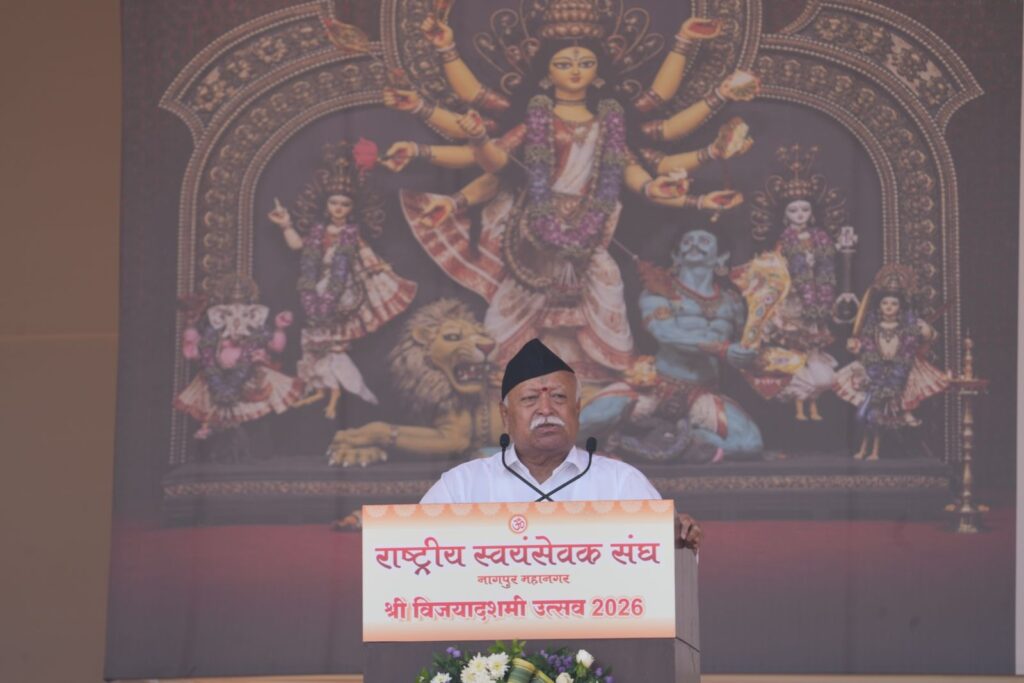
He was addressing the Centenary Culmination Vijayadashmi Utsav of RSS at Reshimbagh Ground in Nagpur. ‘Regardless of whether it is a section of the society staging a protest, the government and administration taking action to maintain peace and law and order, or political leaders, everyone must ensure that their actions do not create tension, hatred, hostility, bitterness or divisions within our united society. However intense our emotions may be, our conduct must remain within the framework of the Constitution and the law. Everyone must also remain mindful of the need to maintain civilian dignity and decorum in their language, actions and dealings. We must ensure that the desire to win votes, the temptation of cheap popularity or the greed for political gains does not overpower our conscience and goodwill,’ Dr. Bhagwat said.
Sanjay Gupta, editor-in-chief of Dainik Jagran, was present as the chief guest on the occasion.
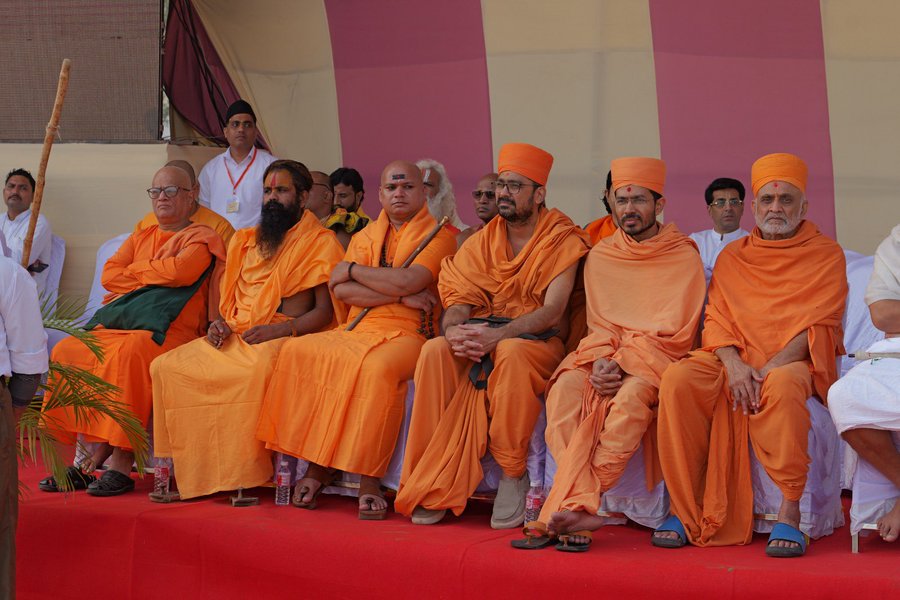
Vidarbha Prant Sanghachalak Deepak Tamshettiwar, Sah Sanghachalak Shridhar Gadge and Nagpur Mahanagar Sanghachalak Rajesh Loya were present on the dais. Rajesh Loya delivered the introductory remarks.
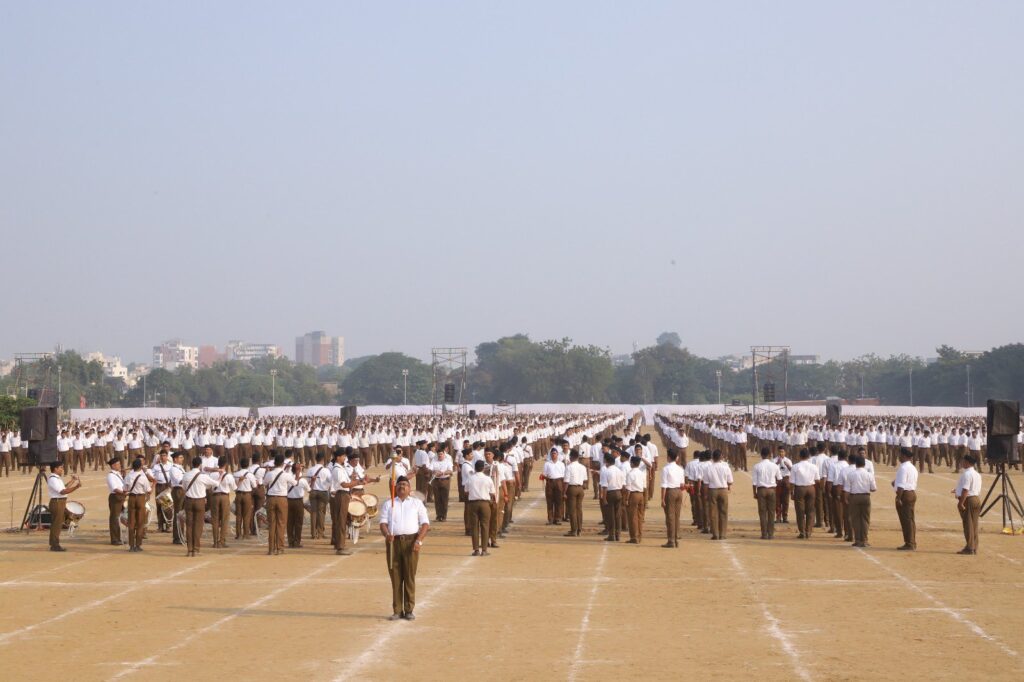
Before the main address, Swayamsevaks provided a guard of honour to the dignitaries on the dais through Pradakshina Sanchalan. Swayamsevaks also presented physical demonstrations. The Ghosh attracted the audience with its impressive formations.
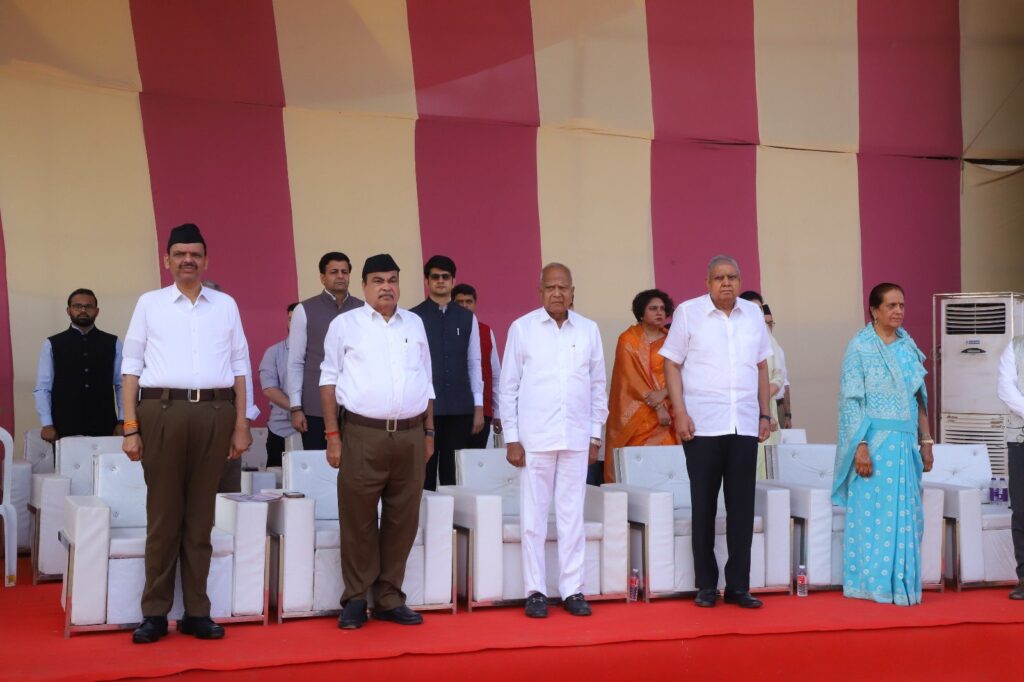
Among the distinguished guests attending the programme were former Vice President of India Jagdeep Dhankhar and Yaniv Revach, Consul General of Israel for India’s Mid-West region. Maharashtra Chief Minister Devendra Fadnavis, Union Minister Nitin Gadkari, former Governor Banwarilal Purohit, and several other dignitaries were also present at the event.
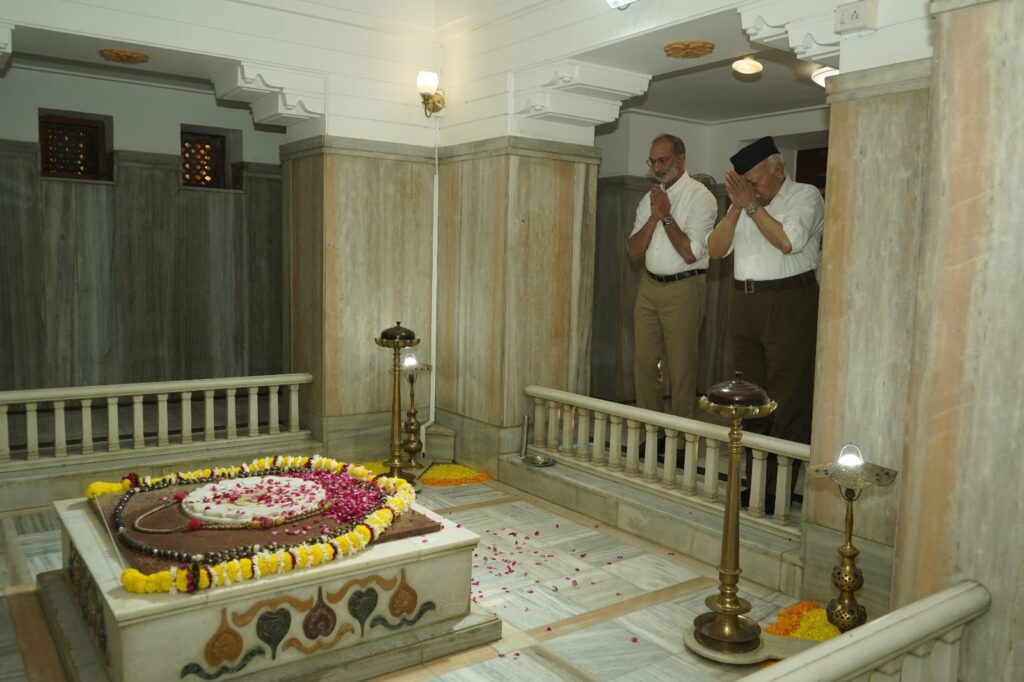
At the beginning of his annual address, Dr. Mohan Bhagwat paid tribute to Sant Ravidas, Mahatma Jyotiba Phule, Swami Shraddhanand of the Arya Samaj, Swami Lakshmanananda Saraswati and Sriman Raj Narayan Basu.
On the occasion, Dr. Bhagwat also reviewed the various programmes organised during the Rashtriya Swayamsevak Sangh’s (RSS) centenary year. According to the figures presented, outreach activities were conducted across 461,527 villages and 41,076 urban settlements, covering a total of 101,988,511 households across the country. A total of 426,497 men and women attended symposiums organised in 1,117 districts. Harmony meetings were held in 5,036 blocks, while Hindu gatherings were organised in 34,187 mandals. These gatherings witnessed the participation of 3,925,225 young people.
‘The Foundation of Seva Bodh’
‘Our Constitution describes us not as subjects, but as ‘We, the People of India ’-a society that is emotionally united despite its diversity. The Constitution’s Directive Principles clearly outline the path towards strengthening this emotional bond further. Although we possess an understanding of the experience that gives rise to this emotional bond, as well as some of the finest philosophical explanations of it in the world, our actual conduct has remained entirely different and inconsistent with these principles. As a result, we fell to a great extent from our position as a Vishwaguru (world leader) that we had to endure foreign subjugation for several centuries. Now, we have once again begun moving towards unity and progress. Therefore, we must emerge from our state of forgetfulness, gain a clear understanding of these principles, embrace them wholeheartedly and develop the qualities consistent with them across every sphere of our lives,’ Dr. Bhagwat said.
Dr. Bhagwat also reviewed the various programmes conducted during the RSS centenary year.
India’s growing global significance
“Curiosity about India is growing across the world. Many Western countries, despite their material prosperity, are experiencing anxiety because of an incomplete worldview based on materialism, individualism and unrestrained consumption. They have no answers to several questions: How should diversity be managed? How can development be balanced with environmental protection? How can we treat those who are different from us with a sense of belonging? How can the erosion of the family system and the decline of values among younger generations be prevented? As a result, the world today is confronting geopolitical tensions, economic uncertainty, environmental crises and destruction arising from struggles for dominance. The world recognises that India has effective answers to all these problems,’ he said.
Concerns over social media and OTT platforms
He expressed concern over the growing trend of drug addiction among the youngsters and emphasised the need to take effective measures to address the problem as soon as possible.
‘With advances in science and technology, all kinds of information and news are reaching people through social media. In many countries, younger generations appear to be accepting information obtained through these platforms without considering whether it is right or wrong. After experiencing the adverse consequences, some countries have imposed restrictions on these platforms. Our country, too, is recognising the need for similar measures, particularly concerning OTT platforms. The government and administration should consider this issue seriously. Even if information is freely available, younger generations must develop the ability to distinguish between what is appropriate and what is not. To address this problem, RSS volunteers will work alongside everyone in India who is engaged in finding solutions, with the aim of building a nationwide response. In the coming years, the major responsibility of building a prosperous India that attains its highest potential and becomes a Vishwaguru will rest on the shoulders of the younger generation. Our youth must be fully equipped and prepared in every respect to accept this challenge and meet it successfully,’ he said.
Dr. Bhagwat expressed regret that the RSS was unnecessarily dragged into unpleasant or unexpected incidents in society, even when the organisation had no connection with those incidents and did not support them.
Attempts to divide India, Hindus and the RSS
‘A storm has risen from the West, driven by a demonic determination to destroy and devastate civilisation, goodness, cultural values and human traditions in India and across the world. Even the so called developed countries are troubled and helpless in the face of this phenomenon. By contrast, over the past several decades, India has gradually established its position in the world through its own strength and appropriate policies. Certain forces are aware that India’s progress could put an end to their activities. These forces conspire to create chaos in various countries and install their own agents to serve their interests. Therefore, India is their decisive and strongest competitor, as well as their ultimate and most important target. These forces operate by considering how to create divisions between India, Hindus and the RSS, and by devising plans to achieve this. Some individuals who share their tendencies also assist them in these efforts,” Dr. Bhagwat criticised.
He concluded by saying that the problems troubling and frightening the world stem from an incomplete perspective on life.
“Otherwise, we too have much to learn from the rest of the world in terms of enterprise and achievement. While learning from others, we must clearly understand and embrace the nature of our national identity, preserve our unity and capabilities, and work together in a co-ordinated and collective effort,’ Dr. Bhagwat urged.
RSS Helped Preserve Hindu Way of Life : Sanjay Gupta
‘The Rashtriya Swayamsevak Sangh and organisations inspired by its ideology are repeatedly accused of promoting Hindu extremism. However, had the RSS not existed, Hindu values and the Hindu way of life might have disappeared long ago,” said Sanjay Gupta, editor-in-chief of ‘Dainik Jagran’ and the chief guest at the event.
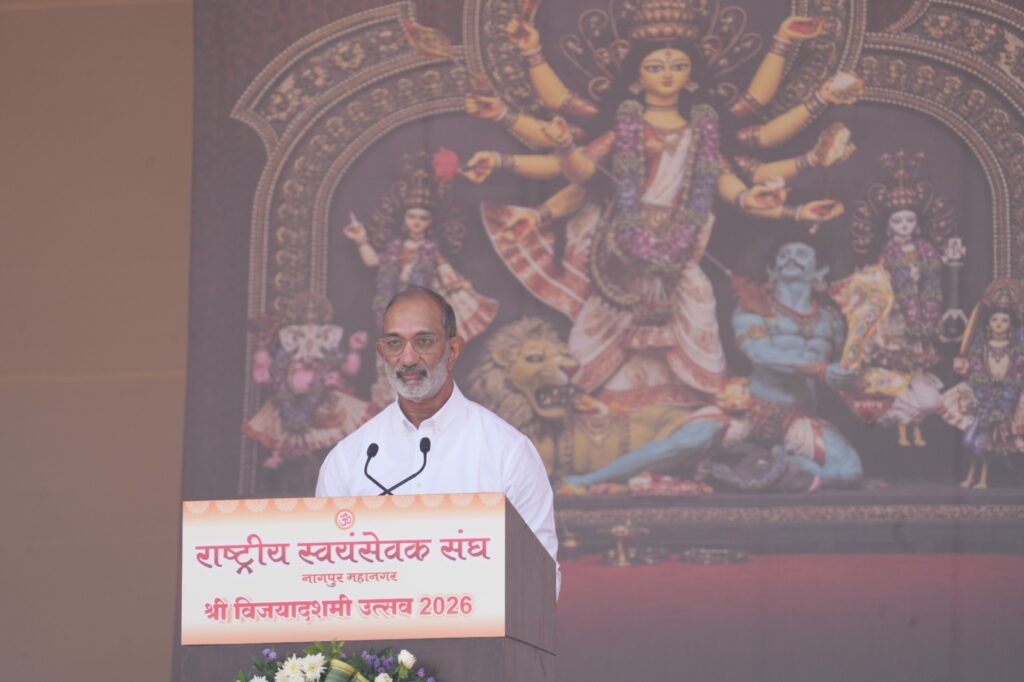
“Even after nearly six hundred years of foreign subjugation, Indian identity and Hindutva have established an influence across the world. The primary credit for this should go to the RSS,’ he said, praising the organisation’s work.
Gupta said that organisations such as the RSS were always necessary to eliminate social evils that become entrenched over time, because the RSS worked with a spirit of selfless service.
‘Political parties also have a responsibility to bring about social reforms. However, political ambitions driven by vote-bank politics give rise to a different kind of social distortion. With a few exceptions, the public appears to have limited confidence in many political leaders, at least when it comes to their commitment to personal development and self-improvement. In such circumstances, the need for and relevance of the RSS and organisations inspired by it become even greater,’ Gupta said.
He further stated that some political parties and numerous social organisations in India were still unwilling to recognise the importance of the RSS.
‘After India gained independence, there was no other major organisation that promoted traditional and cultural Indian values and explained their importance to the public on a comparable scale. From the perspective of independent India, if the RSS and organisations inspired by its values did not exist, it would not be long before the Hindu way of life, in its present form, was separately defined in the Constitution on the basis of caste distinctions, and Hindu society became divided once again,’ Gupta said.
Gupta added that during the previous century, the RSS had focused on addressing various challenges faced by Hindu society that he attributed to appeasement politics.
‘Now, among the challenges the RSS has taken up for the coming century, character-building among the citizens of the country is the highest priority. If India is to regain its previous glory, this will not be possible without character-building,’ he concluded.