

The Unequal Measure of Human Existence
 KRC TIMES Desk
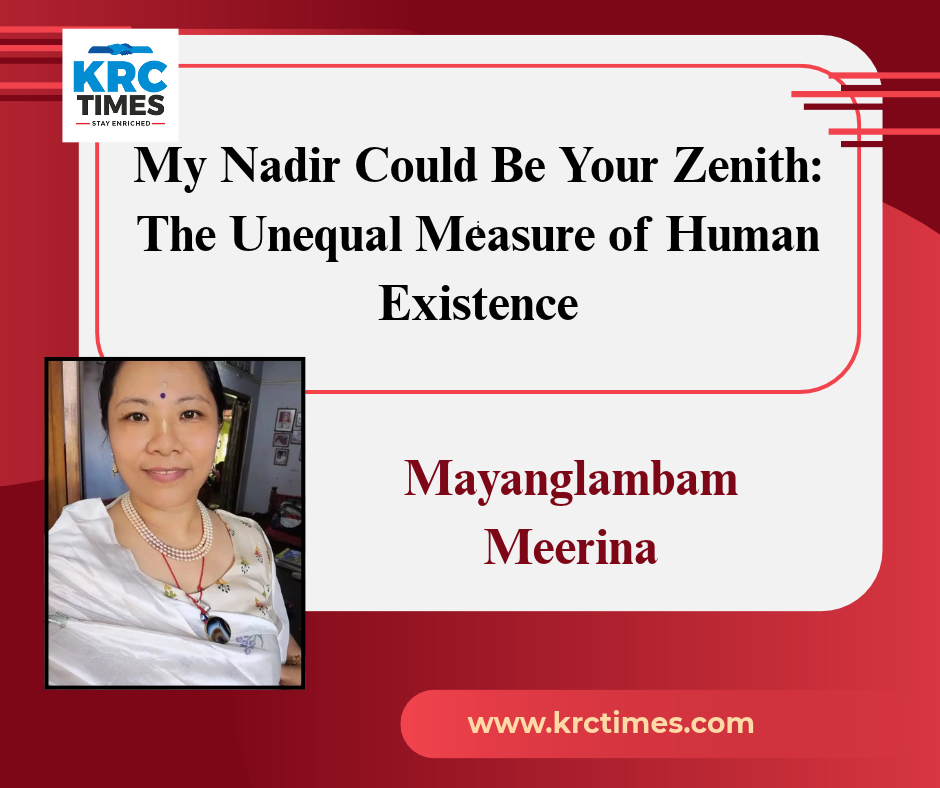
Mayanglambam Meerina
What appears to be someone’s lowest point may be another person’s greatest achievement. Life is not experienced through a common lens; it is shaped by circumstances, opportunities, struggles and the privileges we inherit.
Human existence is an interesting paradox. What one person considers a failure may be another person’s greatest accomplishment. What appears to be the lowest point in someone’s life could represent the highest achievement another has ever imagined. This is the contradiction captured in the expression, “My Nadir Could Be Your Zenith.”
Nadir represents the lowest point, the depth of one’s struggles, while zenith signifies the highest point of achievement, recognition or success. Yet, when these two extremes intersect in society, they reveal a deeper truth about human differences: we do not begin life from the same position, nor do we measure success using the same standards.
For someone born into privilege, access to education, financial security, professional opportunities and social connections may seem like ordinary aspects of life. For another, obtaining a basic education, securing a stable livelihood or providing two meals a day for the family may represent an extraordinary victory. What one individual takes for granted may be another individual’s lifelong aspiration.
This is where the comparison of human achievements becomes complicated. We often judge people by their visible outcomes without understanding the invisible circumstances that shaped their journeys. A person struggling to secure a modest income may be fighting a battle far greater than someone competing for a prestigious position. Yet society frequently celebrates the latter while overlooking the former.
The tragedy lies not in the difference between aspirations but in our tendency to measure everyone using the same yardstick.
The illusion of comparison
Modern society has become increasingly obsessed with comparison. Wealth, professional designations, material possessions, social recognition and public visibility have become convenient indicators of success. Social media has further intensified this culture, presenting carefully curated images of achievement while concealing the struggles, failures and insecurities behind them.
Consequently, people begin to evaluate their lives against standards that may have little relevance to their personal circumstances. Someone celebrating a modest achievement may feel inadequate when compared with another person’s extraordinary success. Similarly, those who have reached considerable heights may fail to recognise the magnitude of what others have overcome.

But success is never entirely relative to material achievement. For a person who has experienced years of uncertainty, finding stability may be a zenith. For someone who has struggled with social exclusion, being accepted and respected may represent the ultimate accomplishment.
For a parent who has sacrificed personal ambitions to secure a better future for their children, seeing them succeed may be the highest point of an otherwise difficult journey.
These achievements may not attract applause, awards or public recognition, but their significance cannot be diminished.
Privilege and the unequal starting line
One of the uncomfortable realities of society is that opportunities are not distributed equally. Some inherit wealth, networks and security, while others inherit economic uncertainty, social disadvantages and responsibilities that begin long before they are old enough to understand them.
The difference is not necessarily in intelligence, determination or ambition. Often, it is in the opportunities available to translate those qualities into tangible achievements.
A young person with access to quality education may view a university degree as a natural progression. Another, struggling to support the family financially, may consider completing secondary education an enormous accomplishment. Both journeys require effort, but the obstacles are vastly different.
This is why comparing achievements without considering circumstances can become an exercise in injustice. We celebrate the destination without acknowledging the distance travelled or the barriers overcome.
The psychological burden of being measured
The constant comparison of human lives also creates an invisible psychological burden. People begin to associate their self-worth with what they possess, where they stand professionally and how society perceives them.
In this race for recognition, individual accomplishments lose their meaning. A milestone that once brought happiness becomes insignificant when placed beside someone else’s success. Gradually, personal fulfilment is replaced by the anxiety of keeping up.
However, life is not a competition in which everyone is expected to reach the same destination at the same time. Some journeys are marked by rapid progress, while others demand years of patience, sacrifice and resilience.
The person standing at the bottom today may be fighting circumstances that others have never experienced. Equally, the person standing at the top may have faced struggles that remain invisible to the world.
Human experiences cannot be accurately understood through appearances alone.
The need for empathy over superiority
Perhaps the greatest lesson in the expression lies in humility. Reaching one’s zenith should not become a reason to look down upon someone standing at their nadir.
Likewise, being at one’s lowest point should not be interpreted as the absence of potential or the end of possibilities.
Positions in life are not permanent. Fortunes change, circumstances evolve, and unexpected events can redefine even the most secure existence. The person who enjoys abundance today may encounter uncertainty tomorrow, while someone struggling today may eventually discover opportunities that transform their life.
What humanity needs, therefore, is less judgement and more understanding. Instead of asking why someone has achieved so little, perhaps we should ask what obstacles they have had to overcome. Instead of measuring another person’s worth through their economic or social position, we should recognise their dignity as an individual.
Ultimately, “My Nadir Could Be Your Zenith” is more than a philosophical expression about contrasting human experiences. It is a reminder that success is subjective, struggles are individual and human dignity should never be determined by social standing.
The highest form of achievement is not necessarily reaching the top of the social ladder. Sometimes, it is simply finding the strength to rise after life has brought us to our lowest point.
And perhaps the real measure of an evolved society is not how much importance it gives to those standing at the zenith, but how much dignity, understanding and opportunity it extends to those still struggling at the nadir.