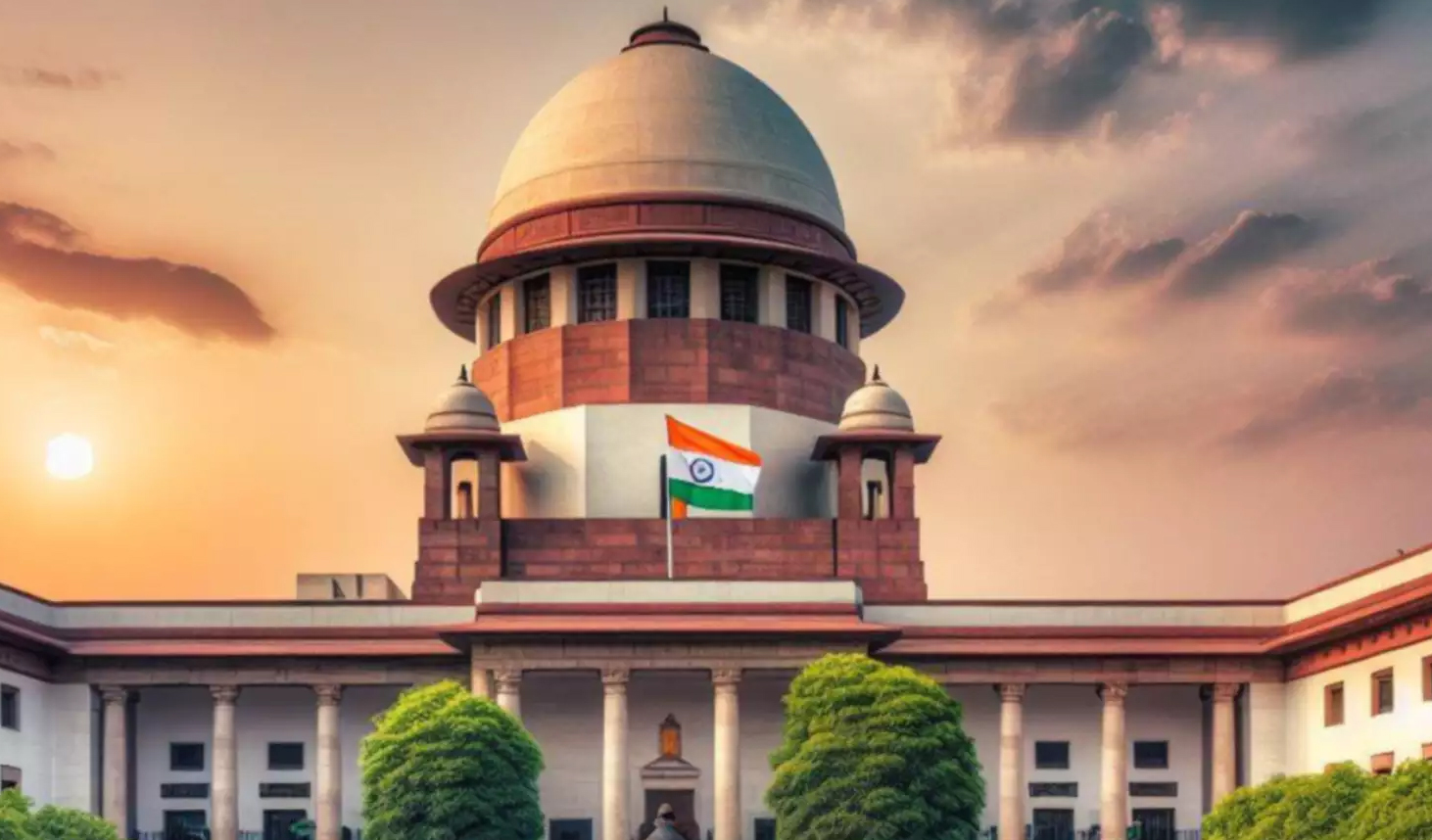


During the special Sunday sitting on October 11, 2026, the Supreme Court bench of Justices Joymalya Bagchi and V. Mohana heard sharp exchanges between senior counsel representing the petitioners and Solicitor General Tushar Mehta representing the Union government
 KRC TIMES National Bureau
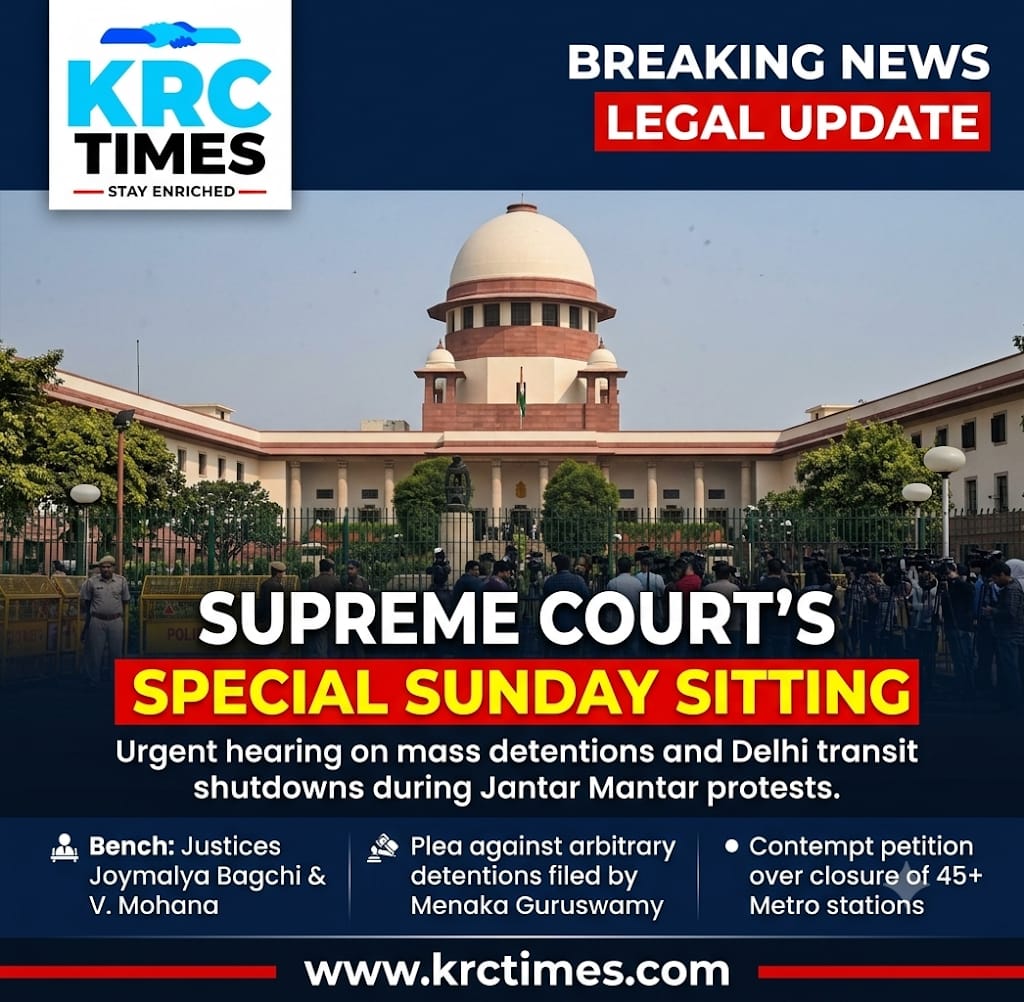
A special Sunday hearing took place on October 11, 2026, before a Supreme Court bench (led by Justice Joymalya Bagchi) addressing transit curbs and detentions during ongoing protests in New Delhi.
Key directives from the hearing included:
- No Illegal Detentions: The bench directed authorities to ensure no peaceful protesters are illegally detained.
- Transit & Connectivity: Directives were issued for normal Delhi Metro and rail operations to continue unhindered, and for internet services to remain undisturbed.
- Access to Justice: The court instructed authorities to remove the Section 163 restriction notice board outside the Supreme Court premises so public access is not impeded.
- Notice to Authorities: The bench called for a short affidavit from the authorities to show cause regarding compliance and the measures enforced.
During the special Sunday sitting on October 11, 2026, the Supreme Court bench of Justices Joymalya Bagchi and V. Mohana heard sharp exchanges between senior counsel representing the petitioners and Solicitor General Tushar Mehta representing the Union government.
Arguments by Senior Advocate Kapil Sibal
- Overreach of Prohibitory Orders: Sibal argued that Delhi Police unlawfully invoked prohibitory orders under Section 163 of the Bharatiya Nagarik Suraksha Sanhita (BNSS) far beyond the specified territorial limits, using localised restrictions as a blanket pretext to detain peaceful individuals across the capital.
- Disproportionate Civic Shutdown: He contended that simultaneous metro station shutdowns, train curbs, and internet throttling constituted a disproportionate assault on the fundamental rights to movement and peaceful assembly.
- Suppression of Dissent: Sibal submitted that the administration’s sweeping measures effectively criminalised ordinary public presence and stifled peaceful opposition.
Arguments by Other Senior Counsel
Dr. Menaka Guruswamy:
- Detention of Opposition Leaders & Train Passengers: Challenged the preventive detention of opposition leaders and former Chief Ministers picked up from their homes and the streets. She highlighted reports of inbound passengers being pulled off long-distance trains arriving in Delhi to block assembly.
- Willful Contempt: Argued that the Delhi administration and DMRC acted in deliberate contempt of the Supreme Court’s prior October 9 order, which had explicitly prohibited blanket shutdowns of essential public transit.
Gopal Sankaranarayanan:
- Targeting of Lawyers: Flagged that roughly 150 advocates holding a peaceful march near the M.C. Setalvad chambers were intercepted, manhandled, and bundled into police vans.
- Right to Practice and Move: Emphasised that lawyers, while claiming no separate class privilege, were deprived of the basic constitutional freedom of movement necessary to carry out their legal duties.
K.K. Venugopal & Shadan Farasat:
- Procedural Violations: Pointed out that hundreds of citizens were taken into custody without being informed of the legal grounds for detention or given access to legal counsel, violating fundamental procedural safeguards.
Arguments and Undertakings by Solicitor General Tushar Mehta
- Plea Rendered Infructuous: Mehta argued that the primary prayers seeking the release of detained protesters had become moot, submitting that the vast majority of preventively detained individuals had already been released by Sunday morning.
- Public Order & Threat Assessment: Maintained that law enforcement acted strictly to preserve public peace, prevent citywide gridlock, and preempt potential security flashpoints stemming from massive uncoordinated crowds.
- Normalcy Restored: Assured the bench that all Delhi Metro lines were fully operational, train services were normalized, and internet connectivity had been completely restored.
- Protection for Professionals: Committed on record that Delhi Police would not obstruct journalists, legal practitioners, or emergency workers from performing their professional duties.
- Rebuke on Bar Rhetoric: Urged restraint among litigating counsel, arguing that senior members of the Bar should not make sensational statements suggesting they had lost faith in the judicial process.