


A New Strategic Balancing Act
 KRC TIMES Desk
Harsha Kakar
Bangladesh’s growing interest in the Mecca Joint Defence Agreement marks a potentially significant development in South Asian geopolitics. The agreement, signed on August 7 by Saudi Arabia, Türkiye and Pakistan, provides for collective defence, with an armed attack against one member to be treated as an attack against all three. The three countries have subsequently moved to institutionalise their cooperation through a Strategic Political and Defence Committee.
Dhaka has not yet received a formal invitation to join. However, Foreign Minister Khalilur Rahman has said Bangladesh would consider membership positively if invited, while State Minister for Foreign Affairs Shama Obaed Islam has stressed that Bangladesh is assessing the proposal and that national interests will be the primary consideration.
That distinction is important. Bangladesh is considering an option, not announcing a decision.
The possible expansion of the pact nevertheless deserves attention because it comes at a time when Dhaka’s foreign and security relationships are undergoing considerable change.
A pact with a different strategic logic
The three founding members have distinct security priorities.
Saudi Arabia has long faced security concerns linked to regional conflicts and attacks originating from the wider Middle East. Türkiye has its own strategic interests across the Mediterranean, Middle East and surrounding regions. Pakistan faces a complex security environment involving India, Afghanistan and internal instability.
The three countries also have longstanding defence relationships. Pakistan has maintained close military links with Saudi Arabia, while Türkiye has emerged as an important defence supplier and partner for Pakistan.
The Mecca agreement brings these relationships into a formal collective-defence framework. Its stated objective is broader than any single bilateral dispute: the three governments have described it as a mechanism for strengthening collective security, defence cooperation and regional stability.
For Bangladesh, however, the strategic calculation is different.
Dhaka does not share the principal security concerns that prompted the existing members to deepen their defence cooperation. Its most immediate security environment is shaped by its borders with India and Myanmar, the Rohingya crisis, maritime interests in the Bay of Bengal and internal security challenges.

That raises a basic question: what specific security requirement would membership address?
The India factor
Any discussion of Bangladesh joining a formal defence arrangement involving Pakistan inevitably has implications for India.
Bangladesh and India share a long land and maritime relationship, extensive trade and connectivity links and cooperation in areas ranging from energy to transport. At the same time, bilateral ties have become more complicated in recent years, particularly following the political change in Dhaka and the presence of former Prime Minister Sheikh Hasina in India.
The possibility of Bangladesh moving closer to Pakistan therefore has a strategic dimension that goes beyond the formal language of the Mecca pact.
India has already said it is monitoring developments that have implications for its security.
But Bangladesh would also have to consider the practical consequences of any major shift.
India remains an important economic and logistical partner. According to Bangladesh government statements cited by The Daily Star, bilateral trade remains substantial, with Bangladesh importing considerably more from India than it exports. India has also continued supplying essential commodities, including diesel through the India-Bangladesh Friendship Pipeline.
For Dhaka, therefore, strategic diversification has to be balanced against economic and geographic realities.
Pakistan’s attraction
Closer defence relations with Pakistan could nevertheless offer Bangladesh opportunities.
The two countries have increased military contacts in recent years, while trade and other bilateral exchanges have also expanded. Defence cooperation could potentially provide Bangladesh with access to training, military technology and a wider network of strategic relationships.
Pakistan itself has strong defence links with Türkiye and Saudi Arabia. For Dhaka, closer engagement with all three could therefore create new channels for military cooperation.
But membership in a collective-defence arrangement is different from bilateral defence cooperation.
A treaty commitment can create obligations that extend beyond the immediate interests of the country joining it. Bangladesh would have to establish clearly what circumstances could trigger collective-defence commitments and what level of military involvement might be expected.
That question becomes especially important when the founding members face security challenges far from Bangladesh’s borders.
The Bay of Bengal dimension
A larger role for Türkiye and Pakistan in Bangladesh’s security environment could also have implications for the Bay of Bengal.
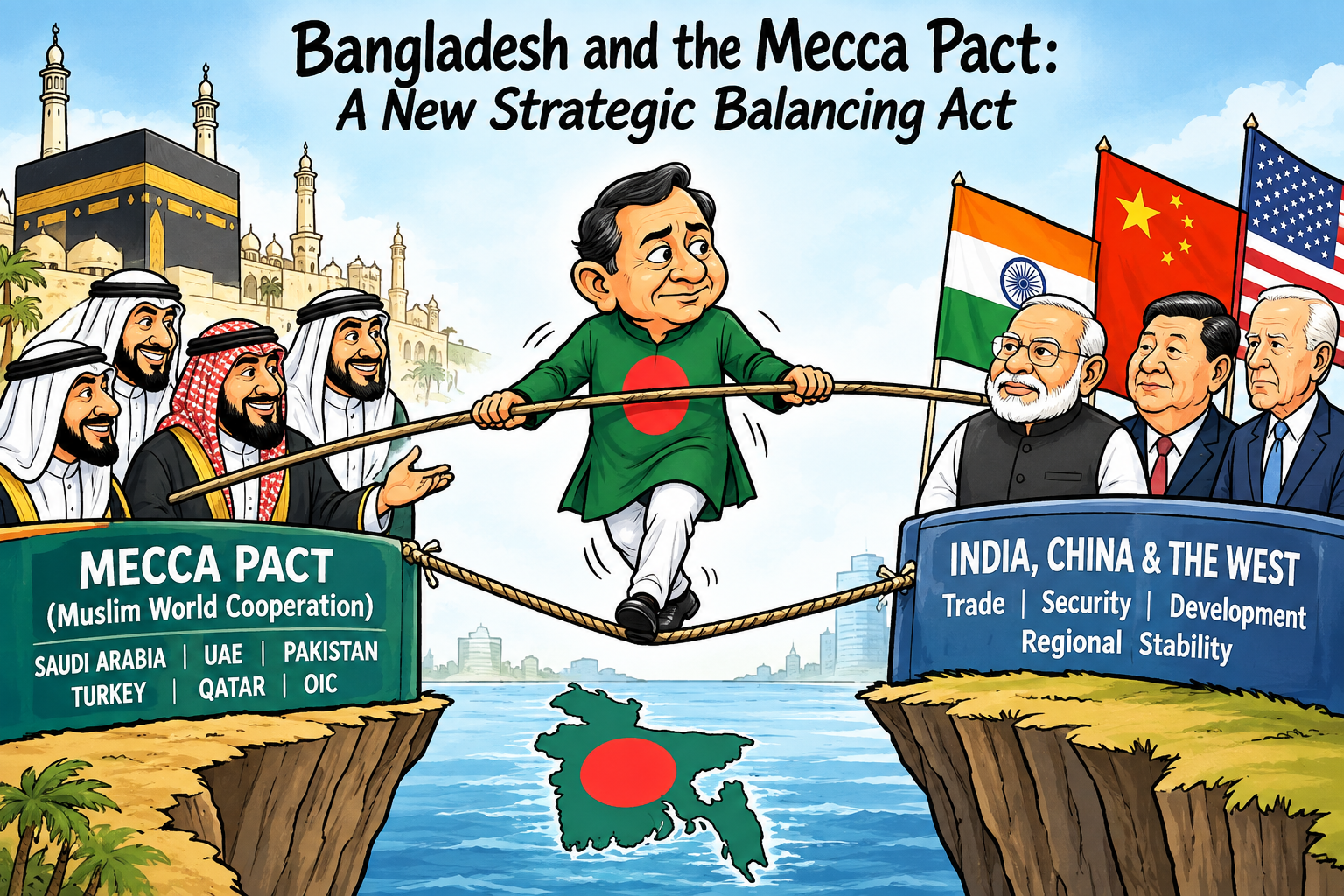
Bangladesh has traditionally sought to maintain relationships with multiple major powers rather than place itself firmly inside a military bloc. Its geographical position makes this balancing act particularly important.
Closer defence cooperation with Türkiye, Pakistan or Saudi Arabia does not automatically mean the establishment of foreign military bases or the deployment of combat forces in Bangladesh. Nor does the Mecca pact itself contain an economic integration mechanism.
But greater military-to-military contacts, intelligence cooperation, naval engagement and defence procurement could gradually alter the strategic environment around the Bay of Bengal.
For India, developments affecting the eastern seaboard and the approaches to the Northeast would naturally attract attention.
Bangladesh’s domestic calculation
There is also a domestic political dimension.
Bangladesh has increasingly sought a foreign policy that emphasises greater strategic autonomy and wider engagement with countries beyond its traditional partners. Senior officials have publicly described the Mecca pact positively, while also stressing that Dhaka will assess the implications before making a decision.

The agreement could also strengthen Bangladesh’s engagement with the wider Muslim world.
Saudi Arabia is particularly important to Bangladesh because of the large Bangladeshi workforce in the Gulf and the country’s longstanding religious, economic and diplomatic links with the kingdom. Türkiye, meanwhile, has developed increasingly significant political and defence ties across South Asia.
Membership could therefore be viewed by Dhaka as part of a broader effort to diversify its strategic partnerships.
Yet diversification and alignment are not necessarily the same thing.
The non-alignment question
The most consequential issue may be whether joining the Mecca pact would narrow Bangladesh’s diplomatic room for manoeuvre.
Bangladesh has historically maintained relationships with competing powers while seeking to avoid becoming part of a major-power or military confrontation. A formal collective-defence arrangement could make that balancing act more complicated.
Consider a hypothetical Indo-Pakistani military crisis. Bangladesh would have to determine how its treaty obligations interact with its geographical dependence on India and its relations with Pakistan.
Similarly, a conflict involving Saudi Arabia or Türkiye could raise questions about the extent to which Bangladesh would be expected to participate.
The experience of the existing members is instructive. Following recent attacks on Saudi Arabia, Pakistan reaffirmed its commitment to the Mecca agreement but said no military response had been discussed under the pact at that point.
That episode illustrates the difference between a collective-defence commitment on paper and the political decisions governments must make when a real crisis occurs.
A decision that requires careful calculation
For Bangladesh, the Mecca pact offers possible diplomatic and defence benefits, but it also introduces questions about strategic autonomy, relations with India, military obligations and involvement in conflicts outside South Asia.
Dhaka has therefore been right to emphasise assessment rather than haste.
The country can deepen relations with Saudi Arabia, Türkiye and Pakistan without necessarily making every relationship part of a formal military alliance. At the same time, if a formal invitation eventually arrives, Bangladesh will have to examine the precise treaty obligations, decision-making mechanisms and military commitments involved.
The central issue is not whether the Mecca pact is desirable or undesirable in the abstract. It is whether its obligations and benefits correspond with Bangladesh’s own security requirements.
Geography remains a powerful factor in foreign policy. Bangladesh shares its longest and most consequential border with India, faces Myanmar across another frontier and sits astride the Bay of Bengal. Its economic relationships are similarly regional as well as global.
Dhaka therefore has several strategic interests to balance simultaneously.
The Mecca pact may become an important part of that calculation. But membership would represent a significant foreign-policy commitment, and the details of that commitment-not merely the symbolism of joining a Muslim-majority defence grouping-will ultimately determine its consequences.
For Bangladesh, the prudent course is to assess those consequences in full before making a decision that could shape its security and diplomatic choices for years to come.