


America’s New War Strategy in the Strait of Hormuz
 KRC TIMES Desk
Col (Dr.) Ashwani Kumar, MiD, VSM (Retd.).
Wars are no longer confined to battlefields defined by territory. Increasingly, they are fought across domains where control matters more than conquest. The ongoing confrontation between the United States, Iran, and Israel marks a decisive shift in this direction. With diplomacy faltering and ceasefire talks failing, the centre of gravity has moved away from land and into the waters of the Strait of Hormuz, where a new form of conflict is unfolding.
This is not a war of invasion. It is a war of denial and control, where navies, not armies, are shaping outcomes.
The Shift from Land to Sea
Traditionally, wars have been measured by territorial gains. Today, that paradigm is changing. The United States, despite its overwhelming military capability, has chosen not to enter Iranian territory. Instead, it has established a robust naval posture in the Gulf deploying warships, enforcing maritime control, and ensuring that key shipping lanes remain under surveillance. This shift is not incidental. It reflects a conscious strategic choice: to exert pressure without triggering the consequences of a ground war.
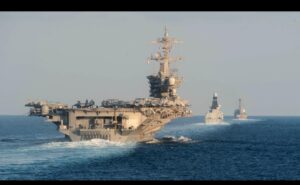
The lessons of Iraq and Afghanistan loom large. Prolonged land engagements, uncertain political outcomes, and high human and economic costs have made policymakers wary of repeating past mistakes. In this context, the sea offers a space where power can be projected without entrapment.
Hormuz: The World’s Most Strategic Waterway.
The Strait of Hormuz is not merely a geographic feature, it is a global economic lifeline. A significant portion of the world’s oil supply passes through this narrow corridor. Any disruption here reverberates across continents impacting prices, trade flows, and economic stability.
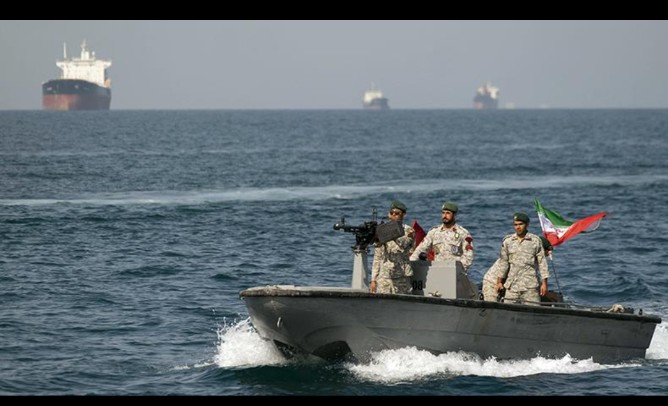
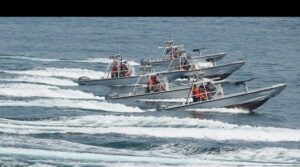
Iran understands this leverage well. Its strategy has never been to dominate the sea in conventional terms, but to deny its safe usage. Through the deployment of mines, drones, and fast attack craft, Iran can create uncertainty forcing global shipping to reconsider routes and increasing the cost of passage.
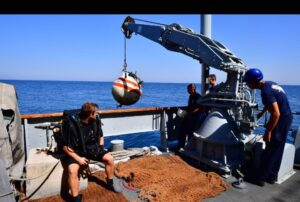
The United States, in response, has moved to counter this denial strategy. Naval escorts, mine-clearing operations, and aerial surveillance are being employed to maintain the flow of commerce.
This dynamic denial versus control defines the present conflict.
America’s Strategy: Blockade Without Occupation.
What is unfolding is a calibrated strategy best described as “blockade without invasion.”
The United States is, controlling maritime access Monitoring and, where necessary, redirecting shipping
Conducting mine-countermeasure operations. Maintaining aerial dominance over the Gulf Yet, crucially, it is avoiding, Ground deployment inside Iran.
Direct occupation
Prolonged land engagement.
This approach allows Washington to maintain pressure while retaining flexibility. It signals strength without committing to an irreversible path. However, it also has limitations. Control at sea does not automatically translate into political resolution. It can constrain an adversary, but it cannot compel long-term compliance.
Iran’s Counter: Disruption as Strategy.
Iran’s response is rooted in asymmetry. It does not seek to match American naval power. Instead, it aims to complicate and disrupt. Naval mines increase risk perception. Drone swarms create persistent threat.
Proxy networks expand the battlefield.
This approach ensures that even without direct confrontation, Iran remains a central actor. It turns the Strait into a contested space where uncertainty itself becomes a weapon. In such a scenario, victory is not defined by dominance, but by endurance.
Why the U.S. Remains “At Sea”
A critical question arises, why has the United States not escalated further?
The answer lies in the inherent risks of a ground campaign against Iran,
Complex terrain, mountains, urban centres, and vast geography.
A large and motivated population.
Deeply embedded defensive networks. Vulnerable supply lines, especially if maritime routes are contested. A ground invasion would not be swift or decisive. It would likely evolve into a prolonged conflict with uncertain outcomes. Thus, the United States finds itself in a position where it can dominate the maritime domain but chooses to avoid the land battlefield. This is not hesitation. It is calculation.
India’s Stake: Security Through Stability.
For India, the developments in Hormuz are of direct consequence. A substantial portion of India’s energy imports transits through this corridor. Any disruption whether physical or psychological affects the following:-
Fuel prices.
Inflation
Trade balances.
The current situation presents both a warning and an opportunity. Immediate Concerns as under :-
Rising insurance costs for shipping. Volatility in energy markets. Supply chain uncertainties. Strategic Imperatives. Diversification of energy sources. Strengthening of naval capabilities.Enhanced maritime domain awareness.
India’s response must be proactive. Stability in distant waters is not a distant concern, it is a domestic necessity.
Lessons from Experience: The Limits of Military Power.
An instructive parallel may be drawn from India’s own experience during the Indian Peace Keeping Force. What began as a limited intervention gradually evolved into a complex and prolonged engagement.
Despite superior capability, the absence of a clearly defined political objective led to operational challenges and eventual disengagement.

The lesson remains relevant: military superiority, whether on land or sea, does not guarantee strategic success without clarity of purpose. In the present context, the United States may control the sea, but the absence of a clear end-state risks prolonging the conflict in different forms.
A New Model of Warfare. What we are witnessing is the emergence of a new model: Control without occupation. Pressure without invasion. Conflict without decisive closure. This model reflects both capability and constraint. It allows for sustained engagement without immediate escalation, but it also risks creating open-ended confrontation. Such wars do not end dramatically. They persist shifting domains, altering intensity, but rarely concluding decisively.
To sum up: Power in Motion, Not Resolution
The Strait of Hormuz has become more than a maritime corridor, it is now the centre of a strategic contest that defines the limits of modern power.
The United States can secure sea lanes, project force, and maintain dominance in the maritime domain. Iran can disrupt, delay, and endure. Israel continues to pursue its security objectives within this broader framework.
Yet, none of these actions resolve the underlying conflict. This is the paradox of contemporary warfare,
the ability to act decisively does not ensure the ability to conclude effectively.
Author’s Note.
In the evolving character of war, control of space is increasingly replacing capture of territory. The ongoing crisis in the Strait of Hormuz illustrates this shift with clarity.
However, history reminds us that control without resolution is only a temporary advantage. Without clearly defined political objectives, even the most sophisticated military strategies risk becoming instruments of prolongation rather than closure.
The challenge before global powers is not merely to manage conflict but to define its end. Until then, wars will continue not as decisive events, but as enduring conditions.
Disclaimer: Views expressed are personal.