


How Drones, Cyber Warfare, Artificial Intelligence and Intelligence Superiority Are Reshaping Global Power, Strategic Imperatives for India
 KRC TIMES Desk
By Col (Dr.) Ashwani Kumar, MiD, VSM (Retd.)
The battlefield is no longer visible.
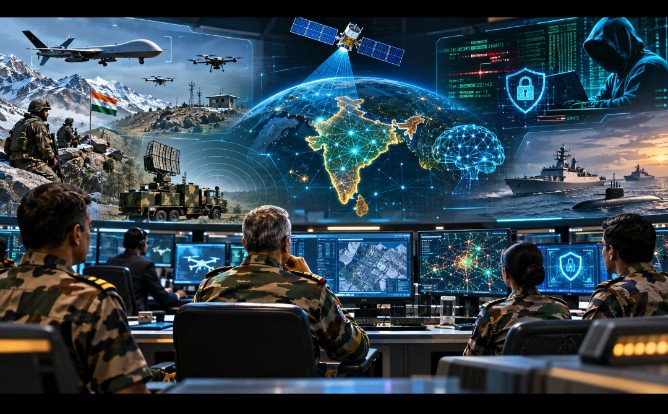
The character of warfare is undergoing a fundamental transformation. The traditional battlefield, defined by geographical boundaries, military formations, tanks, artillery and aircraft, is increasingly being supplemented by an invisible battlefield where intelligence, artificial intelligence, cyber capabilities and technological superiority determine the outcome of conflicts.
Future wars may not necessarily begin with the movement of troops across international borders. They could commence with cyberattacks on critical infrastructure, disruption of military communications, manipulation of information, electronic interference or the systematic degradation of an adversary’s decision-making capabilities. By the time conventional forces are mobilised, an important part of the conflict may already have been fought.
Recent conflicts have demonstrated that military superiority cannot be measured exclusively by manpower, conventional weapons or defence expenditure. The ability to detect an adversary, understand its intentions, disrupt its capabilities and respond faster is becoming equally important. The decisive advantage in future conflicts will belong to nations that can see first, understand first, decide first and act effectively.
From conventional warfare to multi-domain operations.
Modern warfare is no longer confined to land, air and sea. It increasingly encompasses six interconnected domains ie land, air, sea, space, cyberspace and the electromagnetic spectrum.
Satellite imagery may identify adversary activity, artificial intelligence may analyse the information, drones may provide surveillance, electronic warfare may disrupt communications and cyber operations may target supporting infrastructure.
The real military advantage comes from integrating these capabilities into an effective operational framework.
A technologically advanced adversary may attempt to paralyse an opponent’s command-and-control systems without physically destroying its military formations. Disrupting communications, navigation, logistics and information networks can create confusion and delay decisions at critical moments. Consequently, military preparedness must extend beyond conventional combat capabilities. Information superiority, technological resilience and secure communications are becoming equally important.
Intelligence revolution: Technology versus human intelligence.
Intelligence gathering has traditionally depended on Human Intelligence (HUMINT), Signals Intelligence (SIGINT), Imagery Intelligence (IMINT) and reconnaissance. These methods remain relevant, but the speed and sophistication of information collection have changed dramatically. Satellite imagery, commercial surveillance, digital footprints, open-source intelligence and unmanned systems now generate enormous volumes of information. Artificial Intelligence can help identify patterns, detect anomalies and correlate apparently unrelated information. However, technological collection does not automatically produce accurate intelligence.

A satellite image may reveal the movement of vehicles, but it cannot independently establish the intention behind that movement. A communication intercept may identify contact between individuals, but may not explain the purpose of their interaction. This is where HUMINT retains its enduring significance. Having served in operational environments, I believe that the greatest mistake a modern security establishment could make would be to equate technological sophistication with intelligence superiority.
Understanding human motivation, local relationships, terrain, cultural sensitivities and adversary intentions requires experience and professional judgement. The future therefore does not belong to HUMINT or technology in isolation. It belongs to their intelligent integration.
Drone warfare: The new economics of military power.
One of the most significant developments in contemporary warfare is the rapid expansion of unmanned aerial systems.
The Russia-Ukraine conflict and confrontations in the Middle East have demonstrated how relatively inexpensive drones can challenge sophisticated military establishments. They are increasingly employed for surveillance, reconnaissance, target identification and combat operations.
Their significance lies not merely in their technological capabilities but also in their economics. A sophisticated fighter aircraft or air-defence installation may cost hundreds of millions of dollars. Relatively inexpensive unmanned systems, particularly when employed in numbers, can impose disproportionate costs on advanced defence systems.
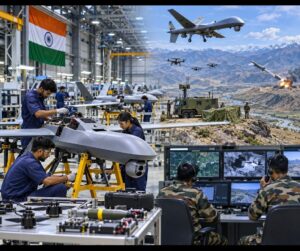
The strategic lesson is clear, a nation capable of designing, manufacturing, deploying, modifying and replacing its own drones has an important advantage over one entirely dependent on foreign suppliers. Indigenous manufacturing must extend beyond assembling airframes. It should include flight-control systems, sensors, batteries, propulsion, communication equipment, software and navigation technologies.

The Ukraine experience has demonstrated the importance of rapid industrial adaptation and battlefield feedback. India must therefore establish a comprehensive indigenous drone ecosystem involving defence manufacturers, private industry, start-ups, universities, engineering institutions and the Armed Forces.
The objective should be a continuous cycle of development, production, deployment, evaluation and improvement. A country that can sustain drone production during prolonged hostilities will possess a significant military advantage. However, manufacturing must be supported by trained operators, effective doctrine, reliable communications and counter-drone capabilities.
Cyber warfare: The invisible battlefield.
If drones are transforming the physical battlefield, cyber capabilities are transforming the invisible one. Modern military establishments depend on digital networks for command and control, logistics, intelligence sharing, navigation and communications. A country possessing advanced cyber expertise may be able to disrupt an opponent’s digital infrastructure, compromise information systems, manipulate data or create uncertainty within decision-making networks.
Cyber operations may also target electricity distribution, telecommunications, transportation, banking and industrial infrastructure. Cyber warfare must therefore be understood as an instrument of national power, not merely an IT security function.
However, cyber superiority is not simply the ability to attack another country’s systems. It also means protecting one’s own infrastructure, maintaining military communications and recovering rapidly from hostile digital operations. India must invest in indigenous cybersecurity technologies, specialised military cyber personnel, secure software, critical infrastructure protection and continuous threat assessment.
Our growing pool of software engineers, cybersecurity professionals and technology researchers should be systematically connected with national defence requirements through appropriate institutional arrangements. The country that can protect its own networks while developing credible capabilities to counter adversarial cyber operations will possess a significant strategic advantage.
Cryptography and secure communications: Lessons from Slidex to modern warfare.
One aspect of military intelligence that deserves particular attention is the security of communications. Throughout military history, commanders have faced a fundamental challenge: how to transmit operational information without allowing an adversary to understand its contents. From couriers and concealed messages to codebooks, cipher machines and modern digital encryption, the objective has remained unchanged.
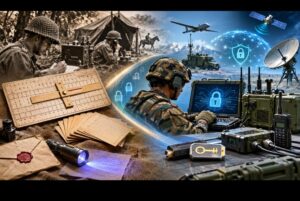
The British Army’s Slidex system is an interesting historical example. It was a paper-based tactical coding system that used prepared vocabulary cards and movable indicators to encode commonly used military words and expressions. It offered a relatively simple means of protecting short field messages. However, it was not an unbreakable encryption system and could be compromised through captured material, repeated use and weaknesses in operating procedures.
Traditional methods of concealing messages, including invisible writing revealed through heat, also have historical intelligence significance. However, concealment is not the same as encryption. A concealed message may remain undiscovered, but its contents are not necessarily protected if it is found. An important exception in cryptographic theory is the One Time Pad. When generated and used under strict conditions, with truly random secret keys that are never reused, it offers information theoretic security.
The modern challenge is even more complex. Advances in quantum computing could threaten certain existing public-key cryptographic systems, making the transition towards post-quantum cryptography increasingly important. The lesson from Slidex to modern encryption is that communication security is never achieved by the cipher alone. It depends on key management, authentication, personnel discipline, network integrity and the ability to respond when a system is compromised. No communication system should be considered absolutely foolproof.
India must ensure that military communications remain secure, resilient and capable of functioning under conditions of cyberattack, electronic interference or infrastructure disruption. Equally, alternative communication arrangements must be available when advanced digital systems become unavailable.
Electronic and information warfare.
Modern military operations depend heavily on radar, satellite navigation, communication links and electromagnetic systems. Disrupting these capabilities can significantly reduce the effectiveness of sophisticated military platforms. Electronic warfare involves detecting hostile emissions, protecting friendly communications and countering adversary sensors and electronic systems.
India must strengthen indigenous electronic warfare capabilities, resilient communication networks and specialised training.
Equally important is information warfare. Social media and digital networks have created an environment in which fabricated videos, manipulated images and misleading narratives can spread rapidly. During a national crisis, misinformation can generate public confusion, damage institutional credibility and influence political decision-making. For India, countering information warfare requires credible public communication, digital forensic capabilities, media literacy and timely verification of information.
Lessons from contemporary conflicts.
The Russia-Ukraine conflict has highlighted the importance of drones, satellite imagery, electronic warfare, cyber operations and rapid technological adaptation. The confrontations involving Iran, Israel and the United States have further demonstrated the strategic significance of missile capabilities, air defence, unmanned systems and intelligence networks. The Red Sea maritime security situation has shown how relatively limited military capabilities can impose wider economic and strategic costs on international shipping.
Several lessons emerge:
- Intelligence superiority must be continuous.
- Military systems must function under electronic and cyber disruption.
- Inexpensive technologies can impose disproportionate costs on sophisticated defence systems.
- Industrial capacity and rapid replacement of equipment are essential in prolonged conflicts.
- Technological superiority must be accompanied by sound military leadership and strategic judgement.
India must study these developments without mechanically copying the military doctrines of other nations.
India’s security environment and strategic preparedness.
India faces a complex security environment involving China, Pakistan, cross-border terrorism, insurgency, maritime vulnerabilities and technological competition. China’s investments in artificial intelligence, space capabilities, cyber warfare, unmanned systems and integrated military structures deserve close attention. India must strengthen border surveillance, intelligence assessment, secure communications and technological preparedness. Pakistan presents a different but equally complex challenge involving cross-border terrorism, infiltration, drone activity and disinformation.
Internal security also requires attention. Insurgency, organised criminal networks, illegal financing and cyber-enabled recruitment may overlap. These threats cannot be addressed through isolated institutional responses.
Having served in Assam, Nagaland, Manipur and Arunachal Pradesh, I believe that the security challenges of the Northeast cannot be understood through technology alone. Difficult terrain, remote settlements, local social structures and cross-border dynamics require sustained ground-level intelligence and community understanding. Drones and satellite imagery can improve surveillance, but human intelligence remains essential for interpreting local developments and identifying emerging threats.
Rebuilding India’s intelligence and defence architecture.
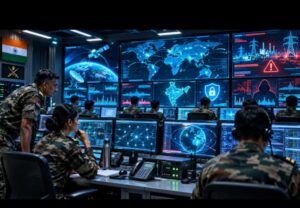
India’s security requirements demand a more integrated approach to intelligence management. Information often exists across different agencies, departments and operational formations. Its value depends on how quickly it can be shared, correlated and converted into an actionable assessment. India should strengthen intelligence fusion mechanisms, AI-assisted analysis, secure information-sharing platforms and coordination between military intelligence, national intelligence institutions, police organisations and relevant civilian agencies. At the same time, the country must establish a comprehensive indigenous defence technology ecosystem.
Five priorities deserve particular attention:
- Drone independence: Develop indigenous design, manufacturing, maintenance and replacement capabilities.
- Cyber preparedness: Strengthen military networks, critical infrastructure protection and specialised cyber expertise.
- Intelligence integration: Combine HUMINT, technical surveillance, geospatial intelligence and AI-assisted analysis.
- Technological sovereignty: Reduce dependence on foreign suppliers for critical electronic components, software and communication systems.
- Operational resilience: Ensure that military formations can continue functioning when communications, navigation or digital networks are disrupted. The objective should be to create a security architecture that is technologically advanced, operationally flexible and institutionally responsive.
The changing role of military leadership.
The future commander will operate in an environment where information arrives continuously from multiple sources and decisions may have to be taken under conditions of incomplete information. Military leaders must understand technology without becoming dependent on it. The principle of mission command remains relevant. Subordinate commanders must understand the commander’s intent and retain the ability to act within their responsibilities when communications are disrupted.
Military training institutions should therefore incorporate AI-assisted operational planning, drone warfare, cyber awareness, electronic warfare, satellite intelligence and simulation-based decision-making. The future military professional must combine technological literacy with traditional military virtues: courage, initiative, discipline, professional competence and responsibility.
To conclude, the next war may begin before anyone recognises it
The history of warfare is a history of adaptation. Gunpowder, mechanised warfare, air power, nuclear weapons and precision-guided systems transformed military operations. Artificial intelligence, autonomous systems, cyber capabilities and integrated intelligence networks represent another major transition.
The future will increasingly favour nations that possess indigenous technological capabilities, resilient industrial systems and the ability to adapt faster than their adversaries. A country that depends entirely on foreign suppliers for drones, electronic components, communication systems and cyber technologies may find its military preparedness constrained during prolonged hostilities.
Conversely, a country capable of manufacturing its own unmanned systems, protecting its digital infrastructure, securing its communications and developing advanced intelligence capabilities will possess a considerable strategic advantage. Having served in operational environments, Military Intelligence and national-level government assignments, I believe that information by itself does not constitute intelligence. Its value lies in its authenticity, interpretation, timeliness and relevance to decision-making.

The most sophisticated surveillance system cannot independently replace an experienced intelligence professional. Equally, human intelligence cannot realise its full potential without modern technology. India must therefore prepare for a future in which military superiority will depend on the integration of intelligence, technology, operational capability, industrial independence and national resilience.
The next generation of warfare may not announce its arrival through the movement of tanks or the roar of aircraft. It may begin silently through a compromised network, a manipulated intelligence picture or the disruption of a critical communication system. The nation that can manufacture its own weapons, protect its own networks, secure its communications, understand its adversary and adapt faster will enter the next era of warfare with a decisive advantage.
The battlefield has changed. Intelligence must evolve. Technology must become indigenous. And India cannot afford to be unprepared.
About the author.
Col (Dr.) Ashwani Kumar, MiD, VSM (Retd.), is a former Indian Army officer. He served in Operation Pawan in Sri Lanka and in several operationally sensitive regions of India. His subsequent professional assignments included Military Intelligence, the Cabinet Secretariat, DIPAC and the Bureau of Police Research & Development. He also served as Senior Instructor at the Military Intelligence Training School, Pune. His professional interests include military strategy, intelligence, counter-insurgency, national security and emerging defence technologies.
Editorial note: The Slidex and One-Time Pad sections distinguish historical tactical coding from modern cryptographic security. The article is an analytical assessment, not a claim that any communication system is completely invulnerable.
Disclaimer: The views expressed in this article are the author’s personal opinions based on his professional experience and publicly available information. They do not represent the official position of the Indian Armed Forces or the Government of India. No classified or sensitive operational information has been disclosed.