

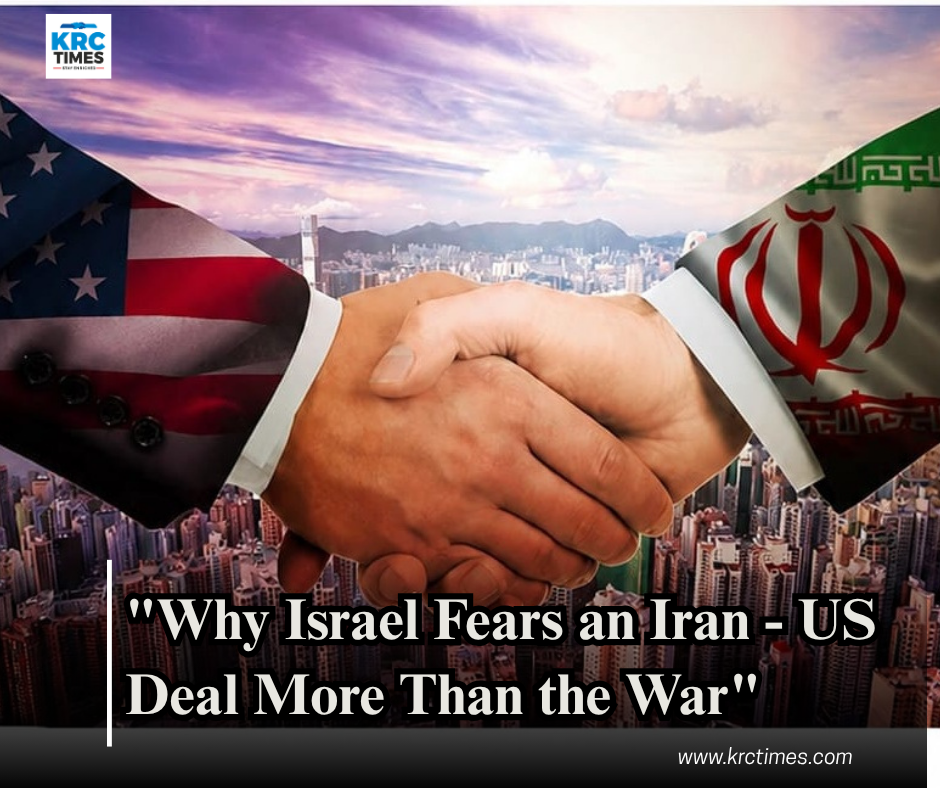
For decades, Israel has viewed Iran not merely as a regional rival but as the most significant long-term strategic challenge to its security
 KRC TIMES Desk
Col (Dr.) Ashwani Kumar, MiD, VSM, (Retd).
Wars are often easier to understand than peace. In war, enemies are clearly identified, objectives are publicly declared, and military actions follow strategic calculations. Peace, however, creates ambiguity. It forces nations to confront compromises and accept outcomes that may fall short of their original goals.
That is precisely why the emerging Iran – United States agreement has generated concern in Israel even as much of the world welcomes the prospect of de-escalation.
Reports suggest that Washington and Tehran are moving toward a framework involving a ceasefire, reopening of the Strait of Hormuz, sanctions relief, release of frozen assets, and fresh negotiations on Iran’s nuclear programme. For many countries, this appears to be a welcome step towards stability. For Israel, however, the picture is far more complex.
The reason is simple. Israel’s concerns were never limited to the war itself. They were focused on what the war was supposed to achieve.
Israel’s Strategic Objective.
For decades, Israel has viewed Iran not merely as a regional rival but as the most significant long-term strategic challenge to its security.
Israeli policymakers have consistently argued that Iran’s uranium enrichment programme, missile capabilities, and regional proxy network collectively create an existential threat that cannot be ignored indefinitely.
From Jerusalem’s perspective, the purpose of sanctions, diplomatic pressure, covert action, and military confrontation was not simply to deter Iran. It was to fundamentally reduce or eliminate the strategic capabilities that could one day threaten Israel’s survival.
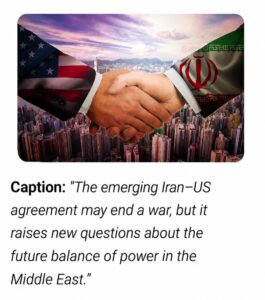
The emerging agreement appears to pursue a different objective.
Instead of seeking decisive strategic defeat, it seeks managed stability. That distinction is crucial.
The United States increasingly appears focused on preventing a wider regional conflict while ensuring that Iran does not cross the nuclear weapons threshold. Israel, however, is focused on whether Iran’s strategic capabilities are permanently constrained.
The Peace That Worries Israel.
What if the war ends, sanctions ease, shipping resumes, and diplomatic relations improve, while Iran retains significant elements of its strategic infrastructure?
This is the question troubling many Israeli strategists.
In such a scenario, Tehran may emerge economically stronger, politically legitimised, and regionally influential without fundamentally altering its long-term strategic ambitions.
The concern is that Iran could regain access to international markets, rebuild its economy, strengthen its technological base, and continue supporting regional allies while retaining much of its nuclear expertise.
For Israel, this would mean that the war had produced temporary calm but not permanent security.
Israel’s concern is therefore not necessarily that America is making peace with Iran. Its concern is that America may be choosing to manage Iran rather than transform it.
The Fourteen Clauses That Could Reshape the Middle East
Israel’s concerns become clearer when one examines the reported fourteen-point Memorandum of Understanding between Washington and Tehran.
According to reports, the proposed framework includes the following:-
(i) An immediate and permanent ceasefire.
(ii) End of hostilities across all fronts, including Lebanon.
(iii) A US commitment not to interfere in Iran’s internal affairs.
(iv) Lifting of the American naval blockade.
(v) Withdrawal of US military deployments around Iran.
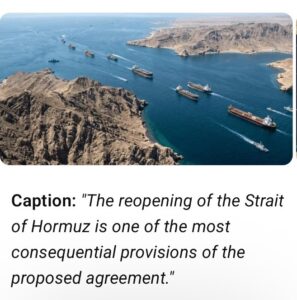
(vi) Reopening of the Strait of Hormuz.
(vii) Suspension of sanctions on Iranian oil and petrochemical exports.
(viii) Restoration of Iran’s access to energy revenues.
(ix) Release of approximately $24 billion in frozen Iranian assets.
(x) Reconstruction assistance worth nearly $300 billion.
(xi) Iran’s commitment not to develop nuclear weapons.
(xii) A freeze on additional military escalation and sanctions.
(xiii) Sixty days of negotiations toward a comprehensive nuclear agreement.
(xiv) Eventual settlement of major nuclear disputes and sanctions issues.
Taken together, these provisions represent far more than a ceasefire.
(a) For Iran, they amount to strategic recognition and economic rehabilitation.
(b) For the United States, they offer a pathway to stability without prolonged military engagement.
(c) For global markets, they promise lower energy prices, secure shipping lanes, and reduced geopolitical risk.
(d) For Israel, however, they raise difficult questions.
If sanctions are eased, frozen assets released, oil exports restored, maritime trade reopened, and reconstruction funding begins flowing into Iran, Tehran’s economy could recover significantly over the next decade.
If military pressure around Iran is simultaneously reduced, Iran may gain greater strategic flexibility.
While the agreement reiterates Iran’s commitment not to develop nuclear weapons, critics in Israel argue that the framework focuses more on managing escalation than permanently dismantling Iran’s strategic capabilities.
This is precisely where Israeli concerns begin. The agreement appears designed to reduce conflict rather than eliminate rivalry. It may stop the war. It does not necessarily end the competition. In fact, some Israeli strategists fear that the fourteen-point framework could create a stronger, wealthier, and internationally accepted Iran while leaving many of the underlying security concerns unresolved.
The reopening of the Strait of Hormuz alone could transform regional economics. Energy markets would stabilise, shipping costs would decline, and Iran’s economic importance would increase substantially.
Supporters view these developments as foundations for long-term peace. Critics view them as foundations for future strategic competition.
The Uranium Question Remains Unresolved.
Yet despite the breadth of the proposed agreement, one issue continues to dominate Israeli strategic thinking, the future of Iran’s uranium enrichment capability. Iran has consistently maintained that uranium enrichment is its sovereign right and that its nuclear programme is peaceful.
Israel sees the issue differently.
Its concern is not merely about uranium enrichment itself but about what strategic experts describe as “breakout capability” the ability to move rapidly from advanced enrichment to weaponization should political circumstances change.
From Israel’s perspective, any agreement that allows Iran to retain substantial enrichment capability leaves the fundamental problem unresolved.
The war may stop. The capability remains. And for Israel, capability matters more than intentions.
Governments change. Policies change. Strategic capabilities endure.
This is why many Israelis view the uranium issue as the core issue rather than the military confrontation itself.
Has Military Power Reached Its Limits?
The conflict has also exposed an uncomfortable reality about modern warfare. Despite sanctions, military pressure, cyber operations, intelligence campaigns, and diplomatic isolation, Iran’s political system remains intact.
Its negotiating position remains relevant. Its strategic calculations remain largely unchanged.
Even after months of confrontation, the most critical issues continue to be negotiated at the diplomatic table rather than settled on the battlefield. This reality demonstrates an important lesson of twenty first-century geopolitics.
Military superiority remains essential for winning battles. It is often less effective in resolving political disputes.
The Iran crisis demonstrates that geography, ideology, economic resilience, strategic patience, and national endurance continue to matter alongside military power.
What America Gains.

Send your resume:
biswa@jigyasu.co.in
krcfoundation@gmail.com
For Washington, the calculation is broader than Israel’s.
America seeks regional stability, secure energy supplies, open maritime routes, lower oil prices, and freedom to focus on larger strategic challenges elsewhere.
A prolonged conflict in West Asia imposes economic costs, military commitments, and diplomatic distractions. The United States must simultaneously manage competition with China, commitments in Europe, and domestic economic priorities.
From Washington’s perspective, a negotiated settlement that reduces tensions may represent strategic success. The objective is not necessarily to defeat Iran. The objective is to prevent a larger war.
This explains the growing divergence between American and Israeli expectations.
What Iran Gains. Iran also stands to gain significantly from an agreement. Reduced sanctions could revive economic growth.
Access to frozen assets could provide immediate financial relief. Greater access to international markets could strengthen industrial development and attract foreign investment.
The reopening of the Strait of Hormuz would restore confidence in regional trade and shipping.
Most importantly, if Iran retains elements of its enrichment capability while avoiding direct confrontation, Tehran may claim that it successfully resisted international pressure without surrendering its strategic rights.
Such an outcome would strengthen the Iranian narrative of resilience and resistance. For Israel, this possibility is deeply unsettling.
The Regional Impact
The consequences of an Iran – US understanding will extend far beyond Washington, Tehran, and Jerusalem. The Gulf states will reassess their security calculations. Energy markets will react. Regional alliances may shift.
China and Russia will carefully observe how America manages a strategic adversary without direct military victory.
For countries such as India, reduced tensions would be broadly positive. India’s interests lie in stable energy supplies, secure maritime routes, regional stability, and uninterrupted trade. New Delhi is therefore likely to welcome de-escalation while maintaining strategic autonomy in its relations with all sides.
The Real Question is?.
The most important question is not whether a deal will be signed.
The real question is whether the deal addresses the underlying causes of the conflict.
(i) Will it genuinely constrain nuclear risks?
(ii) Will it reduce proxy warfare?
(iIi) Will it build long-term trust?
(iv)Will it create a new regional security architecture? Or will it simply postpone the next crisis?
History suggests that unresolved strategic rivalries rarely disappear.
They merely evolve.
The Iran – US agreement may bring peace.
It may reduce tensions.
It may stabilise energy markets and prevent a wider war.
But if the fundamental concerns of the principal actors remain unresolved, peace itself may become only an intermission between confrontations.
To conclude, Israel does not fear peace. It fears a peace that allows Iran to emerge stronger than it was before the war.
For Washington, success may be measured by stability.
For Tehran, success may be measured by survival.
For Israel, success is measured by security.
These are not identical objectives.
That difference explains why the same agreement can be celebrated in Washington, welcomed in Tehran, and questioned in Jerusalem.
And that question may ultimately determine whether an Iran – US deal becomes the foundation of regional stability or merely the opening chapter of the next Middle East crisis.

About the Author.
Ashk Machhanvi is the pen name of Col (Dr.) Ashwani Kumar, MiD, VSM (Retd.), a retired Indian Army officer, defence analyst, researcher, author, and curative historian. A postgraduate in History, he writes extensively on geopolitics, national security, military affairs, civilizational studies, culture, and spirituality. His work combines professional military experience with historical insight and strategic analysis of contemporary global issues.
Disclaimer:
The views expressed are personal and based on open-source information and strategic analysis available at the time of writing. The article is intended solely for academic, editorial, and informational discussion. Images, if used, are for illustrative purposes only and author have no right on them. Propretry remains with the orginatir.