


The removal of heavy sand layers has heightened bank erosion, destroying the riverbanks and causing heavy aggradations down the line
 Sushanta Roy
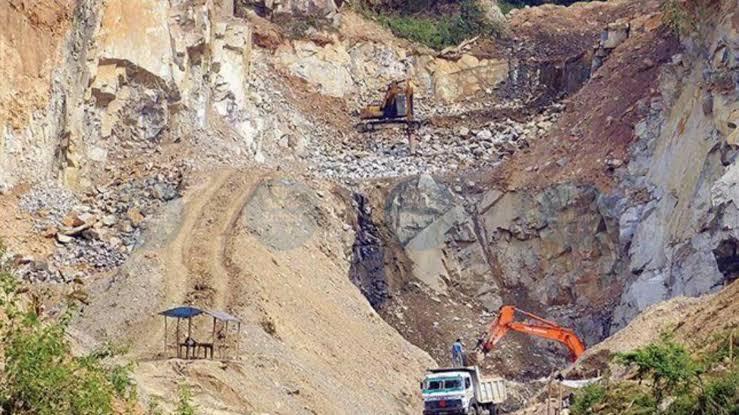
Diphu : The twin hill districts of Karbi Anglong and West Karbi Anglong are facing an unprecedented environmental crisis.
Decades of unscientific extraction of major and minor minerals, alongside rampant destruction of key reserve forests, are rapidly turning this ecologically fragile, biodiversity-rich landscape into a severely degraded terrain.
At the heart of the crisis are the collapse of local river systems and the severe fragmentation of the region’s ancient forest covers, pushing indigenous communities and wildlife toward a tipping point.
The perennial rivers of the districts, which historically supplied water year-round to local settlements, are suffocating under uncontrolled mechanical sand mining.
The River Lungnit and the Jamuna River (which originates in the Khaunbaman Hills) have borne the brunt of unregulated minor mineral extraction.
Unscientific and deeper-than-permitted scraping of riverbeds has altered the natural flow patterns of the Jamuna and Lungnit rivers.
Despite regulatory frameworks like the Sustainable Sand Management Guidelines, extraction depth often exceeds the standard 3-meter threshold.
The removal of heavy sand layers has heightened bank erosion, destroying the riverbanks and causing heavy aggradations down the line.

Send your resume:
biswa@jigyasu.co.in
krcfoundation@gmail.com
Local residents point out that streams that once ran clear are now turning into muddy, seasonal channels, triggering severe artificial water scarcity during the dry seasons.
Compounding the aquatic crisis is the relentless pressure on the region’s dense green canopy. Unregulated and rat-hole coal mining operations across the hills continue to degrade fragile hill slopes, while acid mine drainage pollutes groundwater channels.
The assault on the land is heavily visible across several Reserve Forests, including the Langnit Reserved Forest, Kaki Reserved Forest, and the pristine Panbari Reserved Forest along the northern slopes.
A longitudinal timeline paints a stark picture of the ecological breakdown: 1970s–2000: The initiation of heavy commercial and anthropogenic pressures begins altering the demographic and forest-use patterns in the hills.
2001–2020: According to satellite-based assessments, Karbi Anglong emerged as one of the most severely deforested zones in Assam, losing approximately 97,400 hectares of tree cover—representing a devastating 12% decline in total forest area.
2013–2023: Forest fragmentation accelerated aggressively. A decade-long analysis revealed a further decrease of 108.56 square kilometers of dense forest cover, juxtaposed against a 26.69 square kilometer expansion of agricultural encroachment and over 30 square kilometers of built-up areas.
2024–2026: Population growth (surging to an estimated 1.1 million by 2025) and institutional loopholes have fueled illegal stone quarrying and sand mining.

Recent reports suggest that over 8 million cubic meters of stone were extracted beyond legally sanctioned limits from the hill slopes adjoining critical wildlife reserves.
The destruction of the Panbari RF and adjacent hills has physically choked critical animal migration pathways, notably the Kaziranga–Karbi Anglong Elephant Reserve corridor.
With heavy stone crushers, dust pollution, and deep open-cast mining sites operating within 1 to 2 kilometers of forest boundaries, wild herds are increasingly forced into human settlements.
The historical data from 2000 to 2023 reveals gruesome fallout from this habitat fragmentation, documenting over 1,400 human fatalities and approximately 1,200 elephant deaths directly tied to the shrinking boundaries of the Karbi Anglong forests.
“In the past, our forests were dense, and rivers like the Jamuna and Lungnit flowed throughout the year,” shared a village elder near Manja. “Now, the riverbeds are wide deserts of silt, and the forests are disappearing before our eyes.”
If the Karbi Anglong Autonomous Council (KAAC) and state enforcement agencies fail to immediately enforce stringent environmental safeguards, restrict mining depths, and halt illegal logging, the region faces an irreversible ecological disaster marked by absolute water scarcity and total loss of its rich biodiversity.