

One of the primary issues is that catalyst layers coated on electrodes tend to peel off over time, reducing the durability of the system
 KRC TIMES Assam Bureau
GUWAHATI : Researchers at Indian Institute of Technology Guwahati have developed a new coating technology that could significantly improve the efficiency and durability of solar-powered green hydrogen production systems, marking a major step toward cleaner and more sustainable energy generation.
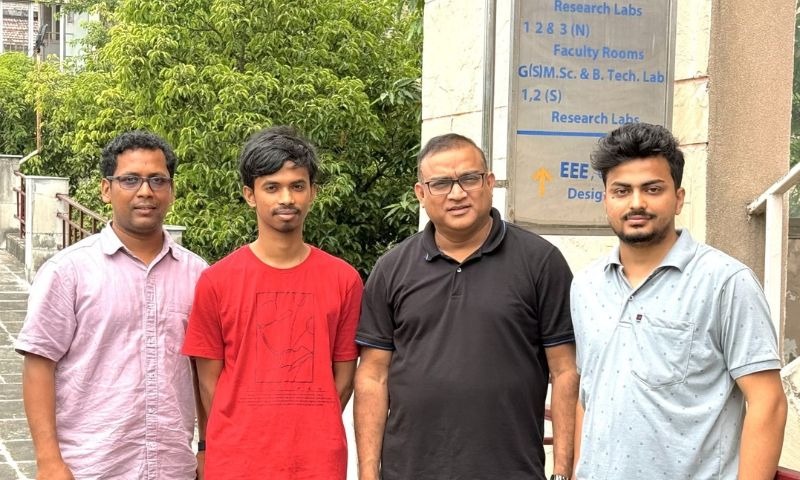
The study, published in the international journal Small, was led by Uttam Manna and Mohammad Qureshi from the Department of Chemistry at IIT Guwahati, along with researchers Hrisikesh Sarma, Alpana Sahu, Anshika Chaudhary, Sumanta Sarkar, Sourav Mandal and Lingaraj Sahoo.
Green hydrogen is widely regarded as one of the cleanest fuels of the future because it is produced by splitting water into hydrogen and oxygen using sunlight without emitting greenhouse gases. However, conventional solar-driven water-splitting systems face major challenges that affect long-term efficiency and stability.
One of the primary issues is that catalyst layers coated on electrodes tend to peel off over time, reducing the durability of the system. Another challenge arises from gas bubbles sticking to electrode surfaces during the reaction process, blocking active sites and slowing hydrogen generation.

To overcome these limitations, the IIT Guwahati team developed a special composite coating designed to both protect the catalyst layer and repel gas bubbles from the electrode surface.
The researchers combined graphitic carbon nitride – a sunlight-responsive photocatalyst – with a bubble-repellent hydrogel coating on porous nickel foam. Unlike conventional systems where catalysts are merely layered on surfaces, the team embedded the catalyst directly within the coating structure.
According to the researchers, this approach created a larger active reaction surface while also preventing the catalyst from peeling away during operation.
Experimental results showed that the new coating achieved 51 per cent higher hydrogen production and 44 per cent higher oxygen production compared to conventional systems.
Explaining the significance of the innovation, Uttam Manna said the bubble-repellent coating increased the rate at which gas bubbles detached from the electrode surface, allowing the water-splitting process to continue more efficiently.
“This strategy is broadly applicable, and many other catalysts may be explored in the future to further advance green hydrogen production,” he said.
The technology is expected to have applications in next-generation clean energy systems, renewable energy storage and large-scale solar-to-fuel conversion technologies.
Mohammad Qureshi said the next phase of research would focus on improving the coating with advanced photocatalysts and scaling up the system for practical solar hydrogen production devices.
The research received support from the Anusandhan National Research Foundation, the Ministry of Electronics and Information Technology, Indian Institute of Technology Guwahati and the Ministry of Education.
Scientists believe the breakthrough could contribute significantly to global efforts aimed at achieving carbon neutrality and reducing dependence on fossil fuels.