

The panel said the fire situation in the Eastern Himalaya differs significantly from that in the western Himalayan region
 KRC TIMES Assam Bureau
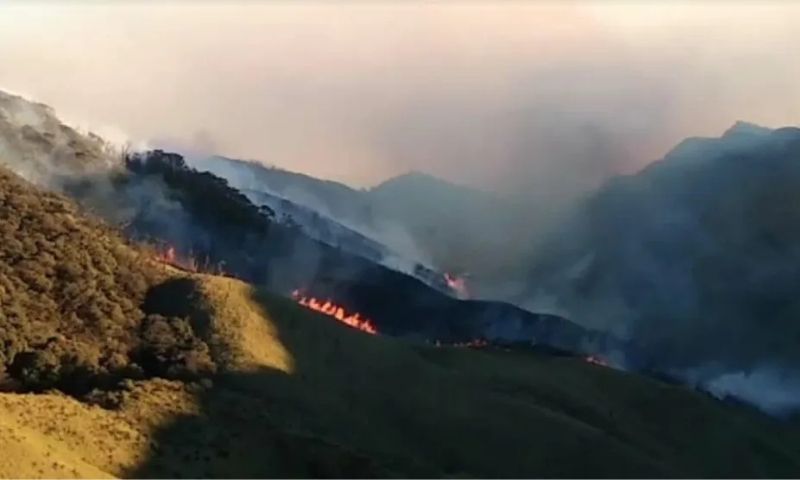
Guwahati | Forest fires are emerging as a growing challenge across the Northeast, but individual State-level measures will not be enough to address the problem, a Parliamentary committee has said, calling for a coordinated regional strategy for the Eastern Himalayan States.
The Department-related Parliamentary Standing Committee on Science and Technology, Environment, Forests and Climate Change, in its report on forest fires in the Himalayan region, has recommended a single, time-bound action plan covering the Eastern Himalayan States.
The panel identified common challenges including Jhum cultivation, difficult terrain, inadequate frontline manpower and irregular funding. It also proposed a permanent regional mechanism to coordinate responses to forest fires that cross State boundaries. Assam, Manipur, Meghalaya, Mizoram and Nagaland have recorded some of the highest numbers of forest-fire detections among Himalayan States over the past four fire seasons, according to the report.

However, the Committee cautioned that the figures do not indicate a uniform increase in fires, with the number of incidents fluctuating significantly between seasons. Arunachal Pradesh, meanwhile, recorded its highest number of fire detections in four years by June 8, 2026, even before the current fire season had ended.
The panel said the fire situation in the Eastern Himalaya differs significantly from that in the western Himalayan region. Forests in the Northeast are characterised by bamboo, moist deciduous vegetation and leaf litter rather than a single dominant, highly combustible forest type. Steep terrain, limited road connectivity and difficult access further complicate firefighting operations.
The Committee identified human activity as a major factor behind the fires, with Jhum cultivation emerging as a key driver. However, it noted that Jhum remains closely linked to the livelihoods and food security of several tribal communities. As a result, fire prevention measures cannot rely solely on restrictions on shifting cultivation and must also provide viable livelihood alternatives.
Manipur provides a significant example of the link between Jhum cultivation and forest fires. The State told the Committee that an estimated 90–95 per cent of forest fires are human-induced, with short-cycle Jhum cultivation identified as the principal cause.
Of 511 active-fire locations detected and subsequently verified between September 2024 and November 2025, 335 — nearly two-thirds — were attributed directly to Jhum cultivation. Data from the Forest Fire Alert System showed 3,588 fire events in Manipur between January 2021 and May 2026, affecting an estimated 12,650 hectares.
Instead of imposing an outright ban on Jhum, Manipur has been promoting alternatives such as agroforestry, horticulture, beekeeping and livelihoods based on non-timber forest produce. The Committee, however, found the funding for Jhum rehabilitation inadequate. Only Rs 19.04 lakh was utilised for dedicated rehabilitation measures during 2025-26, despite Jhum accounting for a substantial share of verified fire incidents.
The panel called for stronger and more transparent incentives for villages that successfully reduce Jhum-related fires. Technology is increasingly being used to improve fire detection and response. In Manipur, 6,967 frontline personnel and members of village and joint forest committees are registered to receive forest-fire alerts from the Forest Survey of India.
The State is also working with the North Eastern Space Applications Centre on forest monitoring, sensors and drone-based surveillance.However, the Committee said technology alone cannot address the problem and stressed the need to strengthen the frontline workforce.

Manipur’s Forest Protection Force is operating at around 45 per cent of its sanctioned strength. The panel has recommended a time-bound recruitment programme and a region-wide training initiative for forest personnel.It also called for stronger fire-response infrastructure and greater support for frontline staff working in difficult terrain.
The Committee has recommended that the Centre bring the Eastern Himalayan States together to formulate a common action plan with clearly defined targets, responsibilities and timelines. It has also proposed a standing regional mechanism to coordinate firefighting and forest protection efforts in cases where fires spread across State boundaries.
Funding disparities have also come under scrutiny. The report records significant variations in CAMPA allocations for forest-fire prevention between 2020-21 and 2025-26.During the period, Meghalaya received Rs 3.55 crore, Mizoram Rs 8.15 crore, Manipur Rs 3.22 crore and Arunachal Pradesh Rs 5.28 crore under the relevant head. Nagaland received no CAMPA allocation under this particular category, while Assam received Rs 12 lakh.
The panel called for more consistent and targeted funding to strengthen fire prevention, early warning systems and frontline response capabilities.The report also highlighted Meghalaya’s traditional system of community-based forest conservation through sacred groves.
The Committee noted that Khasi and Jaintia communities have traditionally protected these forest patches through customary practices that prohibit activities such as tree felling, hunting and removal of fallen wood. According to the panel, several sacred groves have preserved old-growth forests and biodiversity over long periods through community-based enforcement.
It recommended that sacred groves and other community-protected forest patches across the Northeast and Himalayan region be systematically documented and mapped.The Committee stressed that government intervention should strengthen existing customary institutions rather than replace them.
The panel also warned that repeated forest fires can create conditions favourable for the spread of invasive species. In Manipur, species such as Ageratina adenophora and Lantana camara have been spreading in fire-affected areas. The Committee recommended a dedicated regional programme to tackle invasive species, arguing that the problem should not be addressed solely through isolated State-level interventions.
It also called for stronger incentives for fire-free villages, improved infrastructure for forest personnel and greater research into fire-resistant tree species. The panel’s recommendations underline the need for the Northeast to move from fragmented responses to a coordinated regional approach that combines early warning technology, stronger frontline capacity, community participation, livelihood alternatives and sustained funding.