

Assam Education Minister Dr Ranoj Pegu stressed the need to combine academic knowledge with practical skills to improve students’ employability
 KRC TIMES NE Desk
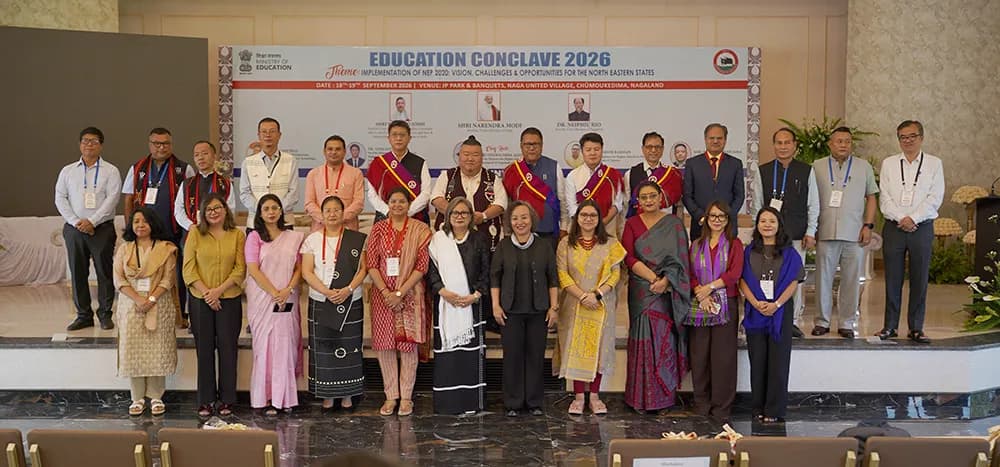
Kohima | A region-specific framework for implementing the National Education Policy (NEP) 2020 in the Northeast, including separate norms for hilly areas and greater coordination among the eight states, emerged as a key focus at the Northeast Education Conclave 2026 in Nagaland.
The two-day conclave, organised by the Nagaland Department of Higher Education, began in Chumoukedima under the theme “Implementation of NEP 2020: Vision, Challenges & Opportunities for the North Eastern States.” Policymakers, education ministers, academics and administrators from across the region are participating in the discussions.
Delivering the keynote address, Nagaland University Vice-Chancellor Jagadish K Patnaik called for an inclusive and context-specific transformation of education in the Northeast. He identified accessibility, equity, quality, flexibility, multilingualism and holistic development as key priorities, while stressing the need to integrate indigenous knowledge with formal education and strengthen skills through technology.
Patnaik also flagged funding as a major challenge, noting that although NEP 2020 envisages substantially higher investment in education, the mechanism for mobilising the required resources remains unclear.
Mizoram seeks separate norms for hill areas
Mizoram Education Minister Dr Vanlalthlana called for education ministers from the eight northeastern states to meet twice a year under the North Eastern Council (NEC) and jointly prepare proposals based on a common assessment of the region’s needs.
He said several provisions of NEP 2020 and the Right to Education Act were framed largely with plain areas in mind and called for a separate index and system for hilly regions.
Vanlalthlana also sought construction norms suited to hill areas and highlighted declining enrolment in government schools across the Northeast. In Nagaland, he said, government schools account for around 80 per cent of schools but have only about 33 per cent of total enrolment.
‘Degrees alone are no longer enough’
Nagaland Higher Education and Tourism Minister Temjen Imna Along said the conclave was aimed at bringing together the region’s experiences and challenges to develop a coordinated approach to NEP implementation.
He stressed that degrees alone could no longer guarantee employment and called for greater emphasis on the practical impact of education and development of critical thinking.
Along also raised the possibility of introducing Christian studies as an academic subject in universities in the Northeast, particularly in Nagaland, Mizoram and Meghalaya. He clarified that the proposal concerned academic study and curriculum, rather than religious institutions.
Assam stresses skills and technology
Assam Education Minister Dr Ranoj Pegu stressed the need to combine academic knowledge with practical skills to improve students’ employability.
He said information technology, media and technology literacy had become essential skills across disciplines, while research and innovation would play a key role in achieving India’s development goals by 2047.
Arunachal Pradesh MLA and Advisor to the HME Mutchu Mithi said education-related decisions would have far-reaching consequences for future generations and called for their long-term impact to be carefully assessed.
Nagaland Chief Minister Neiphiu Rio, in a message read out by Along, said the conclave provided a platform for the northeastern states to exchange ideas and experiences on challenges facing the education sector.
The conclave is expected to explore greater cooperation among the eight states, including sharing of best practices, institutional resources and capacity-building initiatives.