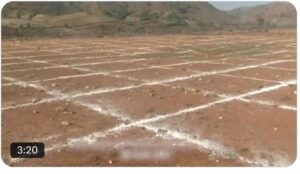


Transforming Barren Land into Green Oasis
 KRC TIMES National Bureau

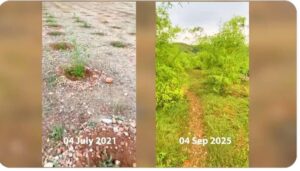
What began in 2021 as a bold experiment to green a barren stretch of land in Rajasthan has today grown into a thriving ecosystem, with Assam’s bamboo playing a central role.
Under the leadership of V K Saxena, then Chairman of the Khadi and Village Industries Commission (KVIC) and now Lieutenant Governor of Delhi, 5,500 bamboo saplings—mostly Assam’s Jati Baa (Bambusa Tulda)—were transported from Khetri, Assam, to Nichla Mandwa village in Udaipur district. The initiative was carried out at the peak of the pandemic, when logistics were difficult, recalls Dr Sukamal Deb, former Deputy CEO of KVIC and in-charge of the North East Region.
“Arranging transport during COVID was an enormous challenge. My team and I had to stay up the entire night to monitor the transition,” Dr Deb said. “But seeing the tall, swaying bamboo today makes every hardship worthwhile.”
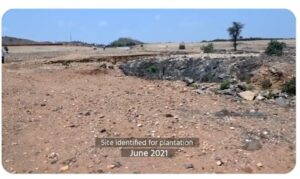
The project, launched on July 4, 2021, began after villagers offered 25 acres of Gram Sabha land for rejuvenation. With support from KVIC, Ahmedabad-based NGO National Council for Civil Liberties (NCCL), local representatives, and community members, the land was prepared for mass plantation.
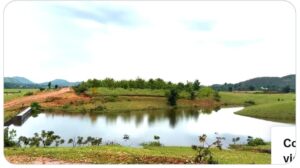
Along with bamboo, saplings of guava, papaya, mango, gooseberry, and moringa were planted. Measures such as digging trenches, repairing a defunct check-dam, installing a solar borewell, and using organic mulching helped sustain the plantation.
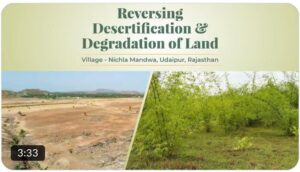
Saxena shared a video of the site’s transformation on X (formerly Twitter), calling it “a small oasis of hope and regeneration in the arid landscape of Rajasthan.” He highlighted that the effort aligns with India’s commitment, announced by the Prime Minister in June 2021, to restore 26 million hectares of degraded land by 2030.
Visiting the site earlier this month, Saxena noted the return of wildlife—squirrels, peacocks, butterflies, dragonflies, and more—around the bamboo groves and fruit trees. “The entire exercise was completed at a cost of just Rs 5 lakh. It is proof of how community effort, innovation, and low-cost measures can bring life back to degraded land,” he said.
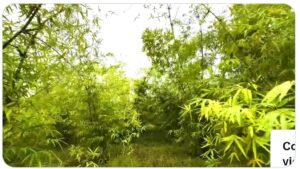
Beyond environmental restoration, the bamboo plantation is expected to support local livelihoods by providing raw material for incense sticks, kites, and furniture.
For Dr Deb, the project is also symbolic. “When bamboo from Assam grows in Rajasthan, it connects the Northeast with the desert culturally, emotionally, and economically. It is a tribute to Mother Earth and a reminder of our duty toward her,” he said.
Nichla Mandwa today stands as a model of land reclamation, offering lessons in sustainability, integration, and resilience that could be replicated across the country and beyond.
Promotional | North East Integration Rally