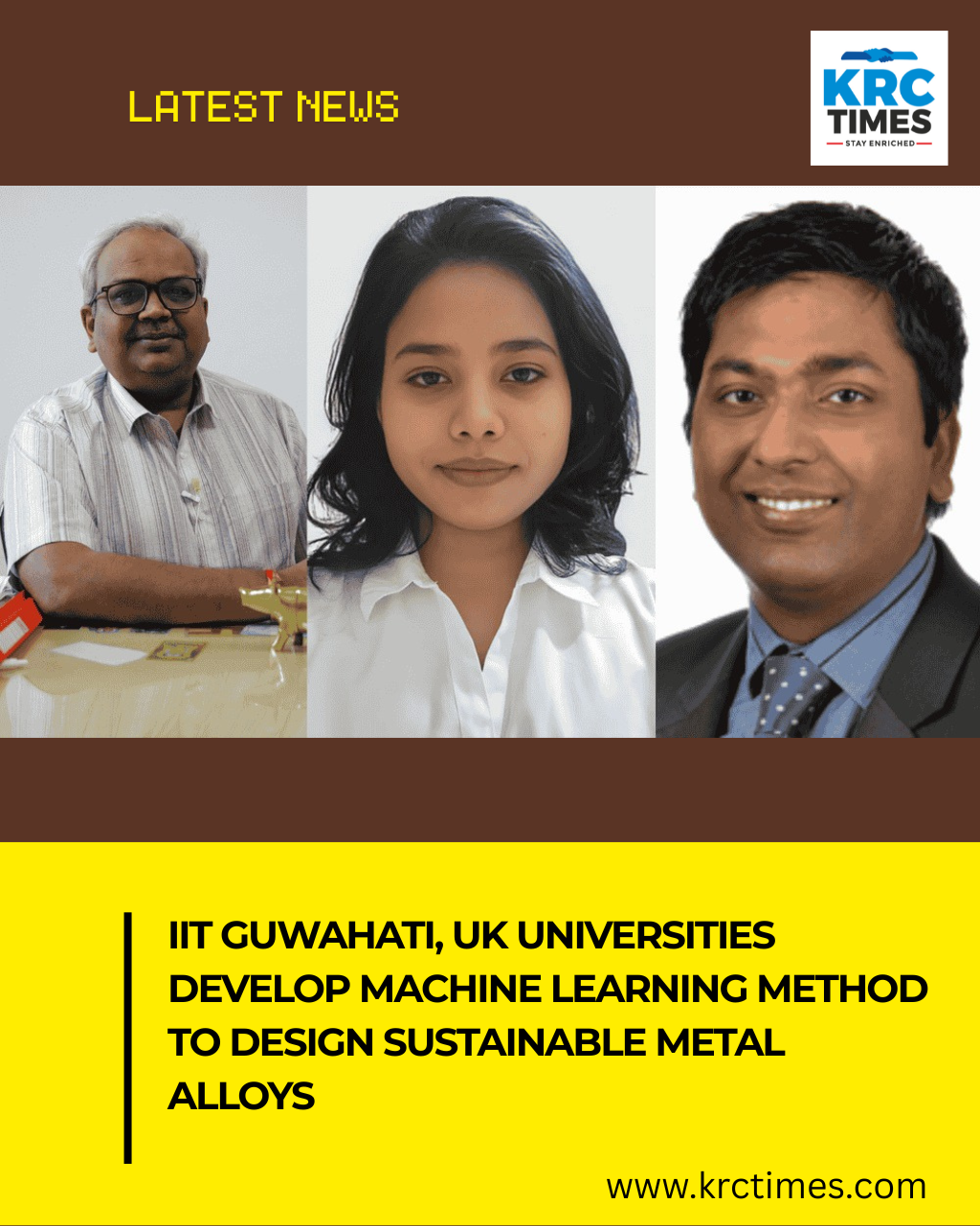
The collaborative research involved experts from the London South Bank University, the University of Manchester and the University of Leeds
 KRC TIMES Assam Bureau
Guwahati : Researchers from the Indian Institute of Technology (IIT) Guwahati, in collaboration with scientists from leading universities in the United Kingdom, have developed a machine learning-based approach to design advanced metal alloys without using Critical Raw Materials (CRMs), offering a sustainable alternative to conventional high-performance materials.
The collaborative research involved experts from the London South Bank University, the University of Manchester and the University of Leeds. The innovation is expected to help identify high-performance materials that are less dependent on fragile global supply chains and environmentally intensive mining practices.
In recent years, High-Entropy Alloys (HEAs) – a class of materials containing several metals in nearly equal proportions – have drawn significant interest from researchers and industry due to their superior strength and stability at high temperatures. These alloys fall under the broader category of Multi-Principal Element Alloys (MPEAs). However, many high-performance HEAs rely heavily on CRMs such as tantalum, niobium, tungsten and hafnium, which are expensive, scarce and difficult to mine.
Heavy dependence on such materials increases import reliance, exposes industries to supply chain disruptions and adds environmental stress, making the reduction of CRM usage a key sustainability challenge.
To address this, the research team led by IIT Guwahati developed a machine learning-assisted alloy design framework focused on identifying CRM-free MPEAs. The researchers first classified critical raw materials into three levels based on supply risk, economic importance and global availability. They then created a database of 3,608 alloy compositions, primarily using elements that are not critically scarce.
Using an Extra Trees Regressor machine learning model combined with optimisation techniques inspired by natural processes, the team searched for alloy compositions capable of achieving high hardness without relying on CRMs. Through this approach, a CRM-free alloy – Ti-Ni-Fe-Cu – was identified as a promising candidate.
The newly proposed alloy was subsequently developed at laboratory scale at IIT Kanpur. Experimental testing showed that its measured hardness closely matched the values predicted by the machine learning model, validating the effectiveness of the AI-driven design framework.
The findings have been published in Scientific Reports, a journal of the Nature Publishing Group. The paper was co-authored by Prof Joshi of IIT Guwahati, along with Dr Swati Singh of IIT Guwahati, Prof Saurav Goel of London South Bank University, Dr Mingwen Bai of the University of Leeds, and Prof Allan Matthews of the University of Manchester.
Researchers said the approach could significantly accelerate the discovery of sustainable, high-performance alloys for applications in aerospace, energy and other critical sectors, while reducing dependence on scarce and environmentally costly raw materials.
Promotional | North East Integration Rally