

Under the new structure, school education will be divided into four stages spanning 15 years, beginning with three years of pre-primary education
 KRC TIMES National Bureau
New Delhi: India’s decades-old 10+2 school education system is being phased out as part of the implementation of the National Education Policy (NEP) 2020, with schools across the country gradually adopting the new 5+3+3+4 academic structure.
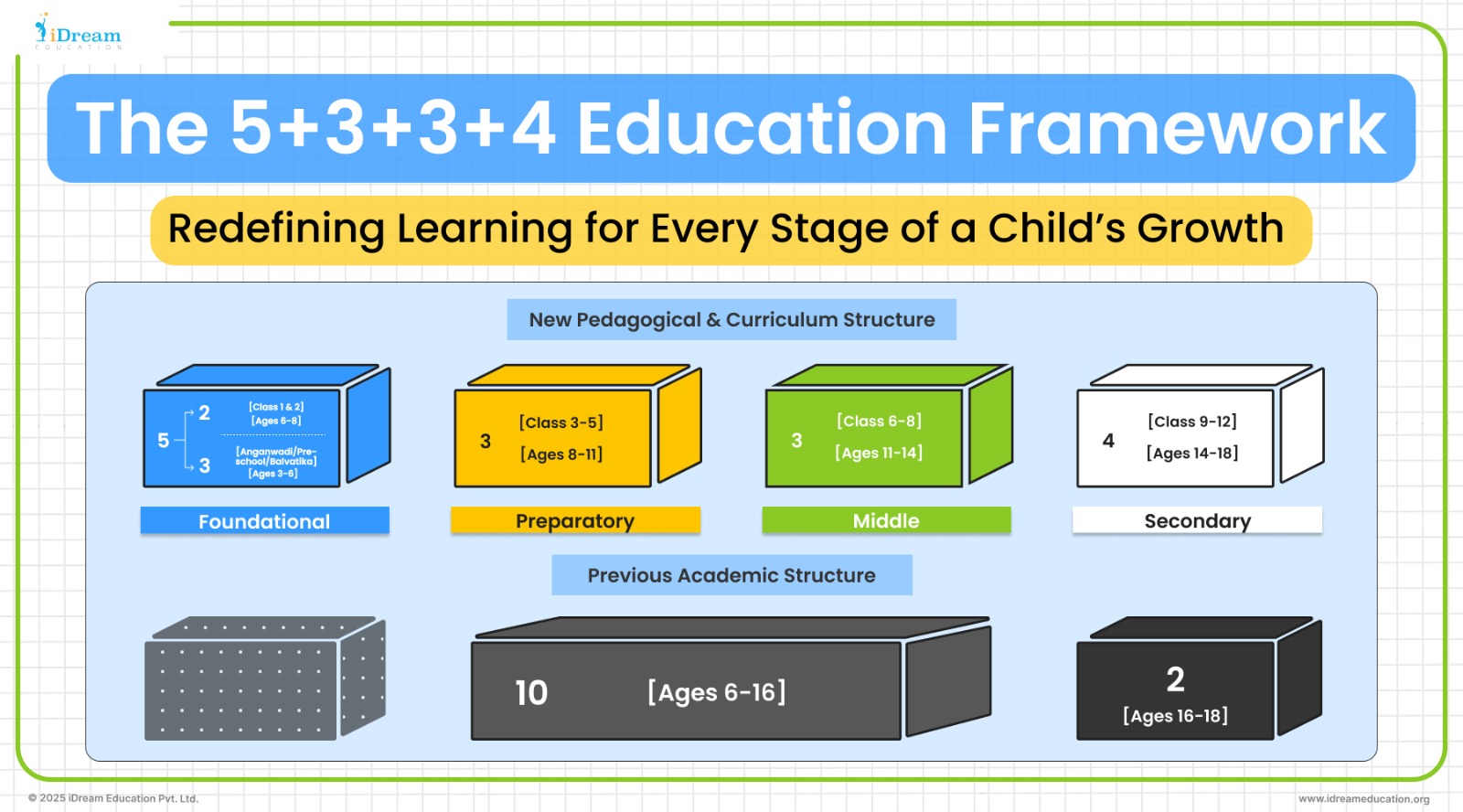
The revised framework aligns school education with the cognitive and developmental stages of children and aims to shift the focus from rote learning to competency-based, experiential, and skill-oriented education.
Under the new structure, school education will be divided into four stages spanning 15 years, beginning with three years of pre-primary education.
The Foundational Stage covers five years, including three years of pre-school or Anganwadi (Balvatika) followed by Classes 1 and 2, for children aged 3 to 8 years. It focuses on play-based and activity-oriented learning to develop language, social, emotional, and cognitive skills.
The Preparatory Stage includes Classes 3 to 5 for children aged 8 to 11 years. During this phase, students transition to formal classroom learning while strengthening literacy, numeracy, and foundational concepts in science and mathematics.
The Middle Stage, comprising Classes 6 to 8 for students aged 11 to 14 years, introduces experiential and discovery-based learning. Vocational education and internship opportunities are also expected to begin from this stage.
The final Secondary Stage covers Classes 9 to 12 for students aged 14 to 18 years. It offers greater flexibility in subject selection, allowing students to combine academic and vocational disciplines instead of being restricted to traditional Science, Commerce, or Arts streams.
The NEP also proposes significant changes in the assessment system by reducing dependence on high-stakes examinations and promoting continuous, competency-based evaluation. Key learning assessments are planned for Classes 3, 5, and 8 to monitor student progress.
Another major reform is the integration of Early Childhood Care and Education (ECCE) into the formal education system. The policy also encourages the use of the mother tongue or regional language as the medium of instruction, particularly during the foundational years.
The Ministry of Education has been rolling out the reforms in phases, with states and Union Territories implementing the new framework according to their respective academic and administrative preparedness.
The 5+3+3+4 model is regarded as one of the most significant structural reforms in India’s education system since Independence, aiming to make learning more flexible, inclusive, and aligned with the needs of the 21st century.