


East BengalConquer Al-Arabi to Make History
 KRC TIMES Desk
Rishov Bhattacharjee
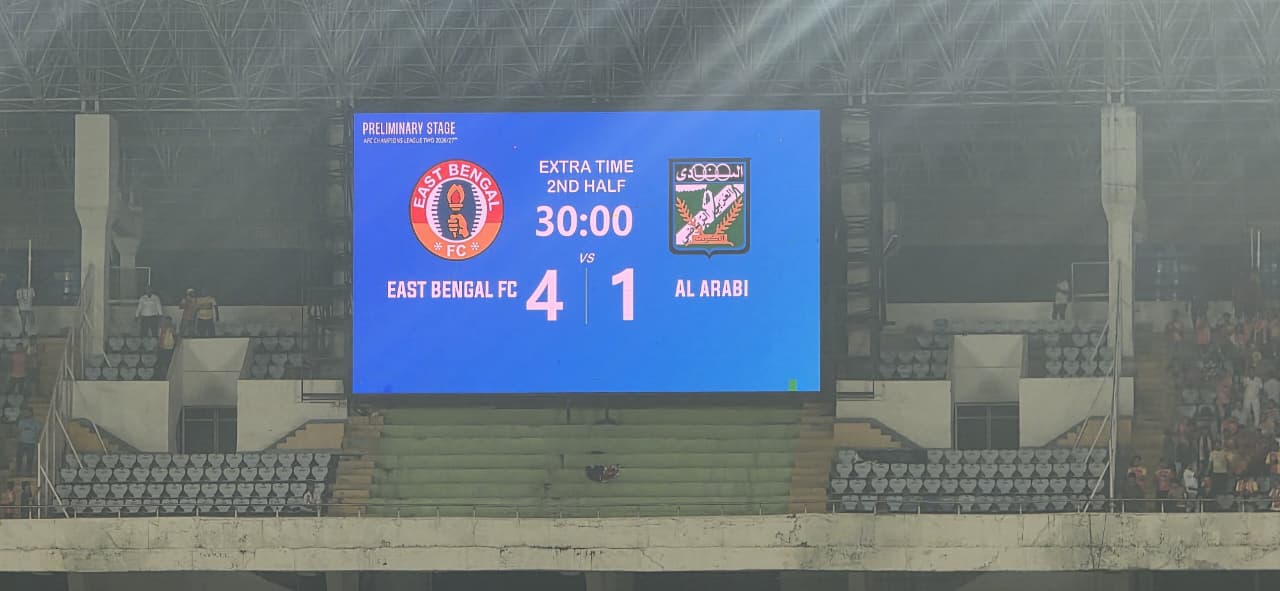
There are football victories remembered for the scoreline, and then there are victories remembered for what they represent. East Bengal’s 4–1 extra-time demolition of Kuwait’s Al-Arabi in the AFC Champions League Two preliminary round belongs firmly to the second category.
On a night when injuries and suspensions had severely restricted their foreign-player options, and an experienced Gulf side appeared stronger on paper, East Bengal produced one of the most remarkable continental performances by an Indian club in
recent memory.
The reward is enormous: a place in the 2026–27 AFC Champions League Two group stage. But the manner in which they achieved it is what makes the victory truly special. East Bengal entered the contest as the reigning Indian Super League champions, but continental football offered a very different challenge. Al-Arabi arrived with considerably greater foreign-player depth and several experienced international players.
East Bengal, meanwhile, were dealing with a depleted squad. With Nacho Monsalve unavailable through injury and Lalchungnunga suspended, they effectively had only two fit foreign players available — Mohammed Bassim Rashid and Dani Ramírez.
That imbalance could easily have become the defining story of the night. Instead, it became the backdrop to East Bengal’s triumph. Perhaps the most significant feature of the performance was the defence. Without their foreign defensive options, the responsibility fell almost entirely on the Indian players. Anwar Ali stood at the heart of a local defensive unit that had to withstand
Al-Arabi’s international attacking talent for 120 minutes.

This was not simply a case of Indian players filling positions. They had to withstand sustained pressure from a team with greater foreign-player depth, continental experience and individual attacking quality. Yet East Bengal remained organised, compact and disciplined.
Goalkeeper Prabhusukhan Singh Gill also produced an important performance when his team needed him most. Together, the defensive unit kept East Bengal alive. For 75 minutes, the contest remained goalless. Then, in the 76th minute, Anayo Iwuala converted a penalty to put Al-Arabi 1–0 ahead.
The timing could hardly have been worse. The clock was running down, the opposition had the lead, and East Bengal’s continental campaign appeared to be slipping away.
But instead of collapsing, East Bengal found one final surge. In the 90th minute, Jay Gupta produced the equaliser. A late equaliser in a knockout match changes everything. The side that thought it had won suddenly has to start again; the side that thought it had lost suddenly believes it can win. East Bengal carried that belief into extra time.
The first 90 minutes demonstrated their ability to survive. The next 30 demonstrated their ability to dominate. Rather than simply trying to reach penalties, East Bengal attacked extra time with renewed confidence. Al-Arabi, who had been ahead only minutes earlier, suddenly found themselves under enormous pressure.
Then came Mohammed Bassim Rashid. In the 108th minute, the Palestinian midfielder produced a superb volley to put East Bengal ahead. The comeback was complete. But East Bengal were not finished. David Hmar added a third, and Rohit Danu
completed the extraordinary transformation. From 0–1 down in the 76th minute to 4–1 winners after extra time — three unanswered goals and a knockout tie completely turned on its head.
The most fascinating aspect of the victory, however, may be what it says about the foreign-player equation in Indian football.
Indian football has spent years debating the balance between overseas experience and domestic talent. East Bengal’s victory does not settle that debate, but it provides a compelling example.
On this particular night, East Bengal had only two fit foreign players. Two. And yet they defeated a side that arrived with zonsiderably greater overseas representation. That does not diminish the contribution of Rashid and Ramírez. Rashid was
instrumental in the comeback, scoring the goal that gave East Bengal the lead in extra time, while Ramírez provided creativity and technical quality.

Send your resume:
biswa@jigyasu.co.in
krcfoundation@gmail.com
But the victory demonstrated something equally important: when the foreign options disappeared from the defensive unit, the Indian core did not disappear with them. It stepped forward. The importance of Anwar Ali deserves particular attention. A defence built almost entirely around Indian players had to remain disciplined against an attack capable of exploiting individual weaknesses.
There was no room for casual mistakes. Every missed runner or poorly timed challenge could have changed the game. Yet the Indian defensive unit held together. This was not a match East Bengal won by dominating every minute. It required patience, defensive intelligence and an understanding of when to press and when to retreat. Most importantly, it required belief.
Antonio López Habas’ tactical approach was crucial. East Bengal did not need to be spectacular for 120 minutes; they needed to remain alive. When Al-Arabi scored, they did not abandon their structure. When the equaliser arrived, they recognised the psychological shift. And once they went ahead, they attacked decisively.
That transition — from survival to aggression — was arguably the defining feature of the night. Habas kept his side prepared for the moment when the match could be turned, and when that moment arrived, East Bengal took it. For East Bengal supporters, this will naturally be remembered as another memorable night in the club’s history. For Indian football, however, it carries a broader
significance.
The AFC Champions League Two is Asia’s second-tier continental club competition, and this victory puts the reigning ISL champions into its 2026–27 group stage. The preliminary round was a single-match tie, making the pressure even greater: win, and
progress; lose, and the continental campaign ends.
East Bengal were therefore not simply playing for another fixture. They were playing for continental relevance. And they delivered.Perhaps the biggest takeaway should not be the number of foreign players East Bengal had, but the number of Indian players who stood up when those players were unavailable.
Jay Gupta resurrected the contest. Anwar Ali marshalled the defence. Prabhusukhan Singh Gill provided security behind them. David Hmar and Rohit Danu finished the job in extra time. That is why this victory deserves to be viewed differently from an ordinary 4–1 win. It was not achieved because East Bengal had every resource at their disposal. It was achieved because, when resources were taken away, the players who remained responded.
Indian football has often been caught between the belief that domestic players need strong foreign teammates to compete and the belief that they can achieve more when given greater responsibility. East Bengal’s night against Al-Arabi offers evidence for
the latter — not definitive proof, but evidence.
When the reigning ISL champions entered one of their biggest matches with only two fit foreign players, many would have expected their limitations to be exposed. Instead, those limitations became the backdrop to one of their greatest strengths.
The Indian players stepped up. They did not merely hold on. They came from behind, survived 120 minutes, scored three times in extra time and finished 4–1 winners.
From 0–1 down to a four-goal triumph. From two foreign players to an Indian defensive masterclass. From the brink of elimination to the AFC Champions League Two group stage. That is why East Bengal’s victory over Al-Arabi should not simply be recorded as another result.
It should be remembered as a statement: when Indian football is placed under continental pressure, its domestic talent can rise to the occasion. And on this extraordinary night in Kolkata, East Bengal’s Indian core did exactly that.