


Destiny, Decision or Disaster? – Part II
 KRC TIMES Desk
Col (Dr.) Ashwani Kumar, MiD, VSM (Retd).
After the Bloodshed Came Silence. The Refugees Who Rebuilt Their Lives from Ashes. When the flames of Partition slowly began to settle, another battle silently started the battle to survive.
Millions who crossed the newly drawn borders did not arrive in India or Pakistan as citizens of hope. They arrived as broken human beings carrying exhaustion, trauma, and memories too painful to describe.
The old man in the village, whose trembling voice still carried the wounds of 1947, once said something unforgettable:
“People think Partition ended when we crossed the border. No… that was only the beginning of our suffering.” For refugees, survival after migration was often harder than the journey itself.
Life Inside Refugee Camps
Refugee camps sprang up across Punjab, Delhi, Haryana, Rajasthan, and many other regions. Schools, gurudwaras, temples, abandoned barracks, and open grounds were converted into temporary shelters.
There was: little food, poor sanitation, outbreaks of disease, and endless uncertainty.
Families who once owned fertile lands, businesses, livestock, and homes now stood in long queues for a handful of grain.
Children searched for missing parents. Women hid silent trauma behind veils of dignity. Elderly people stared blankly into the distance, unable to understand how centuries of belonging had vanished within weeks.
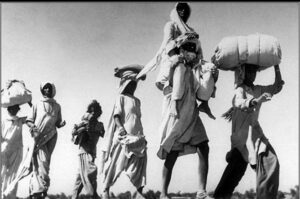
“The old villager recalled how nights inside refugee camps were the worst.
“There were no walls,” he said softly. “Only fear.” The Pain of Leaving Ancestors Behind
For many refugees, the deepest wound was not financial loss – it was emotional uprooting. People had left behind:
ancestral homes, farms, family temples and mosques, childhood memories,
photographs, and even the graves of their forefathers. Many locked their homes believing they would return once violence subsided.
They never returned. The old villager remembered his mother crying silently every evening.
“She did not cry for gold or land,” he said. “She cried because she could not even touch the soil where her parents were buried.” Partition had not only divided land. It had separated people from memory itself.
A Survivor’s Memory of Partition.
During my interactions with elderly survivors of Partition, I once met another family whose memories still carried the pain of 1947 like an unhealed wound. They had migrated from Lahore during the violence of Partition. The elderly gentleman, while narrating his story, repeatedly paused as though every sentence forced him to relive those terrifying nights once again.
He recalled how their refugee convoy came under sudden attack while moving during darkness. Panic spread instantly. People began running in every direction to save their children and families. Amidst the chaos, confusion, screams, and gunfire, their entire family got separated into four different groups.
“There was crying everywhere,” he told me softly.
“Children were screaming for mothers… mothers searching for sons… brothers calling each other in darkness.”
Every morning, the elders would leave the camp in search of their missing family members – sons, daughters, brothers, sisters – not knowing whether they were alive or dead.
It was an unimaginably difficult task.
Those days there were:
No mobile phones,
No communication systems,
No internet,
No certainty.
Only destiny.
Yet they did not lose heart.
For nearly a week, the surviving members searched endlessly through camps, roads, hospitals, refugee caravans, and railway stations. By what the old man described as “God’s grace and destiny,” all the separated family members were finally traced and reunited.
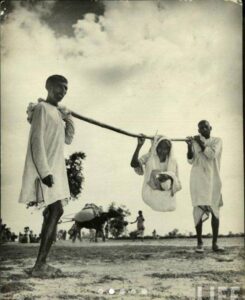
The astonishing part was that many of them had been staying in the same relief camp, unknowingly going out daily to search for one another in the very same areas.
As the elderly gentleman narrated the story, I could feel goosebumps across my body.
Just imagine the agony those families endured during those endless days of uncertainty. Ask them what Azadi truly meant to them. Ask them what destiny meant after surviving Partition.
For them, freedom did not arrive with celebration alone. It arrived mixed with blood, separation, tears, fear, and survival.
Perhaps that is why today, when second-generation political voices casually provoke divisions in the name of slogans, narrow identities, or communal passions, it deeply disturbs the conscience.
The generation that witnessed Partition carried the price of freedom in their blood. They had seen the consequences of hatred with their own eyes. Their patriotism was born from sacrifice, displacement, hunger, and survival not from political convenience.
Their stories remind us that freedom was not gifted easily. It was carried across burning borders by broken families who still chose to rebuild life with courage and dignity.
A Survivor’s Memory of Partition
The Woman Who Served Dal and Tandoori Roti
As narrated by a twelve-year-old survivor
In the burning summer of 1947, when Punjab itself seemed to be crying, my Dada Ji gathered whatever little remained of his world and began walking toward India.
Behind them lay Narowal frightened, uncertain, and slowly emptying itself of old neighbours who had once lived like family for generations.
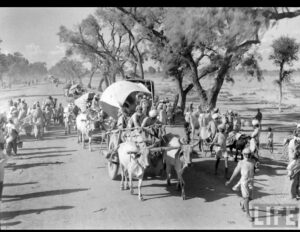
The small group moved silently along the dusty road through villages and scattered settlements near Jassar, Kotli, and the Ravi belt. People walked in long columns carrying bedding, brass utensils, crying children, and memories heavier than luggage itself.
My father was still young.
One of my uncles was barely twelve.
The younger one was only six.
Tai Ji walked quietly beside them.
But the deepest wound was this my Dadi Ji and little Bua Ji had been left behind temporarily in a nearby village with her brother because the roads had suddenly become unsafe.
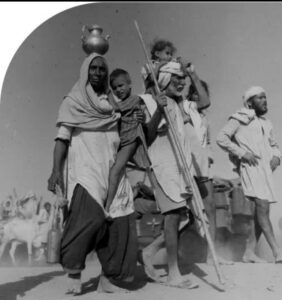
Nobody knew whether they would meet again.
Barefoot, thirsty, and frightened, the family kept moving. The kucha roads (track) were scorching. Dust entered their eyes and mouths. At places near Kotli, smoke could be seen rising from distant homes. People did not speak much anymore. Fear had silenced everyone.
The twelve-year-old boy my Chacha Ji later recalled:
“The only sound I remember was the tired footsteps of people who no longer knew where home was.”
After walking almost an entire day with hardly anything to eat, they finally reached Dera Baba Nanak railway station by evening.
For a brief moment, hope returned. The children thought they would finally get food. Perhaps some milk… perhaps a little atta… perhaps anything. But destiny had another test waiting.
Just before sunset, curfew was imposed in the town.
The bazaar shut down instantly. Doors closed. Silence spread everywhere.
The exhausted family sat helplessly on the railway platform with empty stomachs and swollen feet. The younger child cried softly from hunger. Nobody had the strength left even to console him.
That night, under the dim yellow lamps of the station, surrounded by hundreds of displaced souls, my Dada Ji must have wondered if humanity itself had ended.
And then… God sent help in the form of a human being. A man passing through the station suddenly stopped. He looked carefully toward my Dada Ji.
For a few seconds both men stared at each other through disbelief, dust, and exhaustion. It was an old friend. A fellow teacher from earlier days. In that ocean of refugees, among thousands of broken people, destiny had brought one human being exactly where he was needed.
Without wasting a moment, the man embraced my Dada Ji and took the entire family to his modest home nearby. And there, in that small house with limited means, lived a woman whose love remained unforgettable even after decades.
The moment she saw the exhausted family frightened children, blistered feet, tired faces covered in dust her eyes filled with compassion.
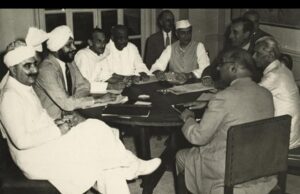
There was no hesitation. No fear. No complaint about shortage. With deep motherly affection she gently said:
“First, all of you take a bath. You are safe here now. I will prepare food.” Those simple words became a blessing for the shattered family. Even today, my Chacha Ji would become emotional while remembering her voice.
She had very little in her house.
The times themselves were uncertain. Food was scarce everywhere. Yet whatever she had, she offered with open hands and an open heart. While the family washed away the dust and pain of the journey, she immediately lit the chulha.
Soon the fragrance of dal filled the small home. One by one, hot tandoori rotis came out. She served everyone herself like a mother feeding her own children after a long separation.
Again and again she would say: “Eat more… the children must eat first.”The hungry children could hardly wait. Nobody spoke while eating.
Tears mixed silently with food. For the displaced family, that simple meal was not merely dal and roti. It was dignity. It was humanity. It was love served on a steel plate.
My Chacha Ji used to say:
“I can still remember her affection even today. We had lost almost everything, but that lady made us feel that humanity was still alive. The taste of her dal and tandoori roti never left my heart.”
That night, after many terrifying days, the family slept peacefully under a safe roof. And in the morning, despite her meagre resources, the noble lady again prepared fresh dal and warm rotis before they resumed their journey. And also gave some food packed in a cloth with mango pickle, onion and green chillies.
Such hospitality cannot be measured in wealth.
In those terrible days of Partition, when people were killing in the name of religion and borders, one ordinary woman showed the true religion of humanity. After thanking the family with folded hands and moist eyes, they moved onward toward Kasuna village near Dera Baba Nanak, where refugee camps had begun forming.
But Dada Ji’s heart was still restless. His wife… his daughter… were still missing. Every passing bullock cart, every arriving convoy, every group of refugees made him stand up anxiously.
And then finally…
One dusty convoy appeared in the distance. Among the frightened faces, he saw them. My Dadi Ji. Little Bua Ji. And her brother who had protected them through the chaos. For a moment, nobody moved. Then the family ran toward each other. Children crying. Women weeping openly. Hands trembling.
A family broken by Partition had become whole again.
Years later, whenever my Chacha Ji narrated this memory, his eyes would still become moist not merely because they lost land or property, but because amid one of history’s darkest tragedies, a simple woman with a kind heart and a small kitchen became their saviour.
History may never record her name. But for one refugee family, she remained nothing less than an angel sent by God.
The Trains of Death.
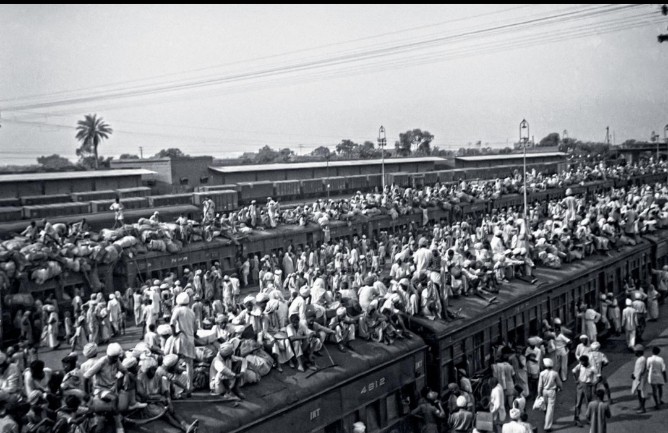
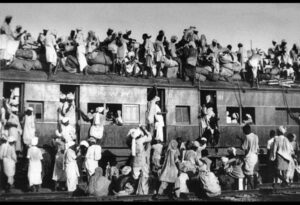
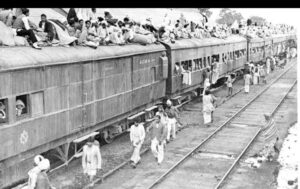
Perhaps nothing symbolised the horror of Partition more than the refugee trains.
Thousands travelled packed inside overcrowded compartments with fear written across every face. Some trains arrived safely. Many never did. Entire trains crossed borders carrying only corpses.
The old villager remembered seeing one such train near Punjab.
“There was complete silence,” he recalled.
“No crying. No shouting. Only silence.”
When the doors opened, bodies fell out.
For days afterward, he could not sleep. Even decades later, the sound of train whistles disturbed him.
Women: The Forgotten Victims.
The suffering of women during Partition remains one of history’s most painful and least spoken truths.
Thousands faced: Abductions, Assaults, Forced conversions,
Separation from families,
and honour killings committed even by their own relatives out of fear and shame.
Many women disappeared forever without names, records, or remembrance.
The old man lowered his eyes while speaking about those days.
“Humanity had gone mad,” he whispered. Yet Humanity Also Survived, Amidst unimaginable brutality, stories of courage and humanity also emerged.
Some villagers protected families of other faiths. Some risked their own lives to escort neighbours safely across borders. Gurudwaras, temples, and mosques became shelters for frightened refugees regardless of religion.
The old villager himself remembered a Muslim neighbour who secretly guided his family through safer routes at night.
“He folded his hands before my father and said,” the old man recalled,
“When this madness ends, remember that not all humans became animals.”
That sentence remained with him for life.
Rebuilding from Nothing.
Over time, refugees slowly rebuilt their lives. They opened small shops, worked as labourers, cultivated barren lands, and educated their children despite poverty and trauma.
Cities like Delhi, Amritsar, Ludhiana, and Jalandhar transformed because of the determination and hard work of refugee families. The old villager smiled faintly while speaking about later years.
“We came with empty hands,” he said,
“but we taught our children never to beg before life.”
That generation carried pain silently, yet rebuilt nations from ruins. Conclusion: The Unfinished Memory of Partition
Even today, Partition survives:
in abandoned homes across borders, in fading black-and-white photographs, in refugee colonies, in stories narrated with trembling voices, and in elderly eyes that still become moist while remembering 1947. The old villager eventually stopped speaking. His trembling hands rested on his walking stick while silence settled around him.
Then after a long pause, he quietly said:
“Borders were drawn on maps…
but the real Partition happened inside human hearts.”
The greatest tribute to those who suffered in 1947 is not hatred or revenge. It is ensuring that future generations never allow fear, communal hatred, political manipulation, or division to destroy humanity again.
Because once humanity collapses, history stops being history. It becomes inherited pain.