

End of Zero MDR for UPI
 KRC TIMES Business Desk
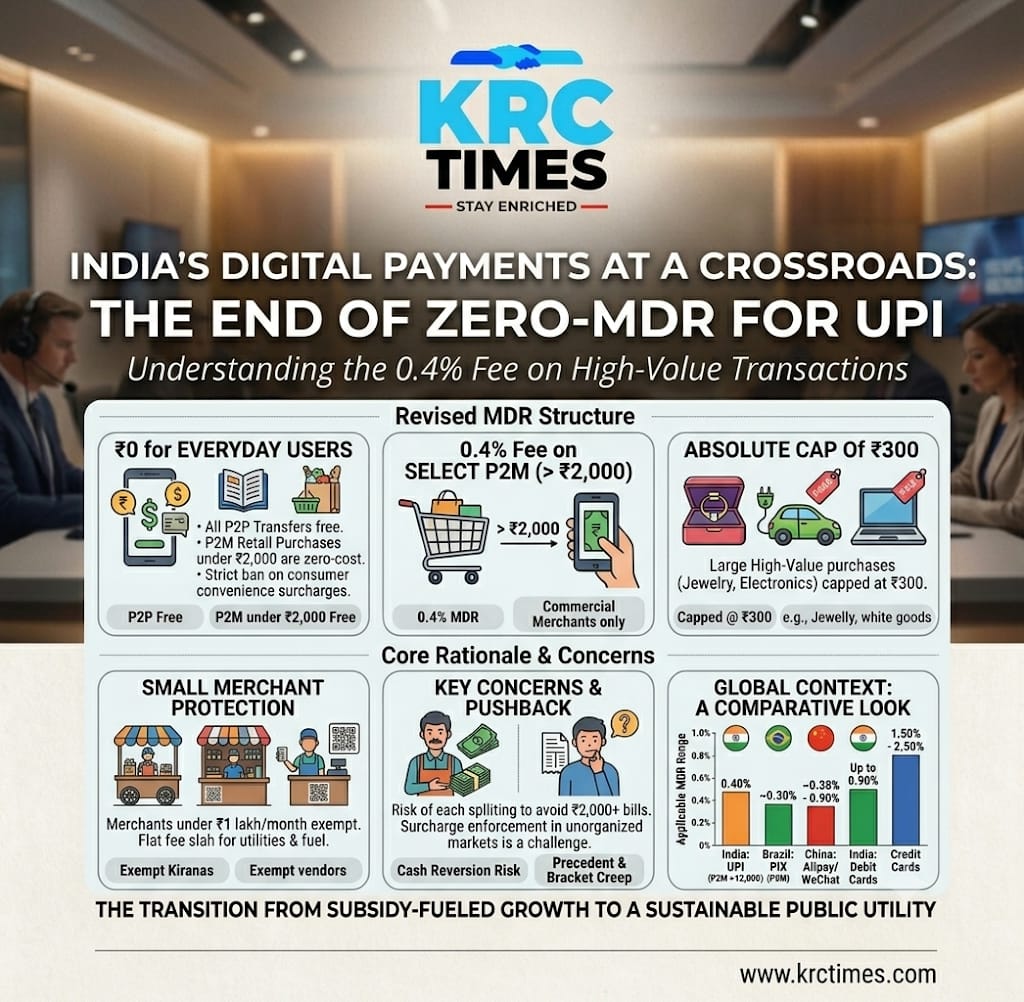
The introduction of a Merchant Discount Rate (MDR) framework on high-value Unified Payments Interface (UPI) transactions marks a major turning point in India’s digital payments architecture. By moving away from an absolute “zero-MDR” regime—which has been in place since January 2020—policymakers and industry stakeholders are navigating a delicate balance between financial sustainability for banks and fintechs on one side, and merchant acceptance and user friction on the other.
1. Structure of the Revised MDR Framework
The National Payments Corporation of India (NPCI) and the Reserve Bank of India (RBI) have structured the MDR framework around clear thresholds to insulate daily retail trade:
- 0.4% Fee on Select P2M Transactions: The baseline MDR is set at 0.4% exclusively for Person-to-Merchant (P2M) transactions exceeding ₹2,000.
- Absolute Cap of ₹300: For large transactions (such as jewelry, electronics, or white goods purchases above ₹75,000), the MDR is capped at ₹300.
- Special Concessions & Fixed Slabs: Essential recurring categories—including fuel, rail bookings, insurance premiums, and utilities—attract a flat nominal fee (₹5), while capital market investments (mutual funds, broking) are capped at a concessional 0.02%.
- Small Merchant (P2PM) Protection: Street vendors, small kirana stores, and micro-merchants receiving under ₹1 lakh per month through standard QR codes remain fully exempt.
- Completely Free for Consumers: Person-to-Person (P2P) transfers, consumer app usage, and P2M transactions up to ₹2,000—which account for over 95% of total UPI transaction volumes—remain strictly free. Payment applications are barred from levying convenience or platform surcharges.
2. The Core Rationale: Ecosystem Viability & Infrastructure Upgrades
The push from the RBI, NPCI, and the banking sector centers on the economics of running the world’s largest real-time retail payment rail:
- Escalating Operating Costs: Handling billions of real-time transactions per month requires heavy capital expenditure in high-concurrency banking servers, API switches, fraud monitoring, and core banking system (CBS) uptime. Annual ecosystem maintenance is estimated at nearly ₹20,000 crore.
- Fiscal Burden of Direct Subsidies: The Union Government has historically allocated budgetary subsidies (roughly ₹1,500–₹2,200 crore annually) to offset the costs of zero MDR. This subsidy was largely viewed as an emergency bridge rather than an indefinite solution.
- Ending Corporate Subsidies: NPCI and banks have argued that under zero MDR, public tax revenue was effectively subsidizing large e-commerce platforms, hypermarkets, and luxury retailers that already pay 1.5% to 2.5% MDR on credit cards without hesitation.
- Revenue Reinvestment: The MDR pool (split across acquiring banks, issuing banks, payment service providers, and app providers) establishes an organic revenue model to fund cybersecurity, AI-driven fraud mitigation, and server capacity, with 5% earmarked for expanding acceptance infrastructure in Tier III–VI cities.
3. Key Concerns and Pushback
Despite built-in exemptions, the decision has sparked debate among retailers, economists, and consumer advocates:
- Risk of Cash Reversion in Mid-Tier Retail: While large organized retailers easily absorb a 0.4% overhead, mid-tier shops (e.g., apparel, consumer electronics, hardware) operate on thin margins. There is concern that shopkeepers may discourage UPI for bills over ₹2,000, asking customers to split payments or revert to unrecorded cash.
- Indirect Consumer Pass-Through: Although the Ministry of Finance has instructed acquiring banks to ensure merchants do not pass MDR directly onto consumers, enforcement remains challenging in unorganized markets where informal “surcharges” or discounts for cash are common.
- Precedent & Bracket Creep: Industry critics note that amending Section 10A of the Payment and Settlement Systems Act removes the statutory zero-charge guarantee, enabling future adjustments to transaction thresholds via executive notification without parliamentary debate.
4. Global Context & Comparative Economics
Compared to global and domestic benchmarks, the 0.4% rate remains among the lowest card/digital rails in the world:
Payment Rail / System | Applicable MDR Range
India: UPI (P2M > ₹2,000) | 0.40% (Capped at ₹300)
Brazil: PIX (P2M) | ~0.33%
China: Alipay / WeChat Pay | ~0.38% – 0.40%
India: RuPay / Visa Debit Cards | Up to 0.90%
Credit Cards (Domestic) | 1.50% – 2.50%
Strategic Outlook
The transition represents the maturation of India’s digital payments journey: moving from a hyper-growth adoption phase fueled by state subsidies to a self-sustaining, commercially viable public utility.
If acquiring banks and NPCI prevent merchant friction through automated tiered billing and transparent reporting, the policy will provide the revenue needed to safeguard digital resilience, reduce technical decline rates, and expand cross-border UPI corridors without impeding grassroots financial inclusion.
Promotional | For admission to the Brain Vision Program