The presentation focused on workplace culture and administrative accountability, identifying 12 archetypes of problematic bureaucratic behaviour that hamper government efficiency
 KRC TIMES Desk
NEW DELHI
In a sharp and unconventional performance review meeting with senior government secretaries, Cabinet Secretary T.V. Somanathan utilised satire, cartoons inspired by R.K. Laxman, and direct administrative data to spotlight systemic bottlenecks and behavioural flaws within the civil services.
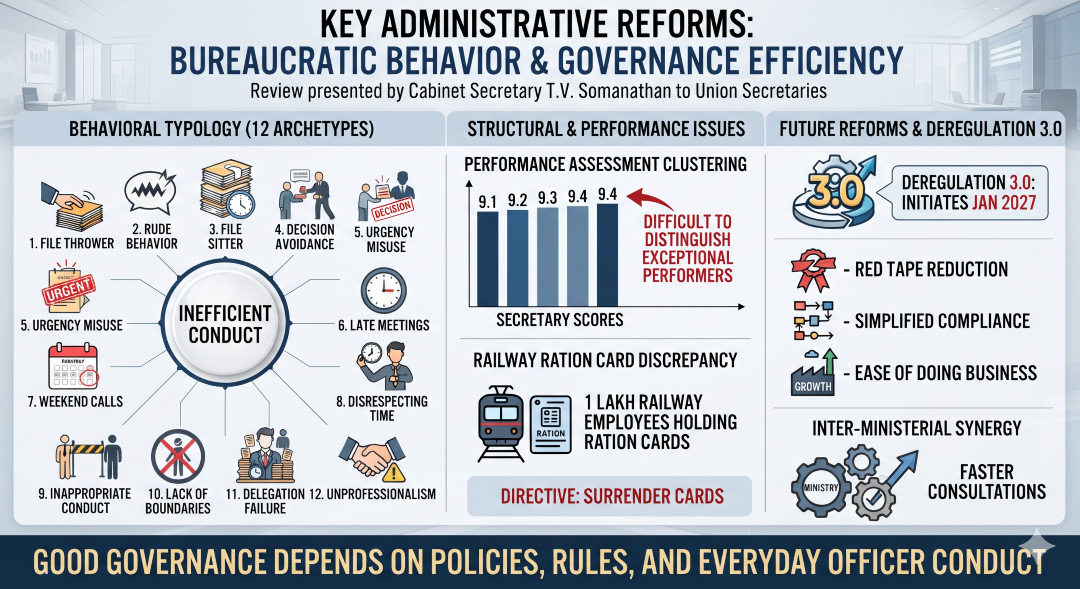
The presentation focused on workplace culture and administrative accountability, identifying 12 archetypes of problematic bureaucratic behaviour that hamper government efficiency.
From “File Sitters” to Workplace Conduct
The session addressed common office dysfunctions, ranging from minor operational delays to toxic workplace habits. Among the behaviors flagged were:
- “File Sitters” and File Throwers: Officers who allow files to pile up indefinitely instead of making timely decisions, or those who display unprofessional outbursts toward subordinates.
- Delegation Avoidance: Officials who unnecessarily pass routine decisions up to Union ministers despite holding the requisite administrative authority.
- Time Inconsideration: Practices such as scheduling abrupt late-night or weekend meetings without respect for staff bandwidth.
- Professional Boundaries: Inappropriate behaviour directed toward women colleagues, with a strict reiteration of the need for professional decorum and safe workplace boundaries.
The Cabinet Secretary emphasized that good governance relies as much on everyday workplace conduct, mutual respect, and timely action as it does on macro-level policies.
Performance Assessment Clustering
Shifting from behavioural culture to structural performance, Somanathan pointed out a notable flaw in the current performance evaluation framework. He noted that when the vast majority of secretaries and senior officers receive clustered scores close to the maximum limit (near 10 on a 10-point scale), the evaluation system loses its analytical edge—making it difficult to separate truly exceptional performers from those merely meeting baseline expectations.
Railway Ration Cards and Inter-Ministerial Coordination
The meeting also dealt with specific cross-departmental compliance issues. During proceedings, the Department of Food and Public Distribution highlighted that roughly one lakh railway employees were holding ration cards to claim benefits under the Pradhan Mantri Garib Kalyan Anna Yojana (PMGKAY) free food grain scheme. Categorizing this as an administrative and compliance discrepancy, Somanathan directed the Railway Board Chairman to ensure that the employees concerned surrender their cards.
Additionally, the Cabinet Secretary called for tighter inter-ministerial synergy, urging key economic departments like Finance and Commerce to streamline consultations and accelerate clearances to avoid policy gridlocks.
Looking Ahead: Deregulation 3.0
The high-level review concluded with a briefing on the government’s upcoming structural push—Deregulation 3.0—slated to roll out in January 2027. Aimed at reducing red tape, cutting down compliance burdens, and boosting the ease of doing business, the initiative is expected to rely heavily on the administrative agility and proactive decision-making of the bureaucracy tasked with its implementation.
Planned to roll out in January 2027, Deregulation 3.0 is the Union government’s upcoming major phase of regulatory and structural reforms. The initiative is designed to build on previous simplification efforts and focuses on several core areas:
- Red Tape Reduction: Demolishing legacy bureaucratic hurdles, bottlenecks, and obsolete procedures that slow down government processing.
- Compliance Burden Simplification: Rationalising and easing compliance requirements to make regulatory frameworks less cumbersome for citizens, institutions, and businesses.
- Improving the Ease of Doing Business: Removing unnecessary procedural roadblocks to ensure smoother interactions between economic stakeholders and government departments.
The Operational Link to Bureaucratic Reform
Discussions surrounding Deregulation 3.0 emphasise that simplifying rules on paper is not enough. Cabinet Secretary T. V. Somanathan’s strict focus on internal administrative conduct—such as cutting down on file delays, eliminating decision avoidance, and streamlining inter-ministerial consultations—serves as a necessary precursor. Deregulation 3.0’s ultimate success depends on an agile, accountable bureaucracy that can translate macro-level policy goals into swift, transparent, and responsive everyday administration.