


With global temperatures continuing to rise and climate disasters becoming more frequent, the Antalya summit must move beyond ambitious targets and deliver concrete commitments on climate finance, adaptation and a just energy transition
 KRC TIMES Desk
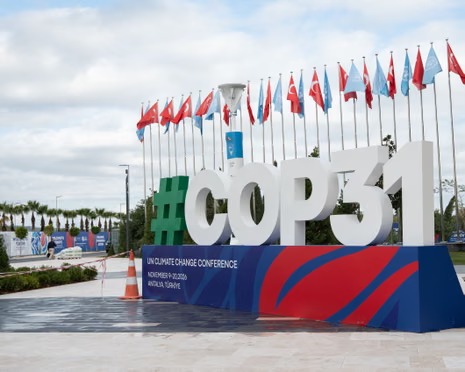
The 31st United Nations Climate Change Conference (COP31), which began on November 9 at the Antalya Expo Centre in Türkiye, has opened without the urgency and political momentum that a climate emergency of this magnitude demands. More than a decade after the Paris Agreement, the world is still struggling to translate its ambitious climate commitments into meaningful action. Global temperatures continue to climb, extreme weather events are becoming increasingly destructive, and the gap between promises and performance remains alarmingly wide.
Scheduled to conclude on November 20, COP31 comes at a critical juncture. The challenge before world leaders is no longer simply to agree on ambitious emission-reduction targets or reaffirm their commitment to limiting global warming. It is to demonstrate that the international community has the political will, financial resources and institutional capacity to turn those commitments into measurable results. Without concrete action, climate conferences risk becoming elaborate diplomatic exercises in which declarations multiply while the planet continues to deteriorate.
The urgency is undeniable. Current projections indicate that the world remains on a trajectory towards approximately 2.8°C of warming by the end of the century under existing policies and commitments, far exceeding the 1.5°C threshold that countries sought to preserve under the Paris Agreement. Every fraction of a degree matters. The consequences are already visible in unprecedented heatwaves, devastating floods, prolonged droughts, erratic monsoons and increasingly destructive storms. Climate change is no longer a distant scientific prediction; it is an immediate economic, social and humanitarian crisis.
Yet the burden is distributed unequally. Developing countries, despite having contributed comparatively less to historical greenhouse gas emissions, are among the most vulnerable to the consequences of global warming. Their economies often depend heavily on climate-sensitive sectors such as agriculture, fisheries and forestry, while their capacity to invest in adaptation and disaster preparedness remains limited. For many developed nations, climate change is still treated primarily as an environmental and economic policy challenge. For vulnerable countries, it is increasingly a question of survival.
India illustrates this unequal reality. Hundreds of millions of people depend directly or indirectly on agriculture, much of which remains vulnerable to changing rainfall patterns. Even a marginal increase in average temperatures can affect crop yields, agricultural productivity, rural employment and food security. More intense cyclones, floods and prolonged dry spells place additional pressure on already vulnerable communities. The economic losses are accompanied by displacement, livelihood insecurity and, in the worst cases, loss of life. The recent cyclone Arnab is another reminder of the growing risks associated with extreme weather events.

Against this backdrop, climate finance remains the most contentious and consequential issue confronting the international negotiations. Developing nations cannot be expected to undertake an expensive transition to cleaner energy, strengthen climate-resilient infrastructure and rebuild after climate disasters without adequate financial support. The countries that industrialised through decades of fossil-fuel consumption carry a greater historical responsibility and must recognise that responsibility through meaningful financial commitments.
The $300 billion annual climate-finance target agreed upon at COP29 in Baku, to be achieved by 2035, was presented as an important step forward. However, it falls considerably short of the estimated $1.3 trillion annually that developing countries require to address their climate challenges. The problem is not merely the size of the commitment but also its quality.
A substantial portion of climate finance continues to arrive in the form of loans rather than grants, adding to the debt burden of countries already struggling with limited fiscal resources. Climate assistance that pushes vulnerable nations deeper into debt cannot be considered an equitable solution.
Climate finance must therefore become the central pillar of international climate cooperation. It should be predictable, accessible, transparent and substantially grant-based, particularly for countries facing the most severe climate impacts. The proposed expansion of adaptation funding, support for vulnerable communities and operationalisation of the Loss and Damage Fund must move beyond procedural assurances. Countries suffering irreversible damage from climate disasters cannot afford to wait for another decade of negotiations.
Equally concerning is the continuing reluctance to confront the central role of fossil fuels in driving global warming. Despite repeated commitments to accelerate the transition towards cleaner energy, coal, oil and natural gas continue to dominate the global energy system. The failure to make fossil-fuel transition a sufficiently central element of the Antalya negotiations raises questions about the seriousness of the international response. A climate summit that avoids confronting the principal source of the crisis cannot reasonably claim to be addressing it.
There is also a question of credibility. Countries hosting and steering climate negotiations must demonstrate consistency between their diplomatic commitments and domestic energy policies. Türkiye, the host, and Australia, which is co-chairing the negotiations, face the challenge of reconciling their climate commitments with their continuing dependence on fossil-fuel industries. Leadership in climate diplomacy cannot rest solely on the ability to negotiate communiqués; it must also be reflected in national decisions on energy production, investment and emissions.
The retreat of the United States under President Donald Trump from the Paris Agreement and its broader scepticism towards multilateral climate cooperation have further complicated the international effort. The absence or reduced engagement of major emitters weakens collective ambition and creates uncertainty about the future of climate finance and technology cooperation. Nevertheless, the climate crisis cannot be allowed to become hostage to changing political administrations or geopolitical rivalries. The atmosphere does not recognise national borders, electoral cycles or diplomatic differences. Climate action requires sustained international cooperation regardless of political circumstances.
What, then, should COP31 deliver? First, the Antalya conference must establish a credible Climate Finance Work Programme with clear timelines, identifiable sources of funding and mechanisms for accountability. Second, it must create a practical roadmap for substantially increasing adaptation finance, including a credible pathway towards tripling available resources. Third, the Loss and Damage Fund must receive adequate and predictable financial contributions so that vulnerable countries can respond to the consequences of climate disasters that they can neither prevent nor absorb independently.

Multilateral development banks also have an important role to play. They must expand concessional lending, reduce borrowing costs and develop financing arrangements in local currencies wherever possible. Climate-vulnerable nations should not be forced to choose between investing in climate resilience and maintaining essential public services. Technology transfer, capacity-building and affordable access to renewable energy must also become integral components of the global climate framework.
India’s experience offers an important lesson in this regard. The country has expanded its renewable and other non-fossil energy capacity while continuing to address the developmental needs of a large population. Non-fossil fuel sources have already crossed the halfway mark in India’s installed electricity capacity, enabling the country to achieve its 2030 capacity target five years ahead of schedule.
This is a significant achievement, although installed capacity should not be confused with the actual share of electricity generated from non-fossil sources. India’s continuing challenge will be to expand clean-energy generation, strengthen storage and transmission infrastructure and ensure an affordable and equitable transition.
The international community must recognise that climate responsibility is both common and differentiated. Every country has a role to play, but the obligations of nations with greater historical emissions and financial capacity cannot be diluted. Developing economies must be supported in pursuing cleaner growth rather than being asked to shoulder the cost of a crisis they did not create to the same extent.
Ultimately, the success of COP31 will not be measured by the number of speeches delivered, declarations adopted or ambitious targets announced. It will be judged by the money actually mobilised, the emissions genuinely reduced, the communities protected and the lives saved. The world has already spent years negotiating what needs to be done. What it needs now is the courage to do it.
Antalya must therefore mark a turning point from climate diplomacy to climate delivery. Another round of promises will not cool a warming planet. Only credible commitments backed by real money, political accountability and sustained action can do that. The world does not need another declaration of intent. It needs results.