

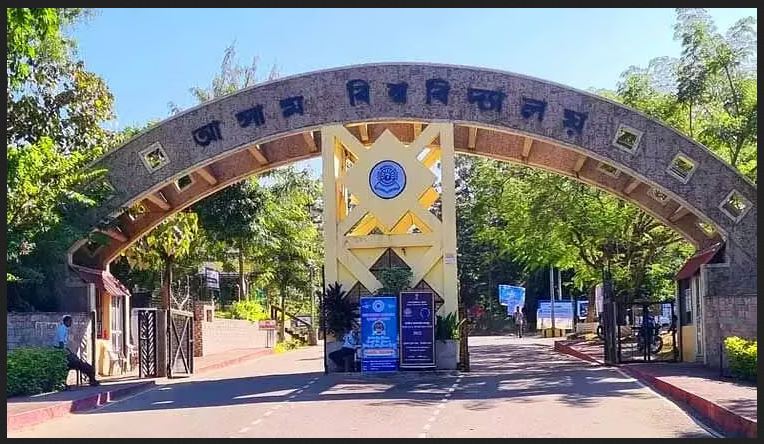
I hope that through capable administration and innovative initiatives, this university will become one of the greatest centers of aspiration and trust for the youth of this region
 KRC TIMES Desk
Pradip Dutta Roy
A valuable decade of my youth was spent in the movement demanding the establishment of Assam University. Yet I have no regrets about it. Through the dedication of our senior educationists, the relentless spirit of the movement, and the united efforts of the people of Barak Valley irrespective of caste or religion, that demand eventually became a reality. Today, even students from the remotest villages of Barak Valley are graduating with postgraduate degrees from this university. That is our true achievement.
The roots of this movement go back to the 1980s.
At that time, the anti-foreigner movement led by AASU and the Assam Gana Sangram Parishad was sweeping across Assam and eventually spread throughout the state as the “Bongal Kheda” movement. However, Barak Valley was an exception, as the movement had little impact here.
During this period, Gauhati University was one of the primary destinations for students from Barak Valley seeking higher education. But the agitation deeply affected the university as well. Students from Barak Valley began facing physical and mental harassment on suspicion of being “Bangladeshis.” Their mark sheets and certificates were torn apart, and they were subjected to various forms of abuse.
Many were forced to abandon their studies and return home. Professor Biswatosh Chowdhury, former Head of the Bengali Department of Assam University, also faced harassment. Similarly, Professor Ashok Sen of Assam University suffered the same treatment. During the AASU agitation, two academic years were lost, and students from Barak Valley were among the worst sufferers.

In that situation, I too had to give up my desire for postgraduate studies and instead enrolled at A.K. Chanda Law College in Silchar to study law.
Around that time, after discussions with classmates and conscious citizens, we decided to launch a movement demanding a university in Barak Valley. From the beginning, our demand was for a Central University, because the financial condition of the state was poor then. State universities like Gauhati and Dibrugarh Universities were already facing severe financial crises.
Before us, the “Shiksha Sangrakshan Samiti,” led by educationist Premendra Mohan Goswami, had already raised this demand. Their contribution to the establishment of Assam University was undoubtedly significant. They submitted memoranda to various authorities and worked to create public awareness, thereby laying the foundation of the movement.
On 18 May 1983, we organized a meeting at A.K. Chanda Law College with the presidents and general secretaries of student unions from seventeen colleges of the then Cachar district. At that meeting, an organization named the “All Cachar Students’ Association” was formed and an executive committee was constituted for the movement. I was appointed president of that committee.
Later, when Cachar district was divided into Karimganj and Hailakandi districts, we formed unit committees in every college across all three districts. The organization was renamed the All Cachar Karimganj Hailakandi Students Association (ACKHSA). Similarly, unit committees were formed in schools as well. Together, these efforts built the foundation of a powerful movement.
Our appeal to the students of Barak Valley was simple: perhaps our own dreams of higher education might never be fulfilled, but future generations should not be deprived of that opportunity. Therefore, everyone must join the movement. This appeal received an overwhelming response, especially from school students across the valley.

At one stage, we launched a “Jail Bharo” movement. Every day, four to five thousand students would gather in front of the Silchar Deputy Commissioner’s office. The administration was forced to arrest them during the day and release them again in the evening. During this period, we repeatedly organized strikes and bandhs, and people from every religion and community responded with extraordinary support.
At one point, the government proposed establishing a state university. We opposed the proposal and organized a successful bandh. Later, Prime Minister Rajiv Gandhi informed us that a Central University would be granted, but only as a campus of the North Eastern Hill University (NEHU). However, we later discovered that under the university’s own regulations, it could not establish a campus in a plain region. Therefore, we rejected that proposal too.
Whenever attempts were made to suppress the movement, our protests intensified. At one stage, we launched a seven-day “Rail Roko” movement. Since all rail traffic passed through Badarpur, students led by Pankaj Kanti Deb Roy, General Secretary of N.C. College Students’ Union, blocked railway tracks from dawn every day. Rail communication in Barak Valley remained suspended for an entire week.
Similarly, we shut down air services in Barak Valley for a week. Protesters from Udharbond and Shalganga lay on the roads to block passengers traveling to the airport. As road communication to Kumbhirgram Airport completely collapsed, Indian Airlines flights had to return empty after landing in Silchar.
During this agitation, rumors spread that protesters were carrying bombs, prompting police to become extremely active in arresting movement leaders. In Udharbond, former two-time MLA Mihir Kanti Som, Debashis Biswas, and others led the movement and had to hide in forests for long periods to escape police repression.

We traveled to Delhi several times to submit memoranda. We met Education Minister K.C. Pant and later Sheila Kaul to press our demand for a Central University. Prominent businessman Mahabir Jain arranged accommodation, food, and transport for twenty-one volunteers at his brother’s residence in Delhi. Not only he, but the Marwari community of Barak Valley extended generous support to the movement.
Tea tribes, Dimasa, Manipuri, and members of every community participated spontaneously. The movement was no longer merely that of ACKHSA; it had become a people’s movement. I believe this united participation of all religious and linguistic communities remains a shining example of communal harmony in Barak Valley’s history.
Later, the University Grants Commission (UGC) issued a new circular stating that no Central University could be established unless the region had a population of at least one crore. At that time, Barak Valley’s population was only thirty-five lakhs.
Meanwhile, another movement erupted in Barak Valley against the third language circular, and ACKHSA members actively participated. During Chief Minister Prafulla Mahanta’s visit to Karimganj, ACKHSA members organized a protest rally. Police opened fire, and Dibyendu and Jaganmoy were martyred.
Earlier, Bodo leader Upendranath Brahma had been harassed at Gauhati University hostel and returned home to launch the demand for a separate Bodoland under the slogan “Divide Assam Fifty-Fifty.” I attended a meeting called by him at Nepali Mandir in Guwahati, where we pledged mutual support for each other’s movements.
Later, at a massive rally in Diphu attended by lakhs of people, Upendranath Brahma announced, in my presence, that the Bodo movement would withdraw its own demand for a Central University and instead support the movement for a Central University in Silchar.

In return, I declared ACKHSA’s full support for the Bodoland movement. Through this alliance, we secured the support of forty-five lakh people from Bodoland for our university demand. Yet the required population target still remained unmet.
Therefore, we met Tripura Chief Minister Nripen Chakraborty and Mizoram Chief Minister Lal Thanhawla. Neither state had a Central University then. Since Barak Valley served as the gateway to both states, we argued that students from Tripura and Mizoram would benefit if a Central University were established here.
Both Chief Ministers supported our demand and wrote to the UGC on behalf of twenty-five lakh people of Tripura and fifteen lakh people of Mizoram. Finally, the UGC was compelled to accept our demand.
The contribution of “Bodofa” Upendranath Brahma in establishing Assam University can never be forgotten. After his untimely death, we demanded that an auditorium in Assam University be named in his memory. Through the initiative of former Vice-Chancellor Professor Tapodhir Bhattacharjee, land was allocated and such an auditorium was eventually established.
Former Silchar MP and Union Minister Santosh Mohan Dev initially supported a state university rather than a Central University, which caused some misunderstanding between us. However, after the martyrdom of Dibyendu and Jaganmoy, he changed his stance and declared that he must stand with the people’s demand. Thereafter, he actively lobbied with the Central Government and the UGC for the establishment of the university.
After a decade-long relentless movement, combined with pressure from MPs and the media, Prime Minister Rajiv Gandhi finally introduced the Assam University Bill in Parliament in 1989. AGP MPs walked out in protest, and MP Bijoya Chakravarty tore copies of the bill inside Parliament. Nevertheless, the bill was eventually passed into law.

But our struggle did not end there. The Prafulla Mahanta government delayed allocating land for the university for a long time. Finally, after Hiteswar Saikia became Chief Minister, 250 bighas of land were allotted at Dargakona.
Even then, AASU and several Assamese nationalist organizations protested against the establishment of the university and even against the name “Assam University.” They argued that under the Assam Accord, the Central Government was obligated to establish a Central University and an IIT in Assam, and since Barak Valley had played no role in the Assam Movement, the university should be located in Brahmaputra Valley instead.
Due to this pressure, the Central Government eventually approved another Central University at Tezpur. However, under the parliamentary act, Assam University was designated a “unitary and residential” university, meaning no affiliated colleges could exist under it.
On 21 January 1994, Prime Minister P.V. Narasimha Rao laid the foundation stone of Assam University and on the same day had to fly to Tezpur to lay the foundation stone of Tezpur University as well — such was the pressure of aggressive Assamese nationalism at the time.
The role of the media and journalists throughout this decade-long movement was remarkable. From the birth of ACKHSA, PTI correspondent and Cachar College professor Shantanu Ghosh, along with Sentinel journalist Jyotilal Choudhury, supported and encouraged us.
The contribution of late Ranbir Roy, owner of the daily Sonar Cachar, can never be forgotten. He allowed us to use a room in his office as ACKHSA headquarters and also extended financial assistance. He even accompanied us to Delhi.

Similarly, Taimur Raja Choudhury of the weekly Samayik Prasanga and late Jyotirmoy Dutta, editor of Dainik Prantajyoti, consistently covered our movement. The contribution of late Jatin Deb Roy, editor of Gati, was also immense.
Through almost daily reports, he carried the movement into every household of Barak Valley. It was an era before social media, when radio was highly influential. Journalist Pradip Mukhopadhyay of All India Radio, Silchar, also played an exceptional role in broadcasting news of the movement.
Now, standing at the threshold of old age and looking back at that movement, many thoughts come to mind. Perhaps some decisions were immature, as is natural in youth. Yet the determination we gained through that long struggle — the refusal to surrender in adverse circumstances — has remained a lifelong source of strength.
Even today, I continue to dream about this university.
I dream that this institution will one day achieve the highest standards of excellence at the national level. There is no reason why it cannot. I firmly believe that Barak Valley and this region do not lack talent. What is needed is proper leadership, encouragement, and guidance.
I dream that this university will open new avenues for the economic development of Barak Valley through research and practical innovation, promote the rich culture and heritage of the region before the world, and preserve and enrich its history through proper research and documentation.
I hope that through capable administration and innovative initiatives, this university will become one of the greatest centers of aspiration and trust for the youth of this region.