


Why India Must Respond to Sonam Wangchuk’s Call
 KRC TIMES Desk

S. Bhattacharya
As Sonam Wangchuk’s hunger strike stretches into its third week, the issue at stake is no longer just one activist’s protest. It has become a test of whether a democracy can hear a peaceful voice before it is silenced by exhaustion.
By any measure, Sonam Wangchuk’s ongoing hunger strike has entered a critical phase. Nineteen days without food is not merely an act of protest; it is a profound physical and moral challenge. Medical reports indicate that the celebrated innovator, education reformer and climate activist has lost significant weight, experienced falling blood sugar levels, low blood pressure and diminishing muscle mass. The signs are worrying, and the concern among his supporters is growing.
Yet the most striking aspect of Wangchuk’s protest is not the visible deterioration of his health. It is the apparent absence of meaningful engagement with the issues he has raised.
India is often described as the world’s largest democracy. Democracies are expected to accommodate disagreement, encourage debate and create channels through which citizens can hold institutions accountable. Elections are one measure of democratic health, but they are not the only one. Equally important is the manner in which governments respond when citizens, dissatisfied with existing avenues of redress, resort to peaceful forms of protest.
Wangchuk has chosen one of the most powerful traditions of non-violent resistance available in the Indian political imagination: the hunger strike. By joining the protest at Jantar Mantar over alleged irregularities in the NEET examination process and demanding accountability from those responsible, he has sought to draw national attention to concerns affecting millions of students and families.
Whether one agrees with every demand he has raised is ultimately secondary. The more pressing issue is whether a peaceful protest of this magnitude deserves a serious response.
A Tradition Rooted in Moral Pressure
India’s political history is inseparable from the idea of non-violent resistance. Hunger strikes occupy a unique place within that tradition because they do not rely on coercion or force. Instead, they depend on moral persuasion. The protester places his or her own well-being at risk to communicate the urgency of a cause.
From Mahatma Gandhi’s fasts during the freedom struggle to numerous movements in independent India, hunger strikes have served as a reminder that democratic politics is not only about power but also about conscience.
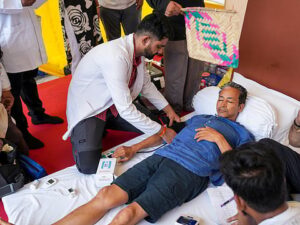
That is why Wangchuk’s protest carries symbolic significance far beyond the immediate controversy surrounding examination governance. It raises a broader question: how should a democratic society respond when an individual with substantial public credibility believes that all other avenues have failed?
The answer need not be agreement. Governments are not obligated to concede every demand made by protesters. But they are expected to engage, explain, listen and communicate. Silence, particularly prolonged silence, risks creating the impression that peaceful dissent is less effective than confrontation.
The Weight of a Familiar Name
For many Indians, Sonam Wangchuk is more than an activist. He is a symbol of innovation, education and creative problem-solving.
His work in alternative education and sustainable development inspired the character of Phunsukh Wangdu in the blockbuster film 3 Idiots. Through that fictional character, millions of young Indians were encouraged to question rote learning, think independently and pursue knowledge with curiosity rather than fear.
The irony is difficult to ignore.
The man whose ideas inspired a generation to challenge outdated systems is now using his own body to challenge what he perceives as institutional failures. The same public that celebrated the fictional hero’s rebellion against flawed educational practices now watches the real-life inspiration behind that character struggle to attract sustained national attention.
Actor Omi Vaidya, remembered for playing Chatur in the film, captured public anxiety when he expressed hope that “Phunsukh Wangdu” would not die. The statement resonated because it underscored the emotional connection many Indians feel with Wangchuk’s work and legacy.
But concern alone is not enough.
The Debate Around the Protest
As often happens with high-profile movements, the focus has increasingly shifted away from the issues being raised and toward the protest itself.
Social media conversations have become filled with speculation about the authenticity of the fast, discussions about what Wangchuk may or may not be consuming, and arguments over the methods he has chosen. Such debates are not unusual, but they risk distracting from the larger questions at hand.
The central issue is not whether every detail of the protest satisfies public scrutiny.
The central issue is why a respected public figure believes that a prolonged hunger strike is necessary in the first place. A healthy democracy should be able to examine the concerns behind a protest without becoming consumed by arguments about the protester’s personal choices. The danger lies in allowing procedural debates to overshadow substantive issues.
History shows that societies often become fascinated by the spectacle of sacrifice while neglecting the reasons that produced it. The result is a cycle in which individuals endure extraordinary hardship while the underlying grievances remain unresolved.

Send your resume:
biswa@jigyasu.co.in
krcfoundation@gmail.com
Students at the Heart of the Matter
At its core, Wangchuk’s intervention is linked to concerns about the integrity and accountability of the examination system.
For millions of Indian students, competitive examinations are not merely tests. They represent years of preparation, family sacrifices and aspirations for a better future. Trust in these systems is therefore essential. Any perception that fairness has been compromised can have consequences far beyond a single examination cycle.
Students invest enormous emotional, intellectual and financial resources in preparing for these assessments. They do so because they believe that merit, effort and honesty will determine outcomes.
When questions arise about transparency or accountability, public confidence suffers.
This is why the debate extends beyond one activist and one government ministry. It touches upon the broader relationship between citizens and institutions. Public trust is difficult to build and easy to lose. Addressing concerns openly and transparently is often the most effective way to preserve that trust.
Even those who disagree with Wangchuk’s demands can acknowledge the importance of maintaining confidence in systems that shape the futures of millions of young people.
The Cost of Silence
Perhaps the most troubling aspect of the current situation is the growing gap between public concern and official engagement. Numerous writers, actors, academics, activists and public figures have appealed to Wangchuk to end his fast. Their concerns are understandable. No one wants to witness irreversible damage to his health.
Yet Wangchuk’s response has been consistent. Rather than asking him to stop protesting, he argues, people should ask why the government has not responded adequately to the issues he has raised.
Whether one agrees with that position or not, it highlights an important principle: responsibility in a democracy does not rest solely with protesters. It also rests with institutions that possess the authority and capacity to engage.
Dialogue does not signify weakness. On the contrary, it is one of the defining strengths of democratic governance. Governments routinely negotiate with stakeholders, explain policies and address public concerns. Such engagement can reduce tensions, clarify misunderstandings and strengthen public confidence.
The absence of dialogue, however, often creates space for frustration, mistrust and polarisation.
A Test for Democratic Culture
The significance of Wangchuk’s fast therefore extends beyond the immediate controversy. It poses a larger question about the kind of democratic culture India wishes to cultivate.
Can peaceful dissent still command attention in an era dominated by social media outrage and political polarisation? Can moral persuasion still influence public discourse? Are institutions willing to engage with critics before situations escalate into crises?

These questions matter because the health of a democracy is measured not only by how it rewards supporters but also by how it responds to critics.
Peaceful protest is one of the most valuable safeguards available to citizens. It provides a non-violent means of expressing dissatisfaction and seeking accountability. When such protests are ignored, the message received by many citizens is deeply troubling: that moderation and restraint may be less effective than confrontation.
No democracy benefits from that perception.
Beyond Agreement and Disagreement
It is entirely possible to disagree with Wangchuk’s demands and still defend his right to be heard. Democratic engagement does not require consensus. It requires willingness to listen.The issue before the country is therefore not whether every citizen supports the hunger strike. Nor is it whether every demand should be accepted.
The issue is whether a respected citizen should have to place his health at grave risk before institutions acknowledge his concerns. As Wangchuk’s fast continues, the danger is that public attention may fade while his physical condition worsens. News cycles move quickly. Social media trends change by the hour. But the consequences of prolonged starvation are not governed by headlines.
A weakening body cannot wait indefinitely for a response.
The Question Before India
Sonam Wangchuk’s hunger strike has already become more than a protest. It is a mirror reflecting the state of public dialogue in contemporary India.
The challenge before the nation is not merely to decide whether his demands are justified. It is to determine whether peaceful dissent still occupies a meaningful place within democratic life.
A society is ultimately judged not by how loudly it celebrates its heroes, but by how attentively it listens when those heroes raise uncomfortable questions.
As the days pass and Wangchuk’s health continues to deteriorate, the central question grows more urgent. Not whether he can endure another day without food.But whether India can afford another day without a conversation.