


The Historical Significance of India-Myanmar Relations
 KRC TIMES Desk
Dr. D.K. Giri
Why did Myanmar’s President Min Aung Hlaing choose New Delhi for his first foreign visit, and what should India do next? It must be acknowledged that in diplomacy, a head of state’s first overseas visit carries significant meaning. It reveals whom a leader trusts, fears, or needs. At the same time, it can also be a “game of confidence.”
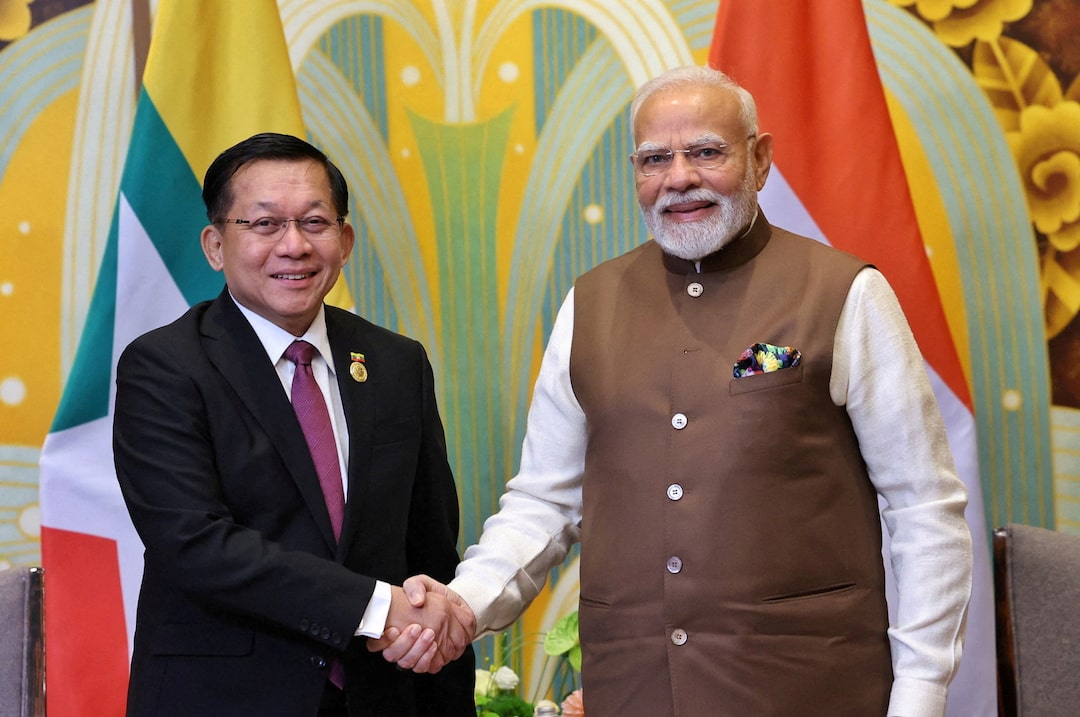
Last Monday, Myanmar’s president arrived in New Delhi. As reported, this was his first foreign trip since assuming office in April this year. He chose Delhi over Beijing or Bangkok. Why? And what should New Delhi do with this gesture of trust?
I have been reflecting on this question since his visit. Myanmar is not just another neighboring country. It shares a 1,643-kilometre border with India and represents a test of India’s foreign policy-a test of geography, history, democracy, and what I call “strategic maturity”: the courage to pursue national interests without compromising national character.
Let me explain.
Why Was Delhi His First Destination?
There may be three practical reasons.
First, security. Myanmar borders India’s sensitive northeastern states-Nagaland, Manipur, Mizoram, and Arunachal Pradesh. Insurgent camps operate across the border, while arms trafficking, drug smuggling, and refugee movements continue to pose challenges. President Hlaing understands this reality. Therefore, he came with a promise:
“We will not allow Myanmar’s territory to be used against India’s security interests.”
This statement, made at Hyderabad House, carries considerable significance.

Send your resume:
biswa@jigyasu.co.in
krcfoundation@gmail.com
For nearly two decades, India has been Myanmar’s quiet partner in counterinsurgency efforts through initiatives such as Operation Sunrise, intelligence-sharing arrangements, and border-fencing projects. Few countries provide Myanmar with this kind of security cooperation. China offers roads and loans; India facilitates joint patrols and operational coordination. In a region where the sound of guns often speaks louder than diplomacy, such cooperation matters greatly.
Second, connectivity. Two major Indian projects in Myanmar have remained stalled for years:
” The Kaladan Multi-Modal Transit Transport Project, which aims to connect Kolkata with Mizoram through Sittwe Port.
” The India-Myanmar-Thailand Trilateral Highway, India’s overland gateway to Southeast Asia and ASEAN.
Both projects are reportedly around 80 percent complete and require sustained political cooperation from Myanmar to reach completion. Hlaing’s visit was also a signal that Myanmar remains committed to moving these projects forward.
For India, this is not charity. It is the practical implementation of the Act East Policy. Without Myanmar, India cannot achieve meaningful land connectivity with Southeast Asia.
Third, strategic balancing. China has expanded its footprint in Myanmar significantly. Under the China-Myanmar Economic Corridor, Beijing has invested approximately $21 billion in infrastructure and development projects. China is also financing the Kyaukphyu deep-sea port, operating oil and gas pipelines into Yunnan Province, supplying weapons, and providing diplomatic support to Myanmar at the United Nations.
Myanmar understands the risks of overdependence. Consequently, every Myanmar leader-including military leaders-has sought to maintain ties with India as a counterbalance.

Hlaing’s visit to Delhi sends a message to Beijing: “We have alternatives.” It also signals to Washington: “Do not lecture us.”
He came not out of affection, but to strengthen leverage. Every nation seeks to balance competing powers in order to preserve foreign-policy independence. India calls this multi-alignment. Myanmar is entitled to pursue the same approach.
The Historical Significance of India-Myanmar Relations
India and Myanmar are far from strangers.
The two countries share Buddhism, tea traditions, and cultural connections stretching back generations. General Aung San, the father of Aung San Suu Kyi, studied at Santiniketan. Former United Nations Secretary-General U Thant of Myanmar was a close friend of Jawaharlal Nehru.
In 1948, India became the first country to recognize Myanmar’s independence. During the 1950s, both nations emerged as important voices in the Non-Aligned Movement. Communities on both sides of the border regularly crossed for marriages, funerals, and festivals.
This shared history gives India something China cannot purchase: grassroots trust.
When India builds a bridge, people often say, “Delhi helped us.” When China builds one, the first question is frequently, “How much debt comes with it?”
Yet history alone is not policy. Sentiment cannot stop a Chinese submarine from appearing at Kyaukphyu. For that, strategy is required.
The China Question
India cannot realistically remove China from Myanmar.
The two countries share a 2,200-kilometre border. Bilateral trade exceeds $12 billion. Chinese-backed pipelines are already operational.
Therefore, India’s objective should not be to replace the yuan with the rupee. The real goal should be ensuring that Myanmar does not become a strategic dependency of China in a manner that threatens Indian interests.
How can this be achieved?
Three Steps India Should Consider
1. Finish what has already been started.
Speed itself is strategy.
Every month of delay in completing the Kaladan project makes Sittwe Port appear increasingly dependent on Chinese alternatives. India must deploy the necessary funding, personnel, and monitoring mechanisms to complete these projects.
A dedicated Prime Minister’s Office cell for Myanmar projects should be established, with weekly reviews and strict timelines.

If India delivers roads, electricity, and ports, Myanmar’s leadership will always have a reason to pick up the phone and call Delhi.
2. Leverage India’s strengths.
While China specializes in hard infrastructure, India can excel in soft infrastructure:
” Information technology
” Pharmaceuticals
” Higher education
” Governance training
” Digital public services
India could offer 1,000 scholarships to Myanmar students and expand training programs for government officials, particularly in e-governance.
A Myanmar bureaucrat educated at an Indian institution such as an IIM is less likely to view Beijing as the only strategic partner available.
3. Engage all stakeholders while maintaining strategic focus.
India should continue engaging Myanmar’s military authorities on security and connectivity issues.
At the same time, channels of communication should remain open with democratic forces, civil society organizations, and ethnic groups-quietly and without public grandstanding.
The United States may choose a policy of public criticism. India must pursue a policy of engagement and influence.
That is what diplomacy requires: dealing with today’s government while preserving relationships with tomorrow’s leaders.
The Democracy Dilemma
New Delhi faces a genuine dilemma regarding democracy in Myanmar.
Should India actively support democratic restoration even if doing so comes at a strategic cost?
Many in the West answer yes. They argue that India, as the world’s largest democracy, should impose sanctions on Myanmar’s military rulers just as the United States has done.
The argument is grounded in democratic values.
However, values detached from geography often become moral lectures. Values informed by geography become policy.
The reality on the ground is straightforward.

If India withdraws, China will fill the vacuum almost immediately-with more weapons, more ports, and greater strategic influence along India’s northeastern frontier.
Refugee flows into Mizoram and Manipur could increase. Insurgent groups could find new opportunities. And Myanmar’s people would still not necessarily obtain genuine democracy; they might simply become more dependent on Chinese-backed political arrangements.
A Test of Indian Diplomacy
Every neighboring country tests India in a different way.
Pakistan tests India’s patience.
China tests India’s strength.
Myanmar tests India’s balance.
Can India secure its borders without behaving like a bully?
Can it compete with China without imitating China?
Can it uphold democratic values without sacrificing essential security interests?
President Hlaing’s visit has given India an opportunity to answer these questions.
The answer appears clear: India should work with whichever government is in power in Myanmar to secure the Northeast, complete critical connectivity projects, and prevent the Indian Ocean from becoming a strategic sphere dominated by China.
This is the essence of the Neighbourhood First Policy.
This is also the essence of the Act East Policy.
For India, Myanmar is not a problem to be solved. It is a relationship to be managed.
And that relationship must be managed with history in our hearts, geography in our minds, and strategy in our hands.

