

The SCO also supported a comprehensive and just solution to the Palestinian issue, opposed unilateral sanctions and reaffirmed its commitment to a multipolar world order
 KRC TIMES Desk
Dr. D. K. Giri
The 26th Summit of the Council of Heads of State of the Shanghai Cooperation Organisation (SCO) concluded in Bishkek on September 1, coinciding with the organisation’s 25th anniversary. Held under the theme “Together for Sustainable Peace, Development and Prosperity,” the summit adopted the Bishkek Declaration. Prime Minister Narendra Modi signed the declaration along with Chinese President Xi Jinping, Russian President Vladimir Putin, Iranian President Masoud Pezeshkian and the leaders of six other member states.
The declaration is firm and unambiguous. It expresses “deep concern over developments in West Asia and around Iran” and condemns “military attacks on the territory of the Islamic Republic of Iran,” which have resulted in civilian casualties and inflicted severe damage on the country’s economy. It further states that such actions “violate the principles and norms of international law and the UN Charter and pose serious risks to international peace, security and stability” – an obvious reference to US-Israeli military operations. The SCO also supported a comprehensive and just solution to the Palestinian issue, opposed unilateral sanctions and reaffirmed its commitment to a multipolar world order.
For India, signing this declaration does not appear straightforward. Just days before the escalation of the war with Iran, Prime Minister Modi was in Israel, where, amid expressions of deepening ties between the two countries, he even described Israel as India’s “fatherland.” How can these two positions – condemning attacks on Iran in Bishkek while praising Israel in Tel Aviv – coexist? This contradiction lies at the heart of India’s current foreign-policy dilemma.
It is natural for heads of government to make grand diplomatic statements while visiting foreign countries. Diplomatic formalities, courtesies and the desire to please the host are all part of statecraft. In Tel Aviv, an Indian prime minister would praise Israel; in Tehran, another prime minister might quote lines from Hafez.
But this issue goes far beyond statements.
India-Israel relations have become deeply entrenched. Defence, technology, agriculture, intelligence cooperation and the Indian diaspora have transformed the relationship from a merely formal one into a strategic partnership. On the other hand, India is part of a grouping whose members – with the exception of Pakistan, which has mastered the art of double standards – have little sympathy for American policies. The Bishkek Declaration is clearly intended to challenge American dominance and unilateral action, support Iran’s rights and question the use of sanctions.
With a few exceptions, political leaders across the world are known for speaking ambiguously on international affairs. Prime Minister Modi cannot be entirely different. If foreign policy is driven solely by national interests while global forums are treated as secondary, his approach would be no different either. Yet India has traditionally been known for taking a moral, neutral and institutional position on global issues – reflected in non-alignment, Panchsheel and a carefully calibrated strategic autonomy. It appears that this tradition has, for the moment, been pushed aside.

The other dimension of India’s foreign policy today is the promotion of “multi-alignment” in a multipolar world. This explains Modi’s desire to remain in both camps – condemning attacks on Iran in Bishkek while supporting Israel’s right to self-defence in Tel Aviv; buying oil from Russia while purchasing weapons from the United States; being part of the Quad while also signing the Bishkek Declaration.
I have two responses to this.
First, some strategically important countries located close to major powers or caught in conflicts with them have made their positions completely clear. Take Sweden and Finland. For decades, they adopted a policy of neutrality – what came to be known as “Finlandisation” – partly out of a need to respect Soviet sensitivities. But after Russia’s invasion of Ukraine made that position untenable, they made a choice and joined the Western security alliance, NATO, to protect their territorial integrity.
When security is at stake, neutrality has a shelf life.
In the SCO, all members except India belong to a camp broadly opposed to Western powers. It was an unusual strategy by Donald Trump that brought Pakistan forward as a potential peace mediator in the Iran war, making India’s position even more complicated.
Second, we should remember the old saying: “A friend to everyone is a friend to no one.” Multi-alignment cannot mean permanent ambiguity. At some point, credibility requires consistency.
My argument is that a country like India, which seeks to project a moral position in world affairs, must build and preserve its credibility. As a democracy, an inclusive and liberal society, and a responsible power that speaks for international law, India’s image must be nurtured. It has taken decades to build this moral capital.
Modi and his team may want to put pressure on Donald Trump to negotiate with India on respectful terms – on tariffs, trade, technology transfer and the Pakistan issue. Donald Trump and the United States must also clarify their position on India’s important role in Asia as a counterweight to China. Trump recognised this during his first term, but in his second term he has been inconsistent – imposing what he described as the “toughest sanctions in history” under “Operation Economic Outcast” one day, and then engaging China on rare earths the next.

Coming to the SCO, where India occupies a delicate position, it is a China-led initiative that began in 1996 as the Shanghai Five and became the SCO in 2001. Today, it represents 43 per cent of the world’s population and 23 per cent of the global economy. This summit took place against the backdrop of two ongoing wars involving two SCO members – Russia and Iran – and amid the US-Israeli war against Iran, which has thrown global energy markets into turmoil.
In Bishkek, the principal objectives were to promote the concept of a multipolar world and strengthen mutual trade in opposition to Trump’s unilateral policies. Discussions focused on condemning attacks and sanctions against Iran and attacks on Palestine, but attention was also given to concrete measures. Twenty-eight documents were signed, including rules for a new Universal Centre to address emerging threats, an action plan for ports and logistics centres through 2030, a green technology corridor and, most importantly, a declaration on nuclear safety and energy cooperation.
With Iran now a full member of the SCO, alongside Russia and China, the declaration on energy cooperation has a direct bearing on US efforts to restrict Iranian oil revenues.
The declaration also recalled the organisation’s non-aligned character and emphasised the establishment of an SCO Development Bank to facilitate trade settlements in local currencies – a clear step towards de-dollarisation, or reducing dependence on the US dollar.
For India, which had refused to endorse an SCO statement in June 2025 condemning Israel’s attacks on Iran, signing the latest declaration marks a significant shift. In Bishkek, Modi met Pezeshkian for the first time in two years and discussed regional stability and issues concerning seafarers. It was a small indication that New Delhi wants to keep the channel of dialogue open.
New Delhi may be hoping that summit declarations are merely diplomatic formalities – words that are not legally binding. If only that were true. In today’s world, such declarations are likely to be interpreted in Washington, Tel Aviv and Brussels as signs of alignment with one camp or another.
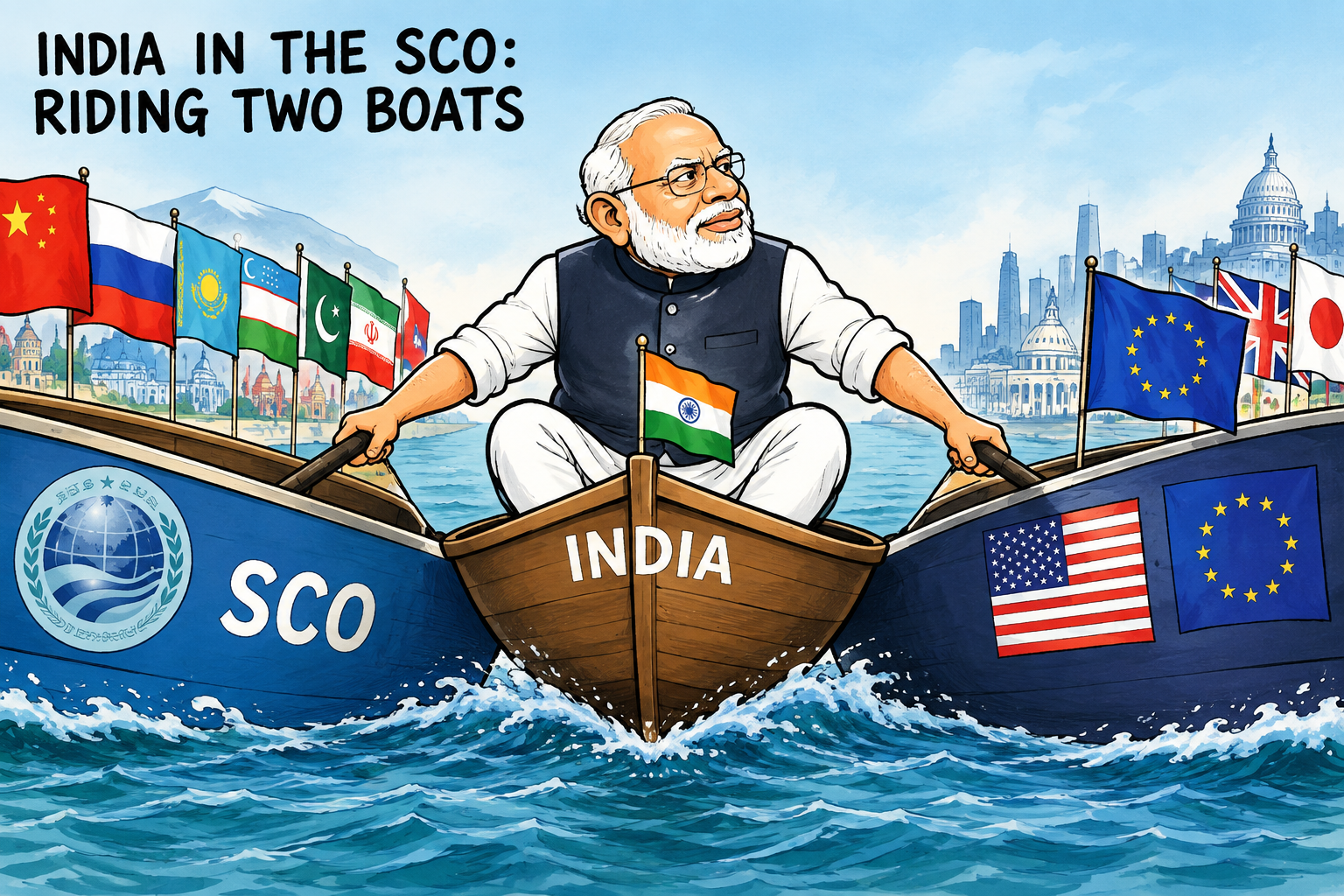
India must choose the right partners who can contribute to the country’s peace, progress and security. India cannot ride two boats indefinitely – one sailing towards Washington and Tel Aviv, and the other towards Beijing, Moscow and Tehran. Even in a policy of multi-alignment, there must be a hierarchy of priorities.
India’s fundamental position is with democratic countries, international law and freedom of navigation. The language of the Bishkek Declaration on international law is appropriate, but its geopolitical anti-Western tilt is not India’s natural position.
The Bishkek summit will be remembered not only for marking 25 years of the SCO but also for highlighting India’s ambiguous position. In a world where everyone wants India to choose a side, saying “we are friends with everyone” may soon mean that we are trusted partners of no one.
Credibility, like trust, takes years to build and can be lost very quickly.
Dr. D. K. Giri. Professor of Practice, Institute of Management, Bhubaneswar